National Palace Museum Curator's Recommended Royal Artifact of the Month: 'Giringi'
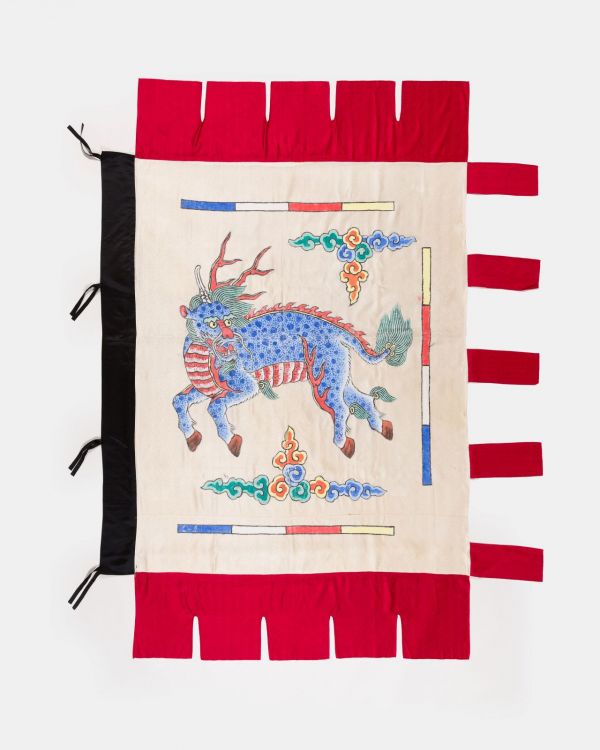
According to the "Royal Culture Encyclopedia - Ceremonial Objects" published by the National Palace Museum in 2019, there was only one type of ceremonial flag not used during the king's procession. It was the Giringi, a flag depicting a girin. The girin is an imaginary creature resembling a deer but with hooves and a mane like a horse. Known for its gentle and kind nature, it was considered a symbol of a virtuous ruler because it does not step on living insects or break newly sprouted grass. Although regarded as a sacred being, in the royal court it was used as a symbol representing the crown prince, the heir to the throne.
The Cultural Heritage Administration's National Palace Museum announced on the 1st that it has selected the Giringi, a flag carried by the ceremonial guards during the Joseon Dynasty crown prince's procession, as the "Curator's Recommended Royal Artifact" this month and will display it in the Royal Ritual Exhibition Hall. Ceremonial guards in the Joseon Dynasty were soldiers who carried axes (부, 斧), battle axes (월, 鉞), ceremonial fans (개선, 蓋扇), and spears (모, 茅) to show the king's dignity during processions. They hung the Giringi on a roughly 3-meter-long bamboo pole tied with strings. When carrying it, one person held the pole while two others held the strings attached to it. At the end of the pole, a supporting tool called a bongjitong (봉지통, 捧持筒) was attached to secure the flag to the waist or shoulder of the bearer and support its weight. When it rained, the flag was covered with a raincoat (우비, 雨備), and when not in use, it was stored wrapped in a blue cotton cloth inside the pole.
The shape of the girin varies over time, resembling horses, deer, dragons, and more. The girin depicted on the Giringi held by the National Palace Museum has the body of a roe deer with the face and scales of a dragon. It has a tail similar to that of a cow, horse-like hooves, and features horns and a mane. The museum explained, "The same form can be confirmed in the illustration of the Giringi in the 'Jinchaneuigwe (進饌儀軌)', a book documenting a feast held for King Gojong in 1892."
© The Asia Business Daily(www.asiae.co.kr). All rights reserved.

















