Top ETF Inflows Rise and Fall Side by Side
Domestic Market's Highest Return +6.5%... 'KODEX KOSDAQ150'
Among Top 10, Highest Return is 'Philadelphia Semiconductor Nasdaq'
All Inverse Investors Suffer Losses
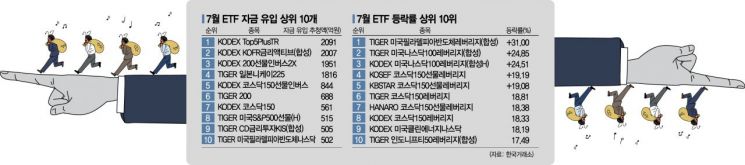
[Asia Economy Reporter Hwang Yoon-joo] During the month of July, investors in Exchange-Traded Funds (ETFs) simultaneously bet on both the ‘rise’ and ‘fall’ of the domestic stock market. As the market showed a strong rebound, the winners were the investors who bet on the rise.
According to the Korea Exchange on the 1st, the top three ETFs with the highest capital inflow in the domestic stock market from July 1 to July 28 were ‘KODEX Top5PlusTR’ (209.1 billion KRW), ‘KODEX KOFR Interest Rate Reactive (Synthetic)’ (200.7 billion KRW), and ‘KODEX 200 Futures Inverse 2X’ (195.1 billion KRW).
The ETF with the highest capital inflow is an index composed of a total of 11 stocks selected based on dividend yield and free-float market capitalization from the KOSPI and KOSDAQ, weighted by free-float market capitalization. It is an ETF that does not distribute dividends to shareholders but reinvests the amount, and it is estimated to have been mainly purchased through retirement pension accounts.
The second-ranked ETF is a short-term bond (interest rate) product, which tends to be a place where institutional short-term funds stay. Recently, as bond investment has attracted attention, individual investors also showed interest in this product.
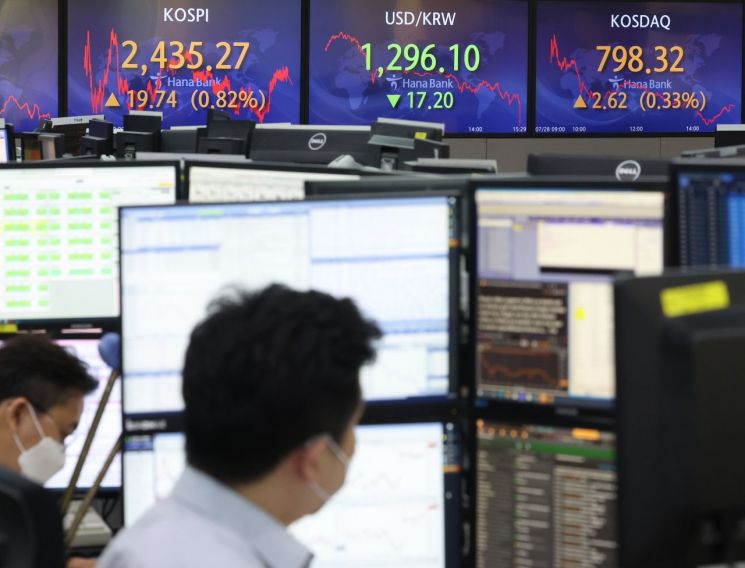
From the third place onward, the tendency to simultaneously bet on both the rise and fall of the KOSPI 200 index and KOSDAQ 150 index became more pronounced. Investors’ funds were mainly concentrated on the ‘fall’ side.
The third-ranked ‘KODEX 200 Futures Inverse 2X’ (195.1 billion KRW), fifth-ranked ‘KODEX KOSDAQ150 Futures Inverse’ (84.4 billion KRW), sixth-ranked ‘TIGER 200’ (68.8 billion KRW), and seventh-ranked ‘KODEX KOSDAQ150’ (56.1 billion KRW) ETFs, representing both index rise and index fall (inverse) ETFs, were all ranked closely.
The clear winner in the sharply divided domestic stock market outlook was the ‘bullish’ investors. Looking at the returns over the past month, investors in ‘KODEX KOSDAQ150’ recorded the best performance with +6.50%. The top capital inflow ETF, ‘KODEX Top5PlusTR,’ showed +4.15%, and ‘TIGER 200’ recorded +2.89%.
This was because the KOSDAQ’s rise rate in July was better than that of the KOSPI. The KOSDAQ index rose by 7.80%, while the KOSPI increased by only 5.10%.
On the other hand, ‘inverse’ investors all recorded losses. During the same period, ‘KODEX KOSDAQ150 Futures Inverse’ was -7.16%, and ‘KODEX 200 Futures Inverse 2X’ was -6.84%.
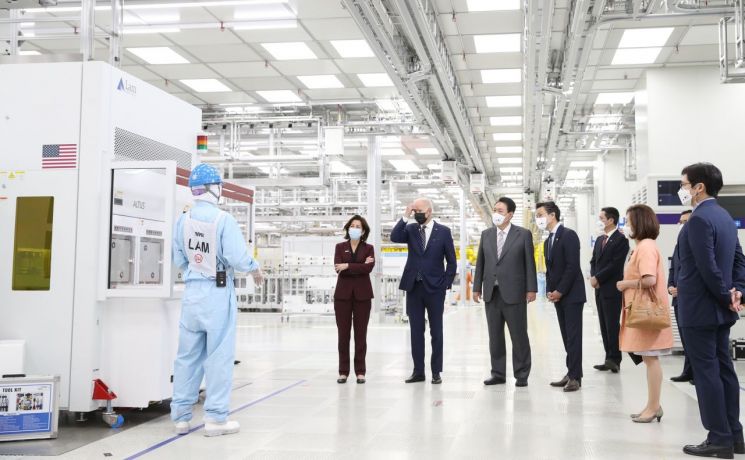
Among the top 10 ETFs by capital inflow, the ETF with the highest return was ‘TIGER US Philadelphia Semiconductor NASDAQ,’ which recorded 10.61%. Although its capital inflow (50.2 billion KRW) was the lowest, it was the only one to record double-digit returns.
Despite concerns about the semiconductor sector causing the Philadelphia Semiconductor Index to plunge, the index rebounded as second-quarter earnings were more robust than expected. Additionally, the passage of the US government’s ‘Semiconductor Support Act’ raised expectations for benefits to related sectors, leading to a rise in related stocks. ‘TIGER Japan Nikkei 225’ (181.6 billion KRW) also showed excellent returns with 6.49%.
Although the stock market showed a strong upward trend last month, it is uncertain whether this momentum will continue. Kim Seok-hwan, a researcher at Mirae Asset Securities Digital Research, analyzed, “Despite inflation conditions after mid-July, US companies’ earnings were good, and the dollar’s strong trend weakened, which strongly contributed to a relief rally. It seems that there was a rebound buying following the sharp drop in the index in June, but the market is still inevitably subject to volatility.”
© The Asia Business Daily(www.asiae.co.kr). All rights reserved.



















