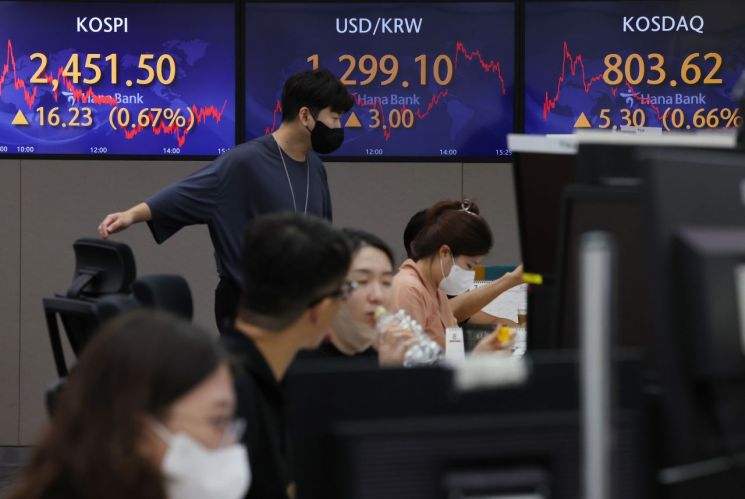
[Asia Economy Reporter Ji Yeon-jin] Foreign investors have returned. After continuously engaging in 'Sell Korea' this year, foreign investors turned to net buying of domestic stocks for the first time last month. Due to the ongoing market downturn this year, recognition of the market bottom and the weakening of the previously strong dollar are expected to sustain foreign buying momentum.
According to the Korea Exchange on the 1st, foreign investors net purchased domestic stocks worth 1.8108 trillion KRW last month. This marks the first net buying record by foreign investors who had sold domestic stocks for six consecutive months this year. During the same period, institutions net sold 1.7417 trillion KRW and individuals net sold 78.5 billion KRW.
Since the beginning of this year, foreign investors sold domestic stocks as U.S. inflation and the resulting interest rate hikes triggered monetary tightening. In February, Russia's invasion of Ukraine caused commodity prices to surge, continuing high inflation and spreading risk-averse sentiment. From the start of the year through June, foreign investors' net sales approached 20 trillion KRW (19.7737 trillion KRW).
However, after the U.S. implemented two 'Giant Steps' (75 basis point interest rate hikes) and inflation fears persisted, concerns over demand contraction grew. This time, with the possibility of an economic recession, energy prices and interest rates declined, which is cited as a background for foreign investors switching to net buying. Additionally, the domestic stock market has continued to decline this year, with the KOSPI falling below its book value, prompting foreign investors to perceive a bottom and encouraging purchases. Choi Yoo-jun, a researcher at Shinhan Investment Corp., explained, "Foreign demand tends to switch to net buying after confirming the price-to-book ratio (PBR) bottom while the KOSPI trades below book value. Since 2000, in eight cases, after confirming the PBR bottom, net buying occurred on average four weeks later. This can be interpreted as short covering of previously shorted stocks and the inflow of bargain buying by some market participants."
The stocks most purchased by foreign investors over the past month were Samsung Electronics, with net purchases worth 546 billion KRW. This was followed by LG Energy Solution (467.8 billion KRW) and SK Hynix (257.4 billion KRW). Conversely, NAVER (-148.9 billion KRW), Hwasung (-89.3 billion KRW), and Samsung Electronics Preferred (-71.4 billion KRW) were among the most net sold.
Son Joo-seop, a researcher at Cape Investment & Securities, stated, "Although foreign capital net outflows and shareholding reductions continued, a recent turnaround has occurred. Given the large scale of outflows, foreign investors also have the greatest potential for future capital inflows. Considering the KOSPI, which may feel cheaper to foreigners, and the KRW-USD exchange rate, which allows for hedging, there are factors supporting foreign inflows." He added, "At this point, it would be advantageous to build portfolios focused on companies maintaining earnings growth momentum as foreign capital with the capacity to enter the domestic market concentrates."
© The Asia Business Daily(www.asiae.co.kr). All rights reserved.
![Clutching a Stolen Dior Bag, Saying "I Hate Being Poor but Real"... The Grotesque Con of a "Human Knockoff" [Slate]](https://cwcontent.asiae.co.kr/asiaresize/183/2026021902243444107_1771435474.jpg)
















