US GDP Shrinks for Second Consecutive Quarter
Biden and Powell Say "Not a Recession Yet"
Markets Forecast Recession Approaching
Export-Dependent Korean Economy Faces Impact
"If US Stocks Fall Again, Korea Will Also Wobble"
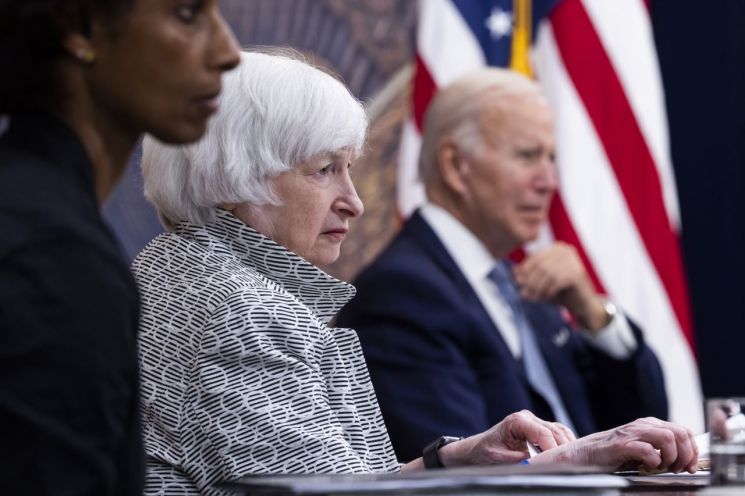
There is an analysis that the U.S. economy's negative growth in the second quarter, following the first quarter, could adversely affect the South Korean economy, which is highly dependent on exports. U.S. President Joe Biden and Federal Reserve (Fed) Chair Jerome Powell have attempted to downplay concerns by stating "this is not a recession yet," but the market harbors significant worries that a sharp interest rate hike could cool employment and trigger a full-fledged recession. Experts predict that if the U.S. economy weakens, South Korean exports could suffer, leading to a decline in the stock market.
On the 28th (local time), after the U.S. Department of Commerce announced that the GDP growth rate for the second quarter was -0.9%, opinions have been divided on whether the global economy has entered a recession. Two consecutive quarters of negative growth are generally considered a "technical recession," but the U.S. government and the Fed have not acknowledged this. At the Federal Open Market Committee (FOMC) press conference the previous day, Chair Powell cited strong employment data and said, "I do not think we are in a recession," and President Biden also drew a line under the recession on the same day. Following this, fears of a recession somewhat eased, the stock market rose, risk asset appetite revived, and the won-dollar exchange rate fell to the 1290 won level.
However, many in the market forecast that even if a full-scale recession has not yet begun, growth could slow down in the second half of the year. In particular, Chair Powell had previously dismissed inflation as "transitory" since the end of last year, but when the consumer price index rose to its highest level in over 40 years, he caused market turmoil by implementing a "giant step" (a 0.75 percentage point increase in the benchmark interest rate) in June. The global financial firm UBS evaluated the situation the day before, stating, "Chair Powell tried to show that the economy is strong by mentioning the strength of the labor market and downplaying the GDP data, but he was not completely resolute."
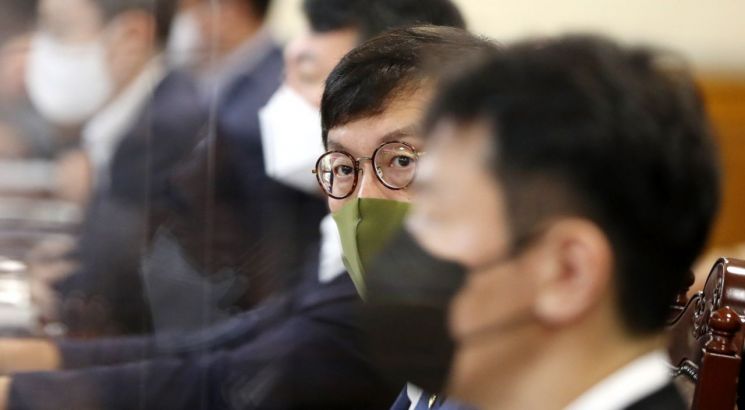 Bank of Korea Governor Lee Chang-yong is attentively listening to the remarks of Deputy Prime Minister and Minister of Economy and Finance Choo Kyung-ho at the emergency macroeconomic and financial meeting held at the Bankers' Hall in Jung-gu, Seoul, on the morning of the 28th.
 [Image source=Yonhap News]
Accordingly, there is an analysis that South Korea may also see changes in its monetary and fiscal policies going forward. With China's economic growth rate slowing sharply to 0.4% in the second quarter and the U.S. entering a technical recession, the likelihood of a red light for exports is high. On the same day, Bang Ki-seon, First Vice Minister of Strategy and Finance, held the 4th Emergency Economic Vice Ministers' Meeting at the Export-Import Bank in Seoul and expressed concern, saying, "Energy imports are surging, and the trade balance is expected to record a deficit," adding, "We will strengthen policy responses to sustain export growth and improve the trade balance."
The Bank of Korea also expects inflation to peak as early as the third quarter of this year. In past periods of severe inflation, such as in 2008 and 2011, crises followed after inflation peaked, causing prices and interest rates to fall rapidly, leading to opinions that the benchmark interest rate could start to decline early next year.
Professor Kim Young-ik of Sogang University Graduate School of Economics said, "Chair Powell says it is not a recession yet because of employment and consumption, but employment is a lagging indicator and will soon decrease, and consumption growth is also slowing. As the U.S. economy enters a recession, we expect South Korea's export growth to the U.S. to decline, and if U.S. stock prices fall once more, the stock market could falter."
© The Asia Business Daily(www.asiae.co.kr). All rights reserved.


















