Loan Interest Rate Hike Accelerates
'Jeonse to Monthly Rent' Shift
July Jeonse Transaction Index Hits Yearly Low
Most Listings Increase Nationwide
"Even Below Market Price, No Renters"
Landlords Unable to Find Next Tenant
Paying Deposit Interest Themselves
[Asia Economy Reporter Hwang Seoyul] Mr. A, who rents out an apartment in Uijeongbu-si, Gyeonggi Province, recently found himself troubled over the return of the jeonse deposit. Until January this year, the jeonse price was 500 million KRW, but he lowered it first to 400 million KRW and then to 350 million KRW, yet he could not find any jeonse inquiries at all. If he fails to find the next tenant by this month, he will not be able to return the full deposit to the current tenant, and he might even have to pay interest on the deposit. Mr. A said, "Even when I list the jeonse price below market value, no one moves in, so I am very worried."
As interest rate hikes accelerate the trend of jeonse turning into monthly rent, cases where landlords cannot find jeonse tenants despite lowering the jeonse price are increasing. On the other hand, monthly rent prices, where demand has shifted, are soaring, making it difficult to ease tenants' concerns about housing costs.
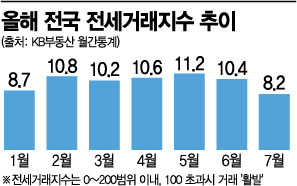
According to the Korea Real Estate Board on the 29th, the nationwide jeonse transaction index for July was 8.2, the lowest figure this year. It dropped by 2.2 points from 10.4 last month, falling into single digits, showing a bleak picture of the jeonse transaction market. The jeonse transaction index is a statistic compiled through surveys of sample real estate agencies, ranging from 0 to 200, with an index above 100 indicating active jeonse transactions.
This is largely due to a sharp decline in jeonse demand. The nationwide jeonse supply-demand index also plunged by 11.3 points from the previous month to 122.3. The jeonse supply-demand index also ranges from 0 to 200. The index, which hovered just below 140 from January (138.5) to May (138.0), dropped to 133.6 last month and entered the 120s for the first time this year. According to real estate big data company Asil (as of that day), jeonse listings increased compared to a month ago in all cities and provinces nationwide except Jeju (-11.4%), Gangwon (-4.6%), and Jeonbuk (-0.1%).
The biggest reason for the decline in jeonse demand is that due to the rise in interest rates on jeonse loans, tenants have no choice but to opt for monthly rent. The COFIX (Cost of Funds Index), which serves as the benchmark for variable interest rates on mortgage loans, rose by 0.40 points month-on-month to 2.38 this month, and jeonse loan interest rates have even exceeded 6% in some cases.
Monthly rent demand has long surpassed jeonse. According to the number of confirmed date jeonse and monthly rent contracts from the Court Registry Information Plaza, monthly rent has been surpassing jeonse from February to June. Given this situation, monthly rent prices, where lease demand has shifted, are soaring. The Korea Real Estate Board's apartment monthly rent integrated price index last month was 103.6, the highest since the index was first compiled.
© The Asia Business Daily(www.asiae.co.kr). All rights reserved.
![Clutching a Stolen Dior Bag, Saying "I Hate Being Poor but Real"... The Grotesque Con of a "Human Knockoff" [Slate]](https://cwcontent.asiae.co.kr/asiaresize/183/2026021902243444107_1771435474.jpg)
















