[Seoul District News] Dobong-gu Announces Establishment and Implementation of Community Welfare Plans Where Residents Identify Welfare Issues and Plan Solutions · Implementation of Established Plans Accelerates in Second Half Through 'Bonggune Ultari' Project ... Jung-gu Jungnim-dong Uncovers and Preserves Old Scenes via Oral History Project
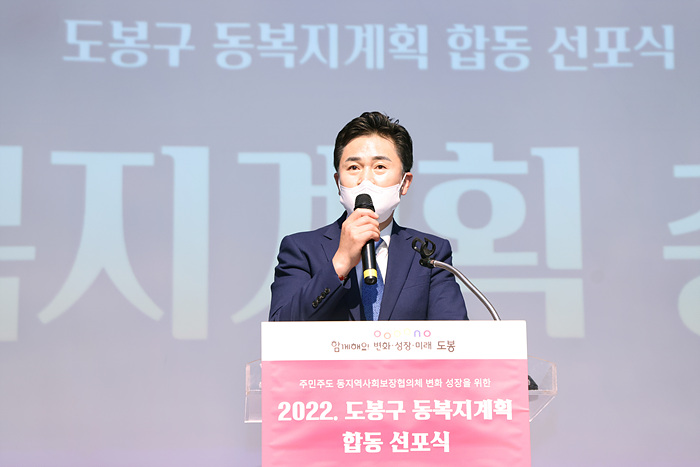 Oh Eun-seok, Dobong District Mayor, is delivering a congratulatory speech at the joint proclamation ceremony of Bongu East Welfare Plan held on the 28th.
[Asia Economy Reporter Park Jong-il] Dobong-gu (Mayor Oh Eon-seok) held a resident-led 'Joint Declaration Ceremony for Dong Welfare Plans' on the 28th at the Seoninbong Hall of the district office, where residents themselves planned and declared the execution of solutions to welfare issues occurring in all 14 neighborhoods (dong) within the district.
At the declaration ceremony, about 300 participants including members of the Dong Community Security Council and residents declared the establishment and execution of welfare plans directly created by the residents.
The commemorative performance for the second half welfare agenda featured residents from all 14 neighborhoods who directly planned and participated, expressing welfare agenda activities through videos, PPT presentations, and storytelling.
Dobong-gu had previously discovered agendas for residents to solve local welfare issues on their own and established plans through the Dong Welfare University in all 14 neighborhoods.
The established Dong welfare plans include welfare agenda activity plans that can be solved independently in the neighborhood, such as care for vulnerable households, support for welfare blind spots, and resource development, and will be actively implemented in the second half through the ‘Bonggune Ultari’ project.
The district aims to increase residents' welfare capacity through the Dong welfare plans and establish a system where residents themselves find and solve welfare problems, thereby establishing a dense welfare safety net at the neighborhood level.
Oh Eon-seok, Mayor of Dobong-gu, said, “It is very meaningful that residents find necessary agendas based on statistics in their own neighborhoods and that residents and related organizations participate together to form public discourse for execution. Since these agendas were selected by residents themselves to solve welfare blind spots, we will actively support their successful promotion in the second half.”
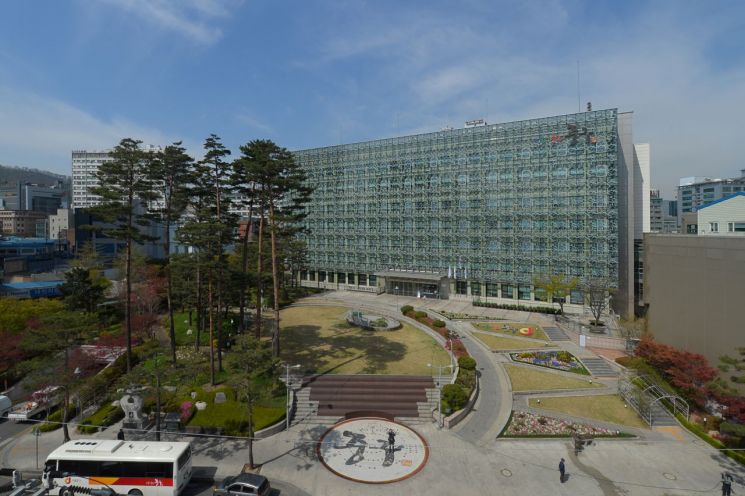
Jung-gu, Seoul (Mayor Kim Gil-seong) Jungnim-dong is recording and utilizing village history through the 'He(He)story, Her(Her)story Oral History' project.
Jungnim-dong is currently experiencing rapid changes, with redevelopment stories around Chungjeongno and the redevelopment of Manri 2 District underway. Also, due to its distinctive commercial district, a new term 'Jungnidan-gil' has emerged, attracting and drawing in many young people, significantly changing the atmosphere. Amid these changes, residents have started efforts to record and preserve the old appearance of the neighborhood, aiming not to forget the value of history while accepting change.
This area has many historically significant places and buildings, such as Seosomun Holy Ground, Yakhyun Cathedral?the first Western-style brick building in Korea?and St. Joseph Apartment, the first corridor-type residential-commercial complex apartment in Korea, increasing the necessity of the project.
Especially meaningful is that local natives who were born and raised in the village directly proposed and participated in this project.
The project aims for completion in 2024 and will proceed in three phases: 1) discovery and production of basic data, 2) systematic production of historical materials, and 3) three-dimensional and diversified historical materials.
This year, the first phase will be conducted, starting with the selection of four local record activists who will investigate historical sites and old shops in the neighborhood. In August, oral history experts will interview six native elderly residents.
Based on this, historical materials will be produced and utilized in various ways such as storybooks, video content, tour programs, and educational materials. The oral history interviewees will gradually expand from elderly residents to middle-aged groups.
Through the oral history project, Jungnim-dong expects to listen to stories of native elderly residents, record and share the village history intertwined with individual lives, foster historical pride and love for the hometown, and discover and preserve the old appearance of Jungnim-dong.
Kim Gil-seong, Mayor of Jung-gu, said, “As a resident who attended elementary, middle, and high school in Jung-gu and witnessed its changes, I hope the oral history project will be well carried out so that children can learn about the neighborhood’s history and elderly residents can relive their memories from that time.”
© The Asia Business Daily(www.asiae.co.kr). All rights reserved.
![Clutching a Stolen Dior Bag, Saying "I Hate Being Poor but Real"... The Grotesque Con of a "Human Knockoff" [Slate]](https://cwcontent.asiae.co.kr/asiaresize/183/2026021902243444107_1771435474.jpg)

















