Expert: "Peak Reached Within 1-2 Weeks... Predicting Severe Cases More Important Than Confirmed Cases"
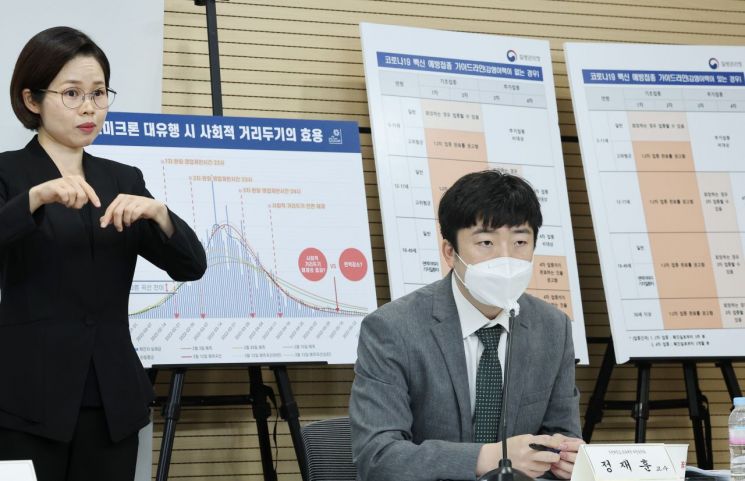 Professor Jaehoon Jeong of the Department of Preventive Medicine at Gachon University College of Medicine attended the "COVID-19 Expert Special Briefing" held by the Central Disease Control Headquarters at the Korea Disease Control and Prevention Agency in Cheongju, Chungbuk, on the 28th. He is responding to questions from the Public Communication Group regarding the effectiveness of social distancing during the Omicron surge.
 [Image source=Yonhap News]
[Asia Economy Intern Reporter Kim Gun-chan] An analysis has emerged suggesting that the peak of the COVID-19 resurgence could be reached within 1 to 2 weeks, and that the scale of the peak will be smaller than previously projected.
On the 28th, the Korea Disease Control and Prevention Agency (KDCA) held a briefing session with COVID-19 experts at the KDCA headquarters in Osong, Chungbuk. Attending the session were Kim Nam-jung, President of the Korean Society of Infectious Diseases and a professor of infectious diseases at Seoul National University Hospital, who serves as a member of the National Infectious Disease Crisis Response Expert Committee, and Professor Jeong Jae-hoon from the Department of Preventive Medicine at Gachon University College of Medicine.
During the briefing, Professor Jeong predicted, "Considering various evidence, it seems a bit difficult to reach the average of about 300,000 cases that experts had anticipated. However, a considerable scale of the outbreak will continue, forming a peak around next week or the week after."
The KDCA and experts had previously forecasted that the current COVID-19 resurgence would peak after mid-next month, with daily confirmed cases possibly reaching the 300,000 range.
Professor Jeong stated, "The predictions made by experts 2 to 3 weeks ago were close to the worst-case scenario, but now that the information is more certain, I believe the scale of the outbreak may decrease somewhat compared to those forecasts."
He added, "The rate of increase in cases has slowed significantly this week, which means the peak could be reached within one or two weeks."
The reasons supporting the claim that the outbreak scale may be smaller than expected include: higher-than-anticipated participation in the fourth vaccination dose helping reduce infections; the BA.2.75 variant, known as 'Kentauros,' having less transmissibility than feared, reducing its likelihood of driving the outbreak; and the fact that most Koreans were infected during the Omicron wave, resulting in a lower reinfection rate compared to other countries.
However, Professor Jeong emphasized, "Since the outbreak is occurring simultaneously worldwide, it is difficult to make precise predictions based on data. It is more important to accurately predict the number of severe cases rather than confirmed cases to ensure sufficient hospital bed availability."
Many questions were raised during the briefing regarding the possibility of reintroducing social distancing measures.
Regarding the reintroduction of social distancing, Professor Jeong said, "In infection control policies, costs and effectiveness must be considered simultaneously. While uniform social distancing has its effects, the social and economic damages are very significant, so there is scientific consensus and agreement that policy directions minimizing harm to the public should be decided."
He explained, "Until the Delta variant wave last year, social distancing could suppress the outbreak, but since the emergence of Omicron, the effectiveness of strong social distancing in reducing the outbreak scale or delaying the peak has become limited."
He added, "Although strong social distancing still has some effect, we are now at a point where the costs, such as economic losses for small business owners and academic setbacks for children, outweigh the benefits."
© The Asia Business Daily(www.asiae.co.kr). All rights reserved.

















