Full Summer Season, Heatwave and Ozone Warnings
Even Tropical Nights Bring 'Steaming Heat'
Heatstroke and Heat Exhaustion Can Be Life-Threatening if Left Untreated
 On the 25th, when a heatwave advisory was issued for most regions nationwide, heat haze was rising from the ground at the Sejongno intersection in Jongno-gu, Seoul. Photo by Jinhyung Kang aymsdream@
[Asia Economy Reporter Yoon Seul-gi] As the monsoon season ends and the intense heat begins in earnest, red flags have been raised regarding citizens' health during the summer. There are concerns that exposure to extreme heat can lead to heat-related illnesses such as heatstroke and heat exhaustion, or that high concentrations of ozone caused by strong sunlight can cause various diseases. International organizations have emphasized that to reduce damage caused by such climate change, the global temperature increase must be limited to 1.5 degrees Celsius.
With the heatwave in full swing, the "scorching heat" continues. The Korea Meteorological Administration (KMA) announced on the 28th that heatwave warnings have been issued for most regions nationwide, forecasting daytime high temperatures ranging from 25 to 34 degrees Celsius, including 33 degrees in Seoul, 31 degrees in Daegu, and 34 degrees in Daejeon, with most areas exceeding 30 degrees during the day. The perceived temperature at midday is expected to soar to 33-35 degrees.
Tropical nights have continued from last night through this morning. Tropical night phenomena (nighttime minimum temperature above 25 degrees) were observed for two consecutive days in Seoul, Incheon, Cheongju in North Chungcheong Province, Jeju City, and Seogwipo City. The KMA forecasted that daytime temperatures will rise to around 30-35 degrees for the time being, and the heat will persist into the night, causing tropical night phenomena to continue or newly appear in various places.
As the weather heats up, heat-related illnesses are also rapidly increasing. Heat-related illnesses are acute conditions caused by heat exposure, showing symptoms such as headache, dizziness, muscle cramps, fatigue, and decreased consciousness when exposed to hot environments for extended periods. Heatstroke and heat exhaustion can be life-threatening if left untreated.
According to the Korea Disease Control and Prevention Agency (KDCA) on the 27th, from May 20 to June 25 this year, 885 cases of heat-related illnesses (7 deaths) were reported through the emergency room surveillance system, a 22.1% increase (160 cases) compared to the same period last year (725 cases). The KDCA stated, "According to last year's emergency room surveillance system operation results, 57% of heat-related illness cases occurred between late July and early August," adding, "As the intense heat begins in earnest and heatwaves continue, the number of heat-related illness patients could increase significantly, so special caution is required."
Heat-related illnesses tend to surge when summer temperatures are high. According to data submitted by Assemblywoman Shin Hyun-young of the Democratic Party of Korea from the KDCA on the 21st, during the worst heatwave in 2018, the number of emergency room visits was 4,526, which was much higher than in 2017 (1,574), 2019 (1,841), 2020 (1,078), and 2021 (1,376).
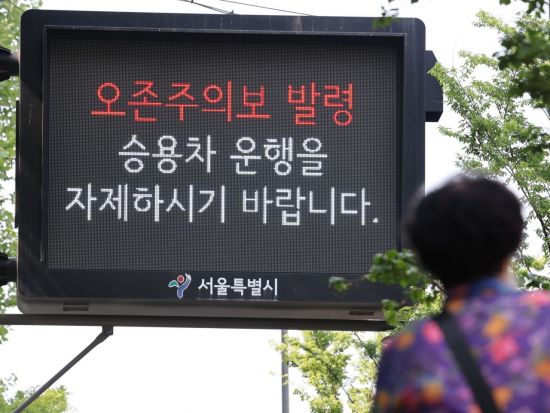 On the afternoon of May 23rd, the first ozone advisory of the year was issued across Seoul. The photo shows the electronic billboard near Seoul City Hall that afternoon. [Image source=Yonhap News]
Meanwhile, high concentrations of ozone in the atmosphere have also become a major culprit harming citizens' health. While fine dust particles can be filtered by wearing masks, gaseous ozone enters the body directly during outdoor activities. Ozone is generated through photochemical reactions between nitrogen oxides (NOx) and volatile organic compounds (VOCs) under ultraviolet light, especially appearing in high concentrations during summer daytime. Repeated exposure can adversely affect the respiratory system and eyes, worsen emphysema and asthma, and reduce lung capacity, leading to decreased lung function.
The problem is that ozone generation is increasing due to climate change. According to a recent report on climate change and ozone released by the National Institute of Environmental Research last month, the annual average ozone concentration in South Korea rose from 0.011 ppm in 1989 to 0.03 ppm in 2020. The number of ozone advisory days increased 3.5 times from 19 days (84 advisories) in 2005 to 67 days (400 advisories) in 2021. An ozone advisory is issued when the 1-hour average concentration exceeds 0.12 ppm.
While the first advisory day is getting earlier, the last advisory day is getting later, resulting in an overall increase in ozone advisory occurrences. In the 2000s, the first ozone advisory was mainly issued in May, but in 2020 and 2021, the first advisory days were April 25 and April 20, respectively, and this year it was even earlier on April 18 (Yeosu, Jeollanam-do). The number of ozone advisory days was 83 in 2010, 133 in 2015, and 400 in 2021.
The continuous rise in ozone concentration and increase in occurrence frequency are largely influenced by climate change. According to the Intergovernmental Panel on Climate Change (IPCC) Sixth Assessment Report, the Earth's surface temperature over the recent 20 years (2001-2020) was 0.99 degrees Celsius higher compared to 1850-1900, and from 2011 to 2020, the Earth's surface temperature was 1.09 degrees Celsius higher than in 1980-1990. This is a result of increased greenhouse gas emissions due to industrialization and other human activities.
The international community views 1.5 degrees Celsius as the critical limit for climate disaster. To avoid climate catastrophes, the global temperature rise must be limited to 1.5 degrees Celsius above pre-industrial levels for humanity to survive. The IPCC analyzed at its 56th session in April that to achieve this goal, global greenhouse gas emissions must be reduced by 43% by 2030 compared to 2019 levels. The report emphasized, "Strengthening current policies is urgent to limit the global temperature rise to 1.5 degrees," and "It is especially necessary to prepare a policy package that comprehensively considers market, regulatory, and technological policies for decarbonization across all sectors of society."
© The Asia Business Daily(www.asiae.co.kr). All rights reserved.


















