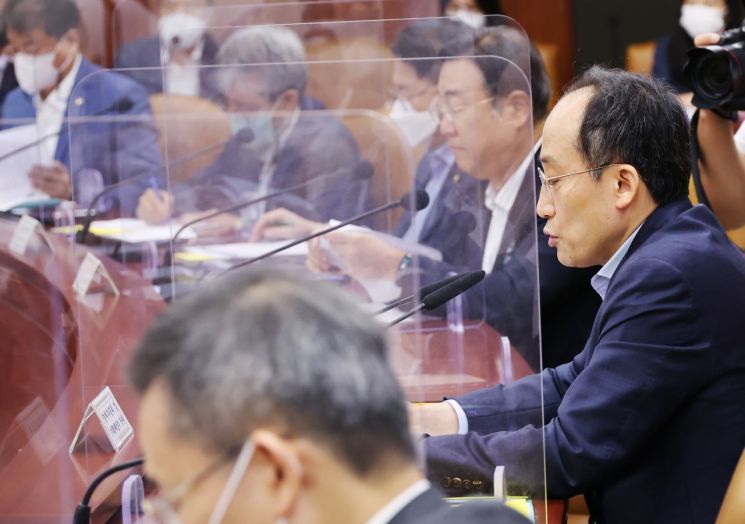
[Asia Economy Sejong=Reporter Kim Hyewon] The government plans to generate over 1.6 trillion KRW in private investment by resolving 'on-site pending projects' that have been hindered by complex regulations. This is the first achievement of the economic regulatory innovation task force (TF) launched by the Yoon Seok-yeol administration.
On the 28th, Deputy Prime Minister and Minister of Economy and Finance Choo Kyung-ho held a meeting of the economic regulatory innovation TF at the Government Seoul Office and announced regulatory innovation measures reflecting this plan. The TF, co-led by Deputy Prime Minister Choo and Professor Kim Jong-seok of SUNY Korea, conducted 14 working-level consultations since the end of last month and identified 50 tasks that can be immediately improved.
The government decided to open a path for large corporations’ on-site pending projects, which had delayed investments such as factory construction due to regulatory uncertainties. As a result, three major companies?Hyundai Heavy Industries, LG Chem, and Lotte Chemical?will be able to proceed with investments totaling 1.6 trillion KRW.
When the government relaxes safety standards for collaborative robots at shipyards and other sites in August this year, Hyundai Heavy Industries plans to invest 320 billion KRW in building a smart yard at its shipyard. Existing safety standards such as the Korean Industrial Standards (KS) include many requirements that are less relevant to work safety, such as electromagnetic waves and electrical connection status, making related investments difficult. Therefore, the government intends to simplify the standards focusing on essential work safety matters.
The industry code for pyrolysis oil production facilities from waste plastics will be clarified. This aims to resolve difficulties in industrial complex entry for related facilities due to unclear industry codes. The government actively interpreted the industry codes at the end of last month, and as a result, LG Chem received approval for entry and permits for its waste plastic pyrolysis oil plant in the Seokmun National Industrial Complex in Dangjin. LG Chem, having obtained the permits, plans to start construction of a plant with an annual capacity of 20,000 tons in the third quarter of this year and complete construction by the first quarter of 2024. The investment effect from LG Chem’s plant construction is estimated to reach 300 billion KRW.
Additionally, the government will establish measures in December to enable biodegradable plastics to be intensively used in product groups that are difficult to collect through existing recycling systems, such as food waste bags. By preparing criteria for selecting focused application areas for biodegradable plastics and mandatory usage regulations for applicable product groups, the government aims to create a stable foundation for nurturing the related industry. With clearer application areas, Lotte Chemical will be able to execute its investment plan of 1 trillion KRW, including facilities for biodegradable plastics, by 2030.
Furthermore, the government identified regulatory improvement tasks across six sectors?new industries, environment, location, health and medical care, and finance?that will stimulate additional investments. These include lifting overlapping sanctions on bidding restrictions for small and medium enterprises (SMEs), easing credit guarantee fund restrictions, promoting market creation in new industries such as mobility and eco-friendly energy, and relaxing standards to increase investment in response to growing demand for medical services. For example, by establishing standards for using portable radiation equipment outside hospitals, the government expects annual exports of 70 billion KRW and domestic sales of 8 billion KRW per company. The list also includes easing environmental regulations that burden SMEs, relaxing entry requirements for corporate industrial complexes and port hinterland complexes, and deregulation to create new types of financial services.
The government plans to continue identifying on-site pending projects that can quickly execute investments through corporate interviews and meetings, and will explore improvement measures for certification systems and shadow regulations. The next economic regulatory innovation TF meeting is being considered for late August. In his opening remarks, Deputy Prime Minister Choo stated, "Regulatory innovation is an urgent task that can no longer be postponed to improve the structure of our economy and enhance growth potential," and added, "We will swiftly and boldly abolish core regulations that constrain companies and markets."
He continued, "Some regulatory improvement tasks in areas such as environment and data will be promptly reviewed and announced separately in early August," and said, "Although there are difficult issues that require additional discussion due to complex interests despite high public interest, we will promptly conclude consultations with stakeholders and report the results."
© The Asia Business Daily(www.asiae.co.kr). All rights reserved.

















