1 in 2 Companies Say "High Early Resignation Rate Among MZ Generation"
More Than Half of 20s and 30s "Quit to Move to Better Companies"
Experts Say "Young People Value Personal Growth Over Community"
 Office workers are heading to work near City Hall Station in Jung-gu, Seoul. Photo by Jinhyung Kang aymsdream@
[Asia Economy Reporter Park Hyun-joo] #. Kim (in his 20s) recently submitted his resignation letter. He was exhausted by frequent overtime and a conservative corporate culture. He said, "Working an extra 1-2 hours was considered normal, and days when I left work on time were so rare I could count them on one hand," adding, "Using annual leave is my right, but I found it strange that I had to feel pressured if I took more than two days off." Kim is preparing to move to a company where work-life balance (WLB) is firmly guaranteed, even if the salary is lower.
More young people like Kim, who struggled to get hired, are deciding to quit their jobs and seek reemployment. Unlike the older generation that valued stable jobs, the 2030 generation, which prioritizes self-development and work-life balance, tends to decide to quit without hesitation if conditions do not meet their expectations.
According to Statistics Korea, as of May, the average tenure at the first job for young people was 1 year and 6.8 months. Among 4,117,000 young people aged 15-29 who obtained wage employment as their first job, 2,638,000 (65.6%) had quit their first job after graduation. Only 34.4% continued to maintain their first job.
Among the young people who quit, 45.1% cited 'dissatisfaction with wages and working conditions such as working hours' as the reason for leaving. This was followed by 'personal and family reasons such as health, childcare, and marriage' (15.3%), and 'completion of temporary or seasonal work, end of contract period' (14.0%).
Companies also recognize the high early turnover rate among young employees. According to a survey conducted last year by the employment platform Saramin targeting 500 companies on the status of 'early resignations within one year,' 49.2% of responding companies said, "The early resignation rate of the MZ generation (Millennials + Generation Z) is high."
Companies cited the primary reason for the MZ generation's frequent early resignations as "a generation that values personal satisfaction much more" (60.2%, multiple responses allowed). Other reasons included ▲ "less patience compared to previous generations" (32.5%) ▲ "corporate organizational culture not keeping up with changes in the times" (30.5%) ▲ "clear self-expression of likes and dislikes" (29.7%) ▲ "low expectations for results gained through long-term effort" (26.8%) ▲ "intolerance of injustice and unfairness within the organization" (13%) ▲ and "strong spirit of challenge" (3.3%).
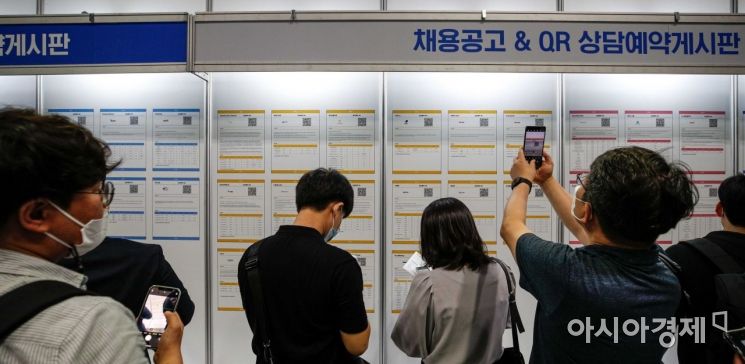 Job seekers participating in the 'Mid-sized Companies Job Fair' held on the 5th at COEX in Gangnam-gu, Seoul, are looking at the recruitment bulletin board. Photo by Kang Jin-hyung aymsdream@
The most common reason for 20s and 30s deciding to quit was 'preparing to move to a better company' (56.3% for 20s, 55.7% for 30s). In particular, those in their 20s were found to be considering resignation based on their 'growth potential.' According to a survey conducted on June 6 by Embrain Trend Monitor targeting 1,000 working adults aged 15-59 nationwide, respondents in their 20s cited 'vision for the job' (31.3%) and 'lack of future orientation' (26.8%) as reasons for contemplating resignation.
A (27-year-old) who resigned at the end of last year also decided to quit to move to a better company. His criterion for choosing a company was 'growth potential.' He said, "Compared to my peers, my salary was at a decent level, and the corporate culture was not bad," but added, "I worked for three years but felt that I was not building a portfolio. I was anxious because I couldn't see my future at the company." He lacked tangible achievements to prove his career relative to his time at the company.
The 20s and 30s also had a positive view of colleagues quitting their jobs. According to the Embrain Trend Monitor survey, 60.4% of respondents in their 20s and 56.4% in their 30s viewed the resignation of acquaintances or colleagues with envy, while those in their 40s and 50s were slightly lower at 46.4% and 43.2%, respectively. The response that "there is rather a congratulatory atmosphere" was reported as ▲ 61.6% for 20s ▲ 52.0% for 30s ▲ 35.6% for 40s ▲ and 28.4% for 50s. The younger the age group, the more resignation is perceived not as failure or regression but as a new leap forward.
Experts diagnose the high early resignation rate among the 20s and 30s as due to "a generation that prioritizes personal growth over community." Professor Lim Myung-ho of Dankook University's Department of Psychology explained, "In the past, a job was not limited to just economic meaning," adding, "(The older generation) found joy in meeting people within the community or gained a sense of accomplishment through the development and growth of the community." He continued, "In contrast, the younger generation does not place much meaning on the community," and "Rather than thinking about developing the group by demonstrating their talents, they value personal growth and individual worth more."
© The Asia Business Daily(www.asiae.co.kr). All rights reserved.