Lowered Infection Awareness... COVID-19 Outbreak Intensifies
"Frequent Vaccinations Negatively Affect Immunity... Early Treatment Is Key"
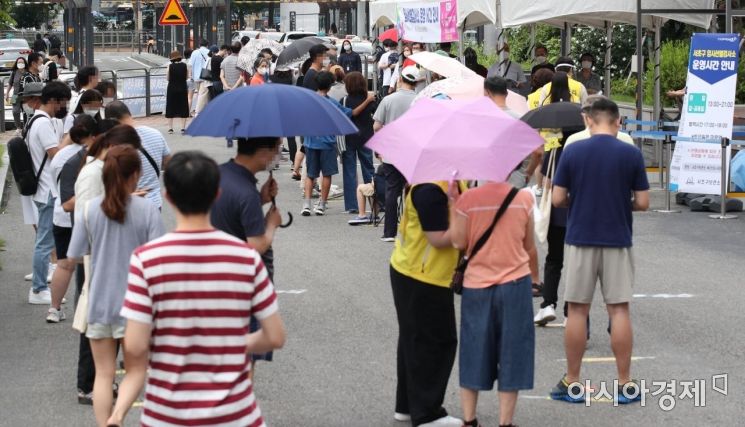 On the 24th, when 65,433 new COVID-19 cases were reported, citizens who visited the temporary screening clinic set up at the Express Bus Terminal in Seocho-gu, Seoul, were waiting to get tested. Photo by Jinhyung Kang aymsdream@
[Asia Economy Reporter Yoon Seul-gi] COVID-19 cases are surging due to the Omicron subvariant. Analysts suggest that the prolonged COVID-19 crisis has led to a relaxed awareness of infection risks, and the overlap with the 'late July to early August' vacation season has made it difficult to avoid COVID-19 infections. Experts emphasize the need to strengthen early treatment measures instead of frequent vaccinations, which may negatively affect the immune system.
According to the Central Disease Control Headquarters, as of midnight on the 25th, the number of confirmed COVID-19 cases nationwide was 35,883. The number of new cases on that day was 29,540 fewer than the previous day (65,433), which is attributed to a decrease in diagnostic tests on Sunday. Based on Monday's report, this is the highest number in 13 weeks since April 25 (34,361).
As the number of confirmed cases increases, the number of critically ill patients is also on the rise. On that day, the number of critically ill patients was 144, which is 1.77 times the 81 patients recorded a week earlier on the 18th. The number of deaths was 17, one fewer than the previous day. Among the deceased, 13 (76.5%) were aged 80 or older, followed by 2 in their 70s, 1 in their 60s, and 1 in their 40s. The cumulative death toll stands at 24,890, with a cumulative COVID-19 fatality rate of 0.13%.
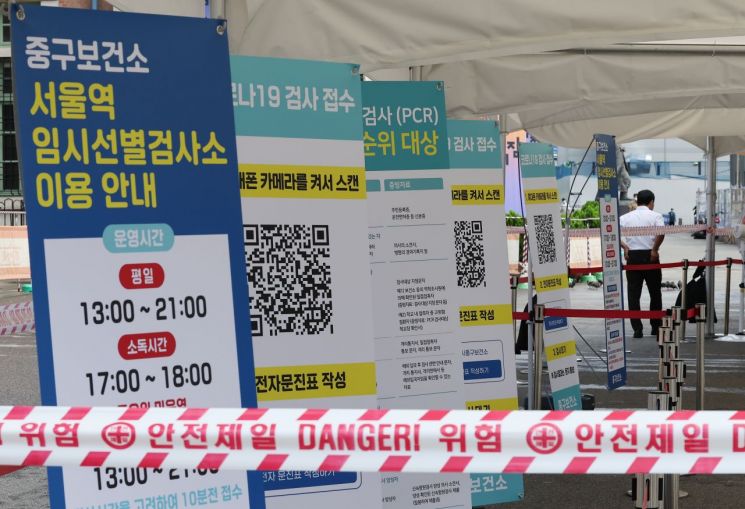 Due to the spread of COVID-19, the temporary screening clinic at Seoul Station in Jung-gu, Seoul, which has been reinstalled, will begin operations on the afternoon of the 25th.
 [Image source=Yonhap News]
◆ Government Emphasizes 'Voluntary Quarantine'... Experts Urge Focus on 'Treatment' Rather Than 'Vaccination'
The government is currently focusing on protecting high-risk groups vulnerable to severe illness and death, emphasizing voluntary quarantine and the fourth vaccine dose. On the 14th, the Presidential Office stated, "The basic philosophy of quarantine is shifting from sacrifice or coercion to autonomy and responsibility," adding, "If the previous government enforced sacrifices on self-employed individuals through time and personnel restrictions and social distancing measures, now we aim to implement sustainable quarantine policies based on citizens' autonomy and responsibility."
However, criticism follows that this effectively shifts quarantine responsibility onto citizens amid signs of a new COVID-19 surge. Woo Sang-ho, Emergency Response Committee Chairman of the Democratic Party, attended the first meeting of the COVID-19 Re-Surge Task Force on the 22nd and criticized the voluntary quarantine policy, saying, "They loudly claimed to implement scientific quarantine, but it has ultimately become a 'survival of the fittest quarantine' where citizens are left to fend for themselves."
Another issue is that as the government gradually relaxes quarantine guidelines, citizens' awareness of COVID-19 risks has diminished. Some even say that since the COVID-19 fatality rate is at the level of seasonal flu, it is acceptable to get infected.
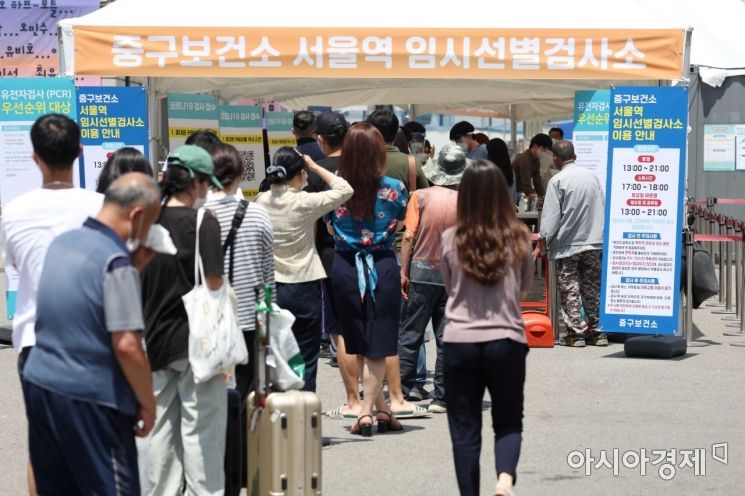 The temporary COVID-19 screening site set up at Seoul Station Plaza on the 25th is crowded with citizens seeking testing. Photo by Moon Honam munonam@
Experts emphasize that the currently circulating Omicron subvariants such as BA.5 have very high transmissibility, making it difficult to avoid family cluster infections, and that strengthening early treatment measures is effective.
Professor Cheon Eun-mi of the Respiratory Medicine Department at Ewha Mokdong Hospital said, "Rather than provoking anxiety about infection, it is important to focus on treatment since the likelihood of testing positive is high," adding, "Vaccines were a method to suppress the pandemic initially, but repeated vaccinations can cause side effects that weaken immunity. Now, the key is whether appropriate treatments can be administered quickly at the early stage of infection."
Regarding the current COVID-19 situation, Professor Cheon analyzed, "The large-scale spread of the Omicron variant has already passed, and now Omicron subvariants are circulating," adding, "Since these are variants within the same Omicron lineage, reinfection rates will be much lower, and even if reinfection occurs, natural immunity from previous Omicron infections will reduce the severity."
© The Asia Business Daily(www.asiae.co.kr). All rights reserved.



















