Presidential Office 'Top 10 National Proposals' Online Public Vote
Mandatory Closure of Large Marts Abolishment Leads with 400,000 Votes
"Voting Until 31st, Top 3 Will Be Actively Reflected in State Affairs"
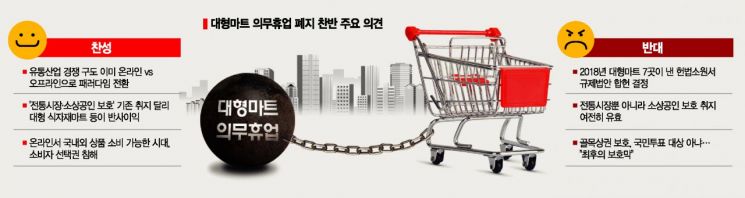
Effectiveness Lost to Online Competition vs. Continued Purpose of Protecting Small Businesses Tied
Fair Trade Commission Also Considering Lifting Restrictions on Large Mart Dawn Deliveries
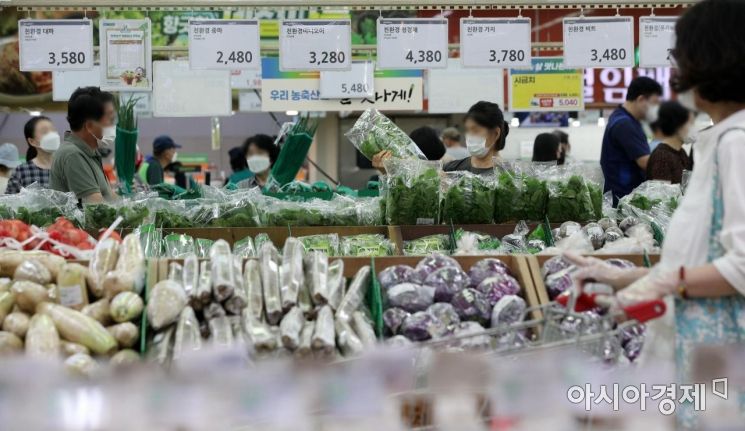 As vegetable prices soar due to early heatwaves, poor crop yields, and delayed shipments, increasing the burden of food costs on consumers, citizens are shopping at a large supermarket in Seoul on the 17th. Photo by Hyunmin Kim kimhyun81@
[Asia Economy Reporter Kim Yuri] The Yoon Seok-yeol administration is rapidly advancing discussions on easing regulations on large supermarket operations that have been in place for over a decade. In an online public proposal vote conducted by the Presidential Office, the "abolition of mandatory closure days for large supermarkets" has received the most votes. Meanwhile, the Fair Trade Commission and the Ministry of Trade, Industry and Energy are considering lifting restrictions on early morning deliveries by large supermarkets. However, since legal amendments are required and opposition voices are strong, the process ahead is expected to be challenging.
According to the Presidential Office's public proposal as of 10:45 a.m. on the 25th, among the "Top 10 Public Proposals," the abolition of mandatory closure days for large supermarkets has received 400,200 'likes,' garnering the most votes. The introduction of a 9,900 KRW K-Transportation Pass and allowing rollover of unused mobile data on cell phones follow closely with 396,288 and 396,129 votes, respectively. The Presidential Office selected 10 proposals out of approximately 12,000 complaints, suggestions, and petitions deemed feasible for policy implementation and announced that an online public vote will be held for 10 days until the 31st, with the top three proposals to be reflected in government policy.
Separately, the Fair Trade Commission has identified 44 regulations that restrict competition, including provisions limiting early morning deliveries by large supermarkets, and is consulting with relevant ministries on improvement measures. Under current regulations, online shopping malls operated by large supermarkets cannot use offline stores to make early morning deliveries during restricted hours (midnight to 10 a.m.). The Fair Trade Commission views these restrictions as competition-limiting, discriminatory, and detrimental to consumer benefits, thus needing rationalization. While online retailers face no such restrictions, large supermarkets are limited even when conducting online sales, restricting competition and consumer choice in the online distribution market.
Under the Distribution Industry Development Act introduced in 2012, local governments must designate two mandatory closure days per month for large supermarkets. Operating hours can also be restricted between midnight and 10 a.m. The purpose is to protect neighborhood businesses, promote coexistence and balanced development, maintain diversity in the distribution ecosystem, and safeguard workers' health rights. Accordingly, 90% of regions nationwide, including Seoul, designate the second and fourth Sundays of each month as mandatory closure days.
Large supermarkets are welcoming the possibility of abolishing the mandatory closure system. It is projected that if the regulation is lifted, individual large supermarkets' annual sales could increase by up to 1 trillion KRW. A representative from a large supermarket stated, "Sunday sales are about 2.5 times the average daily sales, yet we are forced to close on half of the Sundays each month, and even on Sundays we operate, consumers are confused and unable to find us. Considering this, the sales increase could be even greater."
There are also growing voices that the regulation has lost its effectiveness as online grocery shopping has already become established. Another large supermarket representative pointed out, "The mandatory closure of large supermarkets, which started with the intention of revitalizing traditional markets, no longer reflects the current era where competition exists between online and offline distribution channels. Despite academic research showing that mandatory closures have limited impact on increasing traditional market sales, the regulation has persisted for 10 years." It is rather evaluated that, contrary to the original intent, online and large food material supermarkets have benefited.
On the other hand, there is strong opposition emphasizing the need to protect neighborhood businesses. The Korea Federation of Small and Medium Business Owners issued a statement on the 21st, saying, "Restrictions on large supermarket operating hours and mandatory closures were ruled constitutional in a 2018 constitutional appeal filed by seven large supermarkets. Despite this legality, the new government is removing protections for neighborhood businesses through public voting and realizing the wishes of large corporations."
The Small Business Association also criticized on the 11th, "In a situation where neighborhood businesses are collapsing after COVID-19, easing regulations on online delivery during large supermarket closure days will push small business owners into greater hardship. We want to ask the Fair Trade Commission whether they believe the playing field, which was tilted 10 years ago, has now changed to allow fair competition."
The ball is now in the National Assembly's court. To allow online deliveries using offline stores during restricted hours and mandatory closure days or to abolish the mandatory closure system, amendments to the Distribution Industry Development Act are necessary. Assemblyman Ko Yong-jin of the Democratic Party proposed an amendment in June last year that would allow large supermarkets to deliver online products regardless of mandatory closure days or operating hour restrictions. Assemblyman Lee Jong-bae of the People Power Party also proposed a similar amendment in July 2020. Assemblyman Choi Seung-jae of the People Power Party proposed an amendment allowing local governments to autonomously decide the number and days of mandatory closure days in consultation with local residents.
© The Asia Business Daily(www.asiae.co.kr). All rights reserved.
![Clutching a Stolen Dior Bag, Saying "I Hate Being Poor but Real"... The Grotesque Con of a "Human Knockoff" [Slate]](https://cwcontent.asiae.co.kr/asiaresize/183/2026021902243444107_1771435474.jpg)

















