Reluctant to Test and Treat After Confirmation Due to 'Economic Burden'
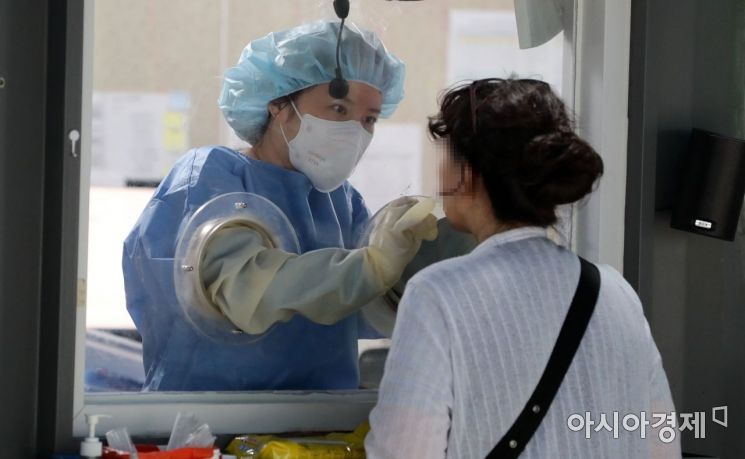 On the 24th, when 65,433 new COVID-19 cases were reported, citizens visiting the screening clinic set up at Yongsan-gu Public Health Center in Seoul were waiting to get tested. The photo is unrelated to specific expressions in the article. Photo by Jinhyung Kang aymsdream@
[Asia Economy Reporter Yoon Seul-gi] It has been revealed that the bottom 10% income vulnerable group has more than twice the risk of death after COVID-19 infection compared to other income brackets. This is analyzed to be due to the greater economic burden of health management on low-income groups, which prevented them from actively undergoing testing and treatment even after being confirmed with COVID-19.
According to the 'Status of COVID-19 Patients Visiting Medical Institutions and Deaths' received by Kim Hoe-jae, a member of the Democratic Party of Korea, from the National Health Insurance Service on the 24th, about 4.8 million health insurance workplace subscribers visited medical institutions due to COVID-19 from January 20, 2020, when the first domestic COVID-19 case occurred, until May 31 of this year. Among them, 917 people died within 30 days after the visit.
When dividing the deceased by health insurance premium income brackets, the number of deaths within 30 days among COVID-19 patients in the bottom 10% income bracket (1st decile) was 199. Calculated per 100,000 patients, the death count was 44.3. This is the highest figure among the 1st to 10th deciles, amounting to 2.2 times the overall death rate of 20.2 per 100,000.
By decile, the death rate per 100,000 patients in the 2nd decile, representing the bottom 20% income group, was 27. The death rates per 100,000 patients in the 3rd decile (19.8), 4th decile (16.6), and 5th decile (18.5) were below average. For those with middle or higher income, the death rates were even lower: 15.7 in the 6th decile, 14 in the 7th decile, 15.7 in the 8th decile, and 13.8 in the 9th decile. The top 10% income group (10th decile) had a death rate of 19.2.
Due to government support for COVID-19 diagnosis and treatment, the number of patients visiting medical institutions by income decile ranged similarly from 449,170 (1st decile) to 526,051 (9th decile) without any particular trend.
This indicates that the COVID-19 death risk was higher among the economically vulnerable groups with very low income, suggesting that due to economic conditions, they may have neglected regular health status or management of underlying diseases, or were passive in testing and treatment even after COVID-19 infection.
Meanwhile, the government recently restructured financial support so that patients bear part of the medical expenses incurred during outpatient visits to hospitals and clinics in preparation for a COVID-19 resurgence. The out-of-pocket expense per visit is about 5,000 to 6,000 KRW (clinic level, first visit basis). If patients receive prescriptions at pharmacies, they also bear part of the medication cost. For example, if the total pharmacy medication cost is 12,000 KRW, the patient's share is about 3,600 KRW.
As patient burdens increase, there are concerns that economically vulnerable groups may become more reluctant to visit hospitals and clinics. Representative Kim said, "The COVID-19 disaster has hit low-income groups even harder," and pointed out, "If the state neglects its responsibilities and does not strengthen support at all stages of COVID-19 response, including diagnosis, isolation, and treatment, the COVID-19 situation will ultimately become a 'survival of the fittest' arena for vulnerable groups."
© The Asia Business Daily(www.asiae.co.kr). All rights reserved.

















