Jikganggapjil119, Survey Results of 1,000 Office Workers
[Asia Economy Reporter Lim Chun-han] It has been revealed that the damages such as job loss and income reduction caused by the COVID-19 crisis were more concentrated among non-regular workers.
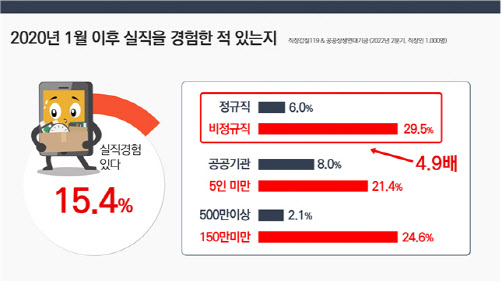
According to the results of a survey titled 'COVID-19 and Changes in Work Life' conducted on 1,000 workers (600 regular workers and 400 non-regular workers) by the civic group Workplace Bullying 119 and the Public Coexistence Solidarity Fund on the 24th, 15.4% of all respondents reported having experienced job loss since the outbreak of COVID-19 in January 2020. Among them, 29.5% of non-regular workers reported job loss experience, which was five times higher than that of regular workers (6.0%). The survey was conducted online from the 10th to the 16th of last month by the public opinion research firm Embrain Public.
Overall, 28.4% of respondents said their income had decreased compared to January 2020. Similarly, 50.5% of non-regular workers reported income reduction, about four times higher than the 13.7% of regular workers. Income reduction was particularly prominent among those earning less than 1.5 million KRW per month (50.9%) and those working at businesses with fewer than five employees (40.5%).
When diagnosed with COVID-19 or experiencing similar symptoms, regular workers were more likely to use paid leave, whereas non-regular workers were less able to do so. A detailed survey of 353 respondents who had been diagnosed with COVID-19 showed that the rate of paid leave usage was 45.0% for regular workers, three times higher than 15.3% for non-regular workers. Conversely, the rate of unpaid leave usage after diagnosis was more than three times higher for non-regular workers (37.4%) compared to regular workers (11.7%). For COVID-19 PCR testing, 50.7% of regular workers used separate paid leave or annual leave, while only 26.0% of non-regular workers did so. As a result, only 11.6% of regular workers experienced income reduction, whereas 44.1% of non-regular workers saw their income decrease.
Mental health deterioration due to the COVID-19 crisis was significantly worse among non-regular workers than regular workers. More non-regular workers (54.7%) reported feeling depressed in the past two weeks compared to regular workers (40.7%), and the percentage of respondents who considered extreme measures was twice as high among non-regular workers (28.0%) compared to regular workers (14.0%).
Kwon Doo-seop, a lawyer and representative of Workplace Bullying 119, stated, "The groups most affected after COVID-19 are non-regular workers and workers at small businesses with fewer than five employees." He added, "For those excluded from the employment insurance system, the government should establish a disaster unemployment benefit that pays 70% of the minimum wage for six months."
© The Asia Business Daily(www.asiae.co.kr). All rights reserved.

















