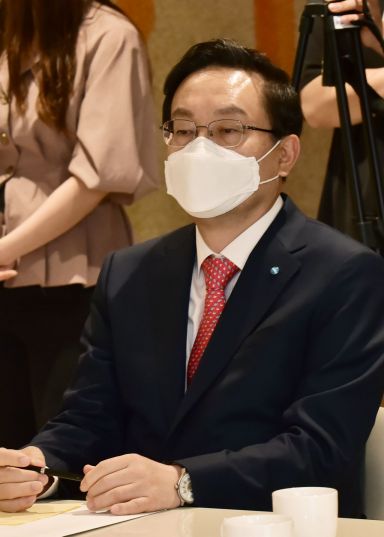
[Asia Economy Reporter Song Seung-seop] Sohn Tae-seung, Chairman of Woori Financial Group, won again in the second trial after winning the first trial in a lawsuit he filed to contest the disciplinary action related to overseas interest rate-linked derivative-linked funds (DLF).
The Administrative Division 8-1 of the Seoul High Court ruled at 2 p.m. on the 22nd, "The defendant (Financial Supervisory Service, FSS)'s appeal is dismissed." This means that the disciplinary action imposed on Chairman Sohn Tae-seung by the FSS was recognized as illegal and ineffective.
The FSS confirmed that there was incomplete sales in the process of launching and selling DLFs at Woori Bank and issued a 'written warning'?a severe disciplinary action?against Sohn Tae-seung, who was then the bank president, citing responsibility for internal control. Disciplinary actions of written warning or higher restrict reappointment and employment in the financial sector. Accordingly, Chairman Sohn filed an administrative lawsuit in March 2020 to cancel the disciplinary action and won in August last year.
At that time, the first trial court ruled in favor of Chairman Sohn, stating, "The FSS misunderstood the legal principles and constituted the grounds for the disciplinary action beyond the scope permitted by law." The court reasoned that there is no legal basis to sanction internal control as an obligation to 'comply with' rather than an obligation to 'establish.' The FSS presented five grounds to justify the disciplinary action, but except for 'deficiencies in the operation and results of the product selection committee,' none were acknowledged.
The second trial began with the FSS's appeal. Both sides fiercely contested the extent to which responsibility for internal control could be imposed, as in the first trial. The FSS argued that if standards for effective operation of internal control were not established, it was the CEO's responsibility, but Chairman Sohn's legal counsel claimed the disciplinary action was baseless.
This ruling is expected to influence trials of CEOs of other financial companies currently underway on similar issues. Whether CEO sanctions are possible on the grounds of internal control is also a key issue in cases such as the Lime Fund and Optimus Fund scandals. The Financial Services Commission is currently withholding processing the FSS's disciplinary proposal and is observing the DLF ruling.
The judicial risk reduction is expected to signal a green light for Chairman Sohn's reappointment. His term runs until March next year.
The FSS, having consecutively lost, must decide whether to appeal to the Supreme Court. The FSS issued a statement on the ruling, saying, "We respect the judgment of the second trial court," and "After thoroughly reviewing the ruling, we plan to coordinate with the Financial Services Commission and others to determine our future position."
© The Asia Business Daily(www.asiae.co.kr). All rights reserved.

















