50s Resident in Incheon Under Epidemiological Investigation... 3rd Dose Completed
Health Authorities "Likely Gradual Spread in the Community"
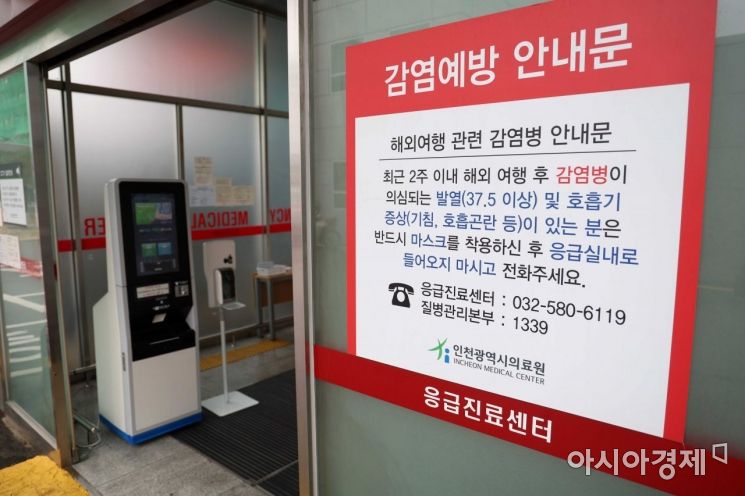 The first suspected case of monkeypox has appeared in South Korea, and health authorities are conducting diagnostic tests. The suspected patient, Mr. A, was transferred to an isolation ward at Incheon Medical Center at around 9:40 PM on the 21st. Monkeypox is a virus endemic to the African region, but since the first reported case in the UK on the 7th of last month, it has been rapidly spreading worldwide. The photo shows Incheon Medical Center on the 22nd. Photo by Moon Honam munonam@
One additional domestic confirmed case has been reported of COVID-19 BA.2.75 (commonly known as 'Kentauros'), which is known to have greater transmissibility and immune evasion than previous variants.
The Central Disease Control Headquarters announced on the 22nd that "one more domestic infection case of the BA.2.75 variant has been confirmed." The health authorities are currently conducting an epidemiological investigation on this confirmed case.
This confirmed case is a person in their 50s residing in Incheon, who has completed three doses of vaccination. Symptoms appeared on the 18th, and the diagnosis was confirmed on the 19th. Currently, the patient is showing mild symptoms and is undergoing home treatment.
Accordingly, the total number of domestic BA.2.75 confirmed cases has reached three. The Central Disease Control Headquarters explained that no epidemiological link has been identified between this confirmed case and the two previous BA.2.75 infection cases.
The first domestic BA.2.75 confirmed case, identified on the 14th, was a person in their 60s living in Incheon, with no history of overseas travel. Four close contacts were identified: one cohabitant and three community members, and so far, no additional confirmed cases have been found among them.
The second case was a foreign national residing in Cheongju, who entered the country from India on the 5th, tested positive for COVID-19 two days later, and was classified as infected with BA.2.75 two weeks afterward.
Since these three confirmed cases have no epidemiological links, concerns are growing that the BA.2.75 variant may already be spreading within the community.
Son Young-rae, head of the Social Strategy Division at the Central Accident Response Headquarters, stated at a briefing that "BA.2.75 is gradually spreading infections centered in the community," adding, "While the share of BA.2.75 is likely to continue increasing, it has not yet shown a widespread upward trend."
He further added, "Currently, it is in the early stages, and meaningful monitoring results sufficient to evaluate the situation have not yet emerged. We will continue to conduct in-depth weekly monitoring to observe changes in its prevalence."
Since its first detection in India in May of this year, BA.2.75 has rapidly spread to the United States, Europe, and other regions. Compared to BA.2, known as the 'stealth Omicron,' BA.2.75 has eight additional spike gene mutations, enabling it to bind more effectively to cells and strongly evade antibodies formed by vaccination or prior infection. The transmissibility and immune evasion of this virus are reported to be stronger than those of BA.5, which has become the dominant strain in South Korea.
© The Asia Business Daily(www.asiae.co.kr). All rights reserved.

















