Some Construction Sites Still Have Poor Toilet Facilities
"Work Through It or Use the Bathroom Inside the House"
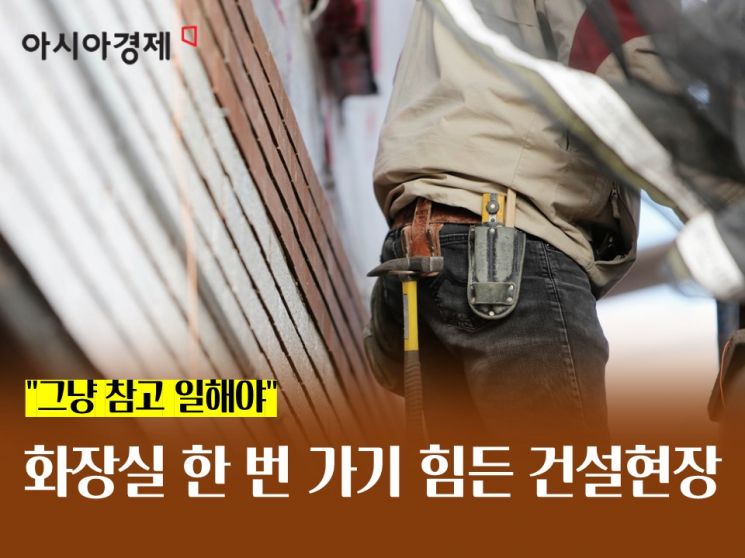 Since 2008, the installation of restrooms at construction sites has been mandatory; however, the restroom facilities at some sites are still known to be in poor condition. / Photo by Song Hyundo, Asia Economy intern reporter
[Asia Economy Reporter Lim Juhyung, Intern Reporter Song Hyundo] A controversy known as the "Excrement Apartment" has erupted after a plastic bag containing human waste was found on the wall of a newly built apartment in Gyeonggi Province. The excrement bags are presumed to have been hidden by workers who worked at the construction site. While there is an outcry that the thoughtless behavior of some workers has caused harm to the residents, some point out that the poor sanitary conditions at construction sites are the root cause of the problem.
The controversy first came to light through a post on an internet cafe on the 19th. According to the post, Mr. A, who moved into a newly built apartment in Hwaseong City, Gyeonggi Province, last May, began to notice a mysterious foul odor coming from the wall of the master bedroom as the weather grew warmer.
Unable to endure it any longer, Mr. A contacted the construction company's after-service (A/S) department on the 29th of the same month to report the defect. Upon arrival, the construction company officials found three plastic bags filled with contents hidden in the space above the ceiling of the dressing room while inspecting Mr. A's home. The bags contained human excrement. The construction company believes it is highly likely that workers hid the excrement bags during the apartment's interior finishing work.
Mr. A expressed frustration, saying, "Seventeen days have passed since the bags were discovered, but the construction company is calling the deodorization work removing wallpaper and ceiling and spraying liquid detergent. The smell is still so strong that it gives me headaches."
Netizens who read the post reacted with concern, saying, "These are thoughtless workers. Why don't they use the restroom?", "Could there be hidden bags in my house too?", and "This is why I can't move into a newly built apartment."
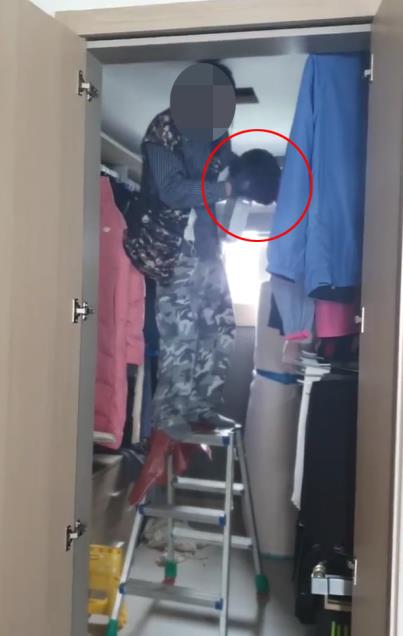 'Feces Bag' Found in Master Bedroom Dressing Room of Newly Built Apartment in Hwaseong, Gyeonggi / Photo by Yonhap News
There are also claims that workers frequently relieve themselves in various places at construction sites. A netizen who works for a construction company pointed out, "More often than people think, workers relieve themselves in various parts of the building. Since many do it in wide-open spaces, it is indeed difficult to control."
Why do some workers relieve themselves at the construction site instead of using restrooms? Workers complain that there are practical limitations to using restrooms during construction work.
Previously, in 2008, the amendment to the "Act on Improvement of Employment of Construction Workers" mandated the installation of restrooms at domestic construction sites. Accordingly, construction sites with a planned construction cost of 100 million won or more must install convenience facilities such as dining rooms, restrooms, and changing rooms for workers and appoint a manager. Failure to comply results in fines.
However, the overall management and sanitary conditions of restroom facilities are separate issues. Some facilities are so poor that they are practically unusable, and in some cases, restrooms are located far from the work area.
According to a 2020 living condition survey conducted by the Construction Workers' Mutual Aid Association targeting construction workers, 97.5% of domestic construction sites had restrooms, but user satisfaction was the lowest among all convenience facilities (restrooms, changing rooms, showers, dining rooms, lounges, etc.). The association pointed out that "although the possession rate is high, dissatisfaction with the total number and sanitary conditions is reflected."
Mr. B (26), who works at construction sites such as apartments and officetels, explained, "The quality of restrooms varies greatly depending on the type of building. Large corporation sites have cleaning staff regularly visit and have restrooms equipped with bidets at multiple points in the building under construction, but in typical apartment sites, you can't expect that. Usually, restrooms are only on the first floor of the building, or sometimes workers have to borrow restrooms from nearby buildings."
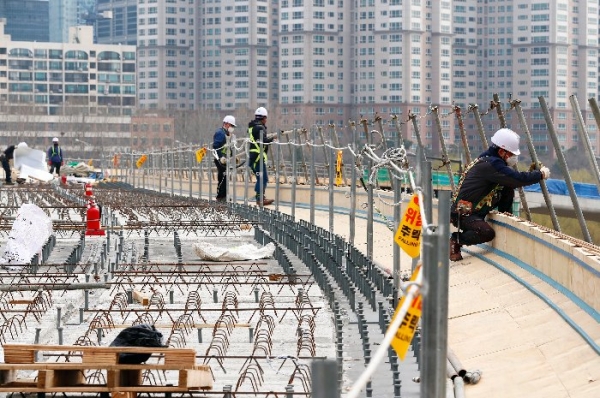 Workers at high-rise construction sites are often reported to experience difficulties using restrooms. The photo is unrelated to specific expressions in the article / Photo by Yonhap News
For small buildings of three to five floors, such restroom facilities are sufficient, but the problem arises when working on high-rise buildings with dozens of floors. Mr. B said, "Can you really go up and down seven or eight floors every time you need to relieve yourself? Most just hold it in or, if they can't, relieve themselves inside the building."
Construction worker Mr. C (27) said, "Sometimes there are makeshift restrooms made of wood or urinals set up in fully exposed areas that are called restrooms. They are not properly managed, so in summer they smell bad, and in winter the toilets freeze. Who would want to use such facilities?"
He added, "Instead of restrooms, workers relieve themselves in rooms or balconies under construction, and later the construction company calls a cleaning company to handle it all at once. If the cleaning subcontractor fails to find the excrement, incidents like this 'Excrement Apartment' occur."
Experts emphasize that it is necessary to have a system with specific regulations on hygiene, not just a simple obligation to install restrooms.
Kim Sungwoo, director of the National Construction Workers' Union, said, "Although the law mandating restroom installation at construction sites was enacted in 2008, there are no detailed regulations specifying the exact location or size of sanitary facilities, which seems to be causing these problems. Establishing specific standards is urgent."
He added, "The lack of awareness among construction companies that actually manage the restrooms is also one of the reasons for the law's ineffectiveness. It is necessary to organize the system so that regulations enhancing worker convenience have legal binding force."
© The Asia Business Daily(www.asiae.co.kr). All rights reserved.



















