Chanel to Raise Prices by 10% in July
34% Increase This Year Following January and March
Louis Vuitton and Dior Expected to Follow
Industry Uses Pricing for Luxury and Differentiation
Continuous Increases to Enhance Scarcity
[Asia Economy Reporter Jeon Jinyoung] The price hikes of famous overseas luxury brands are going beyond limits. Experts and consumers alike continuously criticize these brands for engaging in 'bold business practices,' citing the increased preference for luxury goods since COVID-19 as a reason.
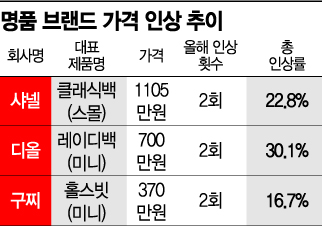
According to the industry on the 21st, the rush of price increases among overseas luxury brands continues. The brand with the largest price hike is the French brand Chanel. Industry insiders say that Chanel is expected to implement a price increase of about 10% in July. If this price hike is confirmed, Chanel will have raised prices three times already this year. For its representative product, the Classic Bag, the small size rose from 8.93 million KRW to 10.52 million KRW in January, a 17.8% increase, and in March, it jumped from 10.52 million KRW to 11.05 million KRW, a 5% increase, totaling a 22.8% rise. If the July increase is decided, the total increase this year will be up to about 33.8%. Previously, Chanel raised prices four times last year?in February, July, September, and November. Compared to before COVID-19, Chanel bag prices have increased by an average of 71%.
The prices of the three major luxury brands, known as ‘EruSha’ (Herm?s, Louis Vuitton, Chanel), including Chanel, continue to rise. Louis Vuitton, which implemented five price increases last year, raised product prices earlier this year, with increases ranging from 8% to 21% depending on the item.
Dior is closely following Chanel. Dior has raised prices twice this year. Industry insiders and consumers point out that Dior continues to raise prices to match Chanel’s price levels. For its representative product, the Lady Bag Mini, the price increased from 5.3 million KRW to 6.4 million KRW in January, a 20.75% increase, and this month, from 6.4 million KRW to 7 million KRW, a 9.375% increase. This amounts to about a 30% increase in one year. Other brands are in similar situations. Gucci raised the price of its representative product, the Horsebit Mini, by 7.9% in February and 8.8% in June, totaling a 16.7% increase.
Luxury jewelry is no different. Jaeger-LeCoultre, which raised prices earlier this year, increased the selling prices of major products by 3-4% starting in June. For example, the Rendez-Vous Classic rose from the high 9 million KRW range to 10.2 million KRW. The three major luxury watch brands, known as ‘RollOka’ (Rolex, Omega, Cartier), are also following suit. Omega raised the price of one of its representative products, the Moonwatch, by about 200,000 KRW in March, and last month increased prices of all gold watch models by about 3%.
Luxury brand companies claim that price increases are inevitable due to rising costs of raw materials and components, as well as exchange rate fluctuations. However, industry insiders agree that these are only superficial reasons, and that brands are sticking to a ‘bold business’ strategy that creates luxury and differentiation through pricing. An industry insider said, "Recently, luxury brands have adopted a strategy of matching prices with competitors and raising prices to increase scarcity," adding, "If rising raw material costs were the reason, there would be no need for periodic price hikes. There is a trend of continuous price increases to pursue luxury." Another industry insider said, "Despite continuous price increases, open runs (rushes to buy newly released products) continue, so the criticism of bold price hikes cannot be avoided."
In fact, LVMH, which owns Louis Vuitton, Dior, Fendi, Celine, and Loewe, recorded sales of 64.2 billion euros (86 trillion KRW) last year despite the poor international economic situation caused by COVID-19. This is a 44% increase compared to 2020 and about 20% higher than in 2019, before the pandemic.
Professor Jung Yeonseung of Dankook University’s Business Administration Department analyzed, "The reason luxury brands continue to raise prices is that they recognize consumers have low price sensitivity and the ability to pay," adding, "In Korea, the preference for luxury goods is high, and especially after the COVID-19 pandemic, this preference has tended to increase further. This may have acted as a background for the price increases."
© The Asia Business Daily(www.asiae.co.kr). All rights reserved.


















