Automotive Journalists Association Symposium
"Fire Response Battery Management System
Cooling and Alerts Triggered When Temperature Exceeds Threshold
Research and Development Support to Begin Next Year"
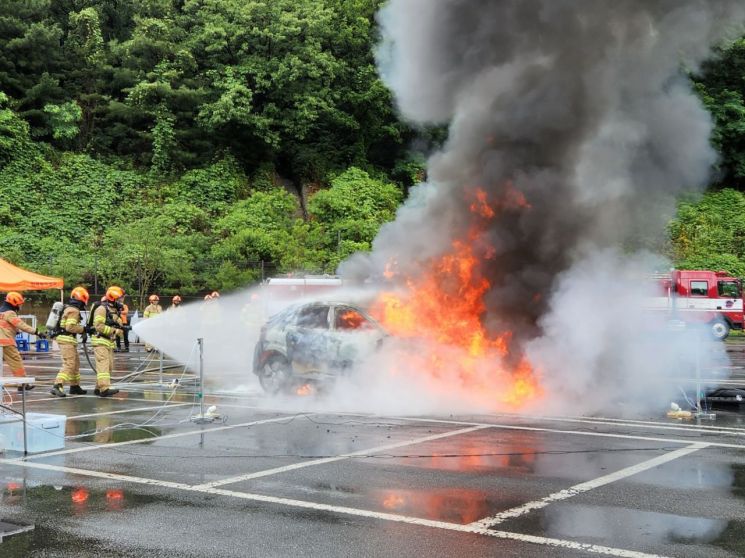
[Asia Economy Reporter Choi Dae-yeol] There have been calls for policy and technological improvements to reduce concerns about electric vehicle (EV) battery fires. Although the frequency of fires is lower compared to conventional internal combustion engines, once a fire occurs, it tends to be large and long-lasting, increasing anxiety as EV adoption expands. In line with the paradigm shift in the automotive industry, authorities plan to enhance safety standards for key components such as batteries, reflecting the need to update safety management systems.
Park Gyun-seong, head of the Automobile Safety Team at the Ministry of Land, Infrastructure and Transport, said at a symposium hosted by the Automobile Journalists Association on the 21st, "We will strengthen safety standards for core devices such as EV batteries and increase investment in safety areas including Battery Management Systems (BMS) capable of responding to fires and fire spread prevention technologies. The government will reorganize the certification system to pre-approve the safety of key battery components and continuously monitor compliance with certification requirements."
Specifically, from next year, research and development (R&D) support will be provided to develop functions such as active cooling systems to lower battery temperature when it exceeds certain thresholds, emergency alerts, and abnormal information storage. Standards to prevent fire spread to surrounding areas during EV fires will also be established. For batteries at the vehicle or device level, the government will set safety standards, conduct performance tests through public institutions during manufacturing, and establish a system to continuously monitor post-production compliance.
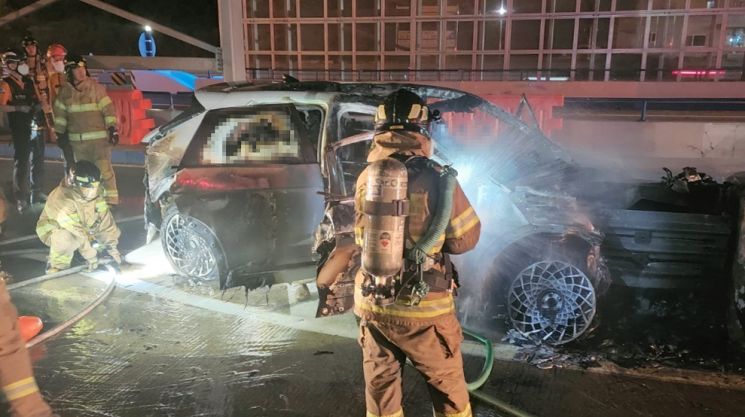 On the night of the 4th of last month, a passenger car entering the Namhae Expressway Branch 2, Seobusan Tollgate in Beombang-dong, Gangseo-gu, Busan, collided with a crash cushion.
 Additionally, the distribution of universal diagnostic devices capable of inspecting EVs will be expanded, and a battery registration system will be introduced to create and manage a database of safety and performance inspection histories. Authorities expect this to have a positive impact on the growing post-use battery industry.
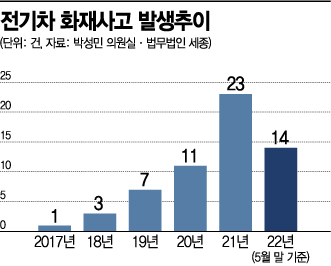
Recently, lithium-ion batteries widely used in EVs have addressed shortcomings of previous products, such as extending driving range, but internal heat and the resulting fire risk remain challenges to be solved. According to Lee Kwang-beom, advisor at the law firm Sejong, there were a total of 4,530 vehicle fires in South Korea last year, accounting for about 0.02% of all registered vehicles. For EVs, there were 23 cases, representing only 0.01% of the total.
Although the frequency is about half, EV fires leave a stronger impression because once ignited, they are difficult to extinguish and can reignite days after suppression, making management and response challenging. Overseas, fire suppression has taken several hours, with cases of reignition occurring hours or days later during storage.
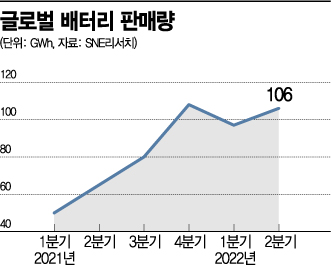
Advisor Lee said, "During EV fires, the internal temperature can soar above 1000 degrees Celsius due to thermal runaway, making suppression difficult. It is necessary to develop flame-retardant materials or technologies that block heat transfer between cells to delay thermal runaway." He also added that evaluation criteria related to thermal runaway should be included among battery safety test standards.
Song Ji-hyun, head of the Major Accident Investigation Division at the Automobile Safety Research Institute, stated, "In addition to the original purpose of BMS for battery management, the scope of anomaly detection and warning functions should be expanded, and fire alarm functions and thermal runaway propagation delay performance should be made mandatory." Kim Yong-won, executive director of the Korea Automobile Manufacturers Association, said, "If lithium-ion battery packs are only fast-charged or heavily discharged, imbalance can occur, reducing performance. It is best to maintain the charge level between 20% and 80% and perform a slow charge about once a month to balance the cells."
© The Asia Business Daily(www.asiae.co.kr). All rights reserved.



















