Discussion on Regional Development Strategy for Building Metaverse and Digital-Based Regional Innovation Ecosystem
Convergence Promotion Center Proposes Regional Innovation Strategies Including Global Metaverse Innovation Special Zone
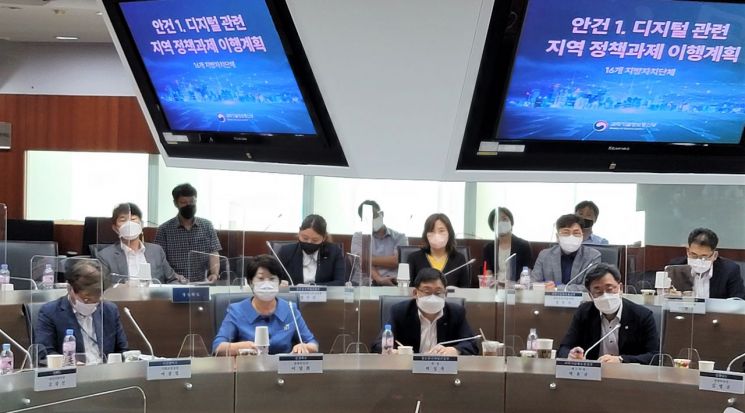
[Asia Economy Yeongnam Reporting Headquarters Reporter Kim Gui-yeol] Gyeongbuk Province held a Metaverse & Digital Policy Seminar on the 20th at the provincial government multipurpose hall.
Attendees included central government ministries, research institutions, universities (POSTECH), the Meta Gyeongbuk Policy Advisory Group, related companies, and officials from city and county governments.
The seminar featured presentations on government metaverse industry policy directions, key contents and implications of the new government's science and technology-related national tasks, and Gyeongbuk Province's metaverse promotion and response plans to address digital-related national agendas such as the metaverse.
Following the presentations, an expert discussion was held to explore proactive response strategies for national tasks in the metaverse and digital fields.
The first presentation was delivered by an official from the Ministry of Science and ICT, who explained the government's policy direction regarding the metaverse industry, focusing on the metaverse sector.
Next, Shim Jeong-min, Director of the Science and Technology Policy Center at the Korea Institute of Science and Technology Planning and Evaluation, presented the new government's science and technology innovation policy directions.
Director Shim categorized 41 national tasks and 136 implementation tasks related to science and technology innovation out of 110 national tasks and 521 implementation tasks, classifying them into seven types and proposing government-level response measures.
He suggested strengthening science and technology leadership at central and local government levels, fostering region-led innovation systems, supporting regional technology-based startups and promising companies' rapid growth through public-private cooperation, establishing systematic support systems for scale-ups, and activating cooperation platforms.
Finally, Park Soo-young, Director of the Gyeongbuk Software Promotion Headquarters, presented the province's response plans to the new government's policy directions.
Director Park proposed establishing the '(tentative name) Gyeongbuk Metaverse Convergence Promotion Center,' a policy and planning specialized organization to promote metaverse convergence across Gyeongbuk's social, economic, and industrial sectors, lead regional innovation and development, and discover and plan mega projects of pre-feasibility study scale in the metaverse field.
Through this, in the short term, the province aims to concentrate its dispersed capabilities, and in the long term, link with the Yoon Suk-yeol administration's global new industry innovation special zone policy to propose the creation of a 'Global Metaverse Innovation Special Zone,' a world-class regional innovation ecosystem model combining corporate ecosystems, knowledge ecosystems, and social innovation ecosystems.
The comprehensive discussion, chaired by Professor Kim Wook-sung of Pohang University of Science and Technology, presented various ideas on the direction the province should take in response to the new government's core keywords, metaverse and digital transformation.
Choi Seong-gwang, Co-chairman of Meta Gyeongbuk Private Joint Committee, pointed out the absolute shortage of policy experts related to digital transformation such as the metaverse nationwide.
He emphasized the need for digital twin-based digital transformation through gaining practical experience via market-competitive businesses centered on companies and collaboration structures through networks.
Um Hee-yoon, Director of the Virtual Convergence Industry Promotion Center at the Korea Radio Promotion Association, stated that the core of the integrated platform project promoted by the government lies in 'connection' between regions.
She stressed the need to prepare so that the project, centered on metropolitan local governments, can expand to basic local governments, regional companies, and individuals, enabling synergy effects of coexistence and cooperation between regions.
Gu Jeong-sik, Director of the Realistic Media Research Center at Gumi Electronics and Information Technology Institute, raised the necessity of metaverse service models using extended reality technology in local manufacturing industry sites and emphasized the importance of policy formulation from the demand side as well as the supplier side.
From the private sector perspective, J&Communication's Acquisition Director emphasized that for Gyeongbuk to lead the metaverse field nationwide, differentiated strategies such as specialized content like healing virtual metaverse and a 'Korean Peninsula regional metaverse encompassing both North and South' are necessary.
Lee Jeong-woo, Gyeongbuk Province's Metaverse Policy Officer, expressed, "In the metaverse field, understanding the government's policy direction and what private companies intend to do must come first," adding, "With the directions of the government and private companies identified through this event, we will thoroughly prepare with differentiated ideas and content unique to Gyeongbuk to surely create 'the land of digital opportunity, the metaverse capital Gyeongbuk.'" He conveyed the province's determination for a great transformation through the metaverse.
© The Asia Business Daily(www.asiae.co.kr). All rights reserved.

















