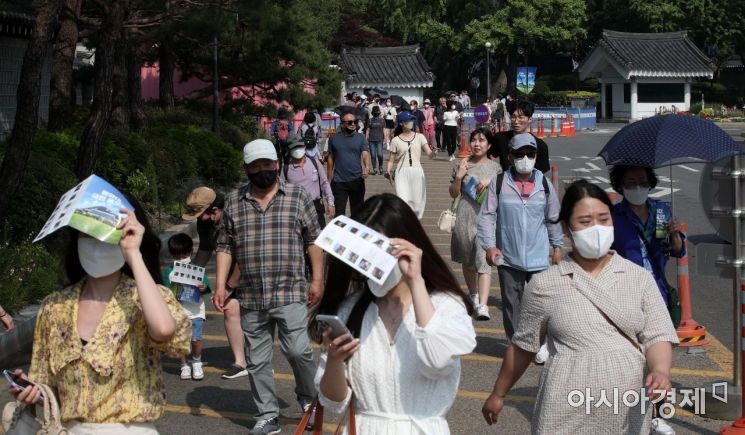
 The area near Cheongwadae in Jongno-gu, Seoul is bustling with citizens. Photo by Kim Hyun-min kimhyun81@
[Asia Economy Reporter Ryu Taemin] The vacancy rate in Seoul's representative commercial districts has decreased for two consecutive quarters. Expectations are rising that the influx of foreign tourists will increase, leading to a projected rise in demand for retail spaces.
According to real estate consulting firm Cushman & Wakefield on the 20th, the average vacancy rate for the six major street commercial districts in Seoul?Myeongdong, Gangnam, Hongdae, Garosugil, Itaewon, and Cheongdam?was recorded at 23.7% in the second quarter of this year. This represents a 1.8 percentage point decrease compared to the previous quarter. The average vacancy rate for these six districts has been declining for two consecutive quarters since the first quarter of this year, when it fell by 0.3 percentage points for the first time after the outbreak of COVID-19.
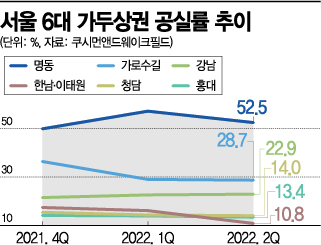
Cushman & Wakefield explained that expectations are spreading that the number of foreign tourists visiting Korea will increase due to the resumption of foreign tourist visa issuance and exemption from self-quarantine for overseas arrivals. In particular, Myeongdong, which suffered significant damage from the decline in foreign tourists during the COVID-19 period, saw its vacancy rate drop sharply by 4.6 percentage points as cosmetics road shops and fashion select shops recently reopened their stores.
There is also analysis that the Samcheong-dong commercial district is being revitalized due to the full opening of the Blue House. Samcheong-dong, which grew as a commercial district following the Korean Wave boom with an increase in foreign group tourists, began to shrink from the mid-to-late 2010s due to the decline in Chinese tourists caused by the THAAD issue and gentrification. Recently, with the full opening of the Blue House, visits by the MZ generation and family tourists have increased, creating an atmosphere of revival in the Samcheong-dong commercial district.
As Seoul's retail spaces have recently regained attention, retail property transactions are actively taking place in the auction market, which is considered a leading indicator of real estate transactions. The bid-to-price ratio for Seoul retail properties remained in the 90% range in the fourth quarter of last year (93.2%) and the first quarter of this year (90.7%), but surged to 112.4% in the second quarter of this year. This is a 27.9 percentage point increase compared to the same period last year (84.57%) during the COVID-19 pandemic.
© The Asia Business Daily(www.asiae.co.kr). All rights reserved.
![Clutching a Stolen Dior Bag, Saying "I Hate Being Poor but Real"... The Grotesque Con of a "Human Knockoff" [Slate]](https://cwcontent.asiae.co.kr/asiaresize/183/2026021902243444107_1771435474.jpg)

















