2.88% of Domestic COVID-19 Cases in the Past Week Are Reinfections
New Zealand's Daily Reinfection Rate 4.96%, New York 15.5%
[Asia Economy Reporter Kim Young-won] As the sixth wave of COVID-19 intensifies, reinfection cases are increasing both domestically and internationally. Experts have diagnosed that immunity acquired through natural infection may somewhat weaken symptoms upon reinfection, but depending on the virus characteristics, the risk level could increase.
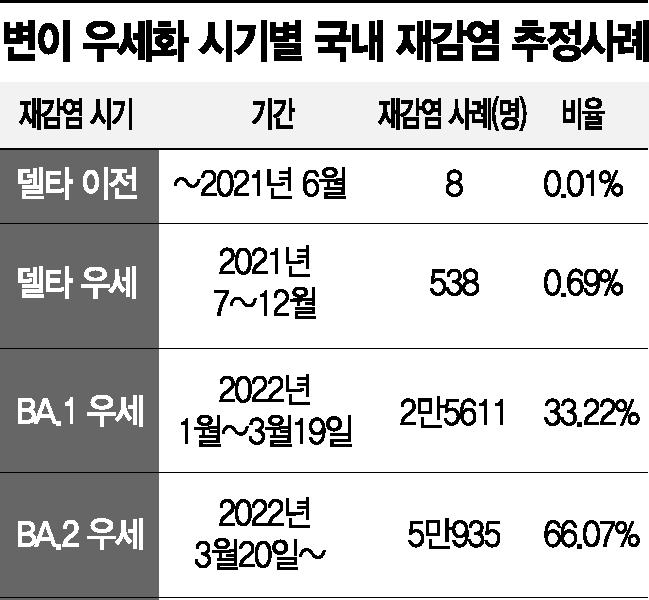
According to the quarantine authorities on the 20th, as of midnight on the 10th, the estimated number of reinfection cases in South Korea totaled 77,200. The reinfection rate during the week from the 4th to the 10th was 2.88%, rising by 0.02 percentage points compared to the previous week. Most domestic reinfection cases occurred during the Omicron and Omicron variant waves. According to the Korea Disease Control and Prevention Agency, among all reinfected individuals, 33.2% of cases occurred between January and March 19 of this year, when Omicron BA.1 was dominant, and 66.0% occurred after March 20, when BA.2 was dominant.
BA.5, which has recently begun to establish itself as the dominant strain overseas, is understood to have immune evasion properties, so reinfection cases are expected to increase further. In South Korea, one case of BA.2.75 was detected; this variant has eight more spike gene mutations than BA.2, indicating a higher immune evasion capability.
Even if reinfection symptoms are mild, elderly are at risk
Experts analyzed that if immunity remains from a previous infection, symptoms upon reinfection may be mild or asymptomatic. Professor Baek Soon-young, Emeritus Professor at the Catholic University College of Medicine, said, "Most people retain cellular immunity, so reinfection cases will likely have mild symptoms," adding, "People infected after completing vaccination develop hybrid immunity, which may result in asymptomatic cases."
However, the risk may be higher for the elderly upon reinfection. Dr. Ziyad Al-Aly of the University of Washington studied 5.6 million U.S. veterans, mostly elderly males, through the U.S. Veterans Health Administration, finding that people infected with COVID-19 two or more times had higher risks of diseases such as lung, heart, and fatigue compared to those infected once. The mortality rate six months after reinfection doubled, and hospitalization rates tripled.
Professor Kim Woo-joo of the Department of Infectious Diseases at Korea University Guro Hospital stated, "Symptoms may vary more depending on the characteristics of the infecting virus than on whether it is a first infection or reinfection," adding, "So far, there seems to be little difference in symptoms between BA.1 and BA.5." He further explained, "Just as the Delta variant, which deeply invades the lungs, causes loss of smell and taste, and Omicron, which mainly infects the upper respiratory tract, shows fewer such symptoms, symptom differences may depend on where the virus invades more."
Reinfections also sharply increasing overseas
Overseas, reinfection frequency is rising sharply alongside variant spread, raising concerns. New Zealand, once called a 'COVID-free country,' expanded its reinfection recognition criteria from '90 days after the first confirmed case' to '28 days after' due to the spread of BA.5. As of the 18th (local time), among 10,772 daily confirmed cases in New Zealand, 585 were reinfections, with a reinfection rate of 4.96%, twice that of South Korea.
In New York, USA, reinfection cases are also increasing alongside variant spread. According to New York City data, during the week of the 21st to 27th of last month, among 45,319 confirmed COVID-19 cases, 7,046 were reinfections, resulting in a reinfection rate of 15.5%. The number of reinfections in New York has increased for three consecutive weeks since mid-last month, when the BA.5 share rose. In the U.S., BA.5 recently surpassed 50% prevalence, becoming the dominant strain.
Domestically, the reinfection recognition criteria have been expanded since the Omicron wave. Regardless of symptoms, if a person tests positive by PCR or professional rapid antigen test 45 days after the first COVID-19 confirmation, they are classified as reinfected. Previously, reinfection was only recognized if: ▲ re-detection occurred between 45 and 89 days after the first confirmation with symptoms or exposure to a confirmed case, or ▲ COVID-19 virus was re-detected after 90 days.
© The Asia Business Daily(www.asiae.co.kr). All rights reserved.


















