Seven Domestic Listed Companies' Revenue Grows 19% Annually
High Proportion of Overseas Sales and Continued Consumables Sales
COVID-19 Resurgence Poses Challenges... "Impact Will Not Be Significant"
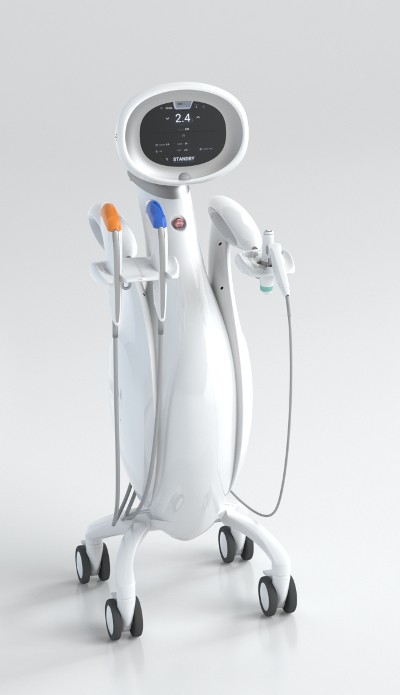
[Asia Economy Reporter Lee Chun-hee] 'K-Beauty' is expanding beyond cosmetics to include convenient cosmetic procedures such as laser treatments. As aesthetic medical device companies actively enter overseas markets, expectations for continuous growth through this expansion are increasing. Although overcoming the obstacle of the COVID-19 resurgence is necessary, it is assessed that aesthetic medical device companies will be able to leap forward in the mid-to-long term, given the high likelihood of endemic (periodic outbreaks of infectious diseases) status.
A 29 Trillion Won Market Opens
According to market research firm Meticulous Research on the 20th, the global aesthetic medical device market is expected to grow by about 11.6% annually and reach $22.17 billion (approximately 29 trillion won) by 2025. Domestic companies have also continued steady growth. The combined sales of seven listed domestic aesthetic medical device companies increased from 169.3 billion won in 2015 to 474.4 billion won last year, an average annual growth rate of 18.7%. Companies such as Lutronic, Iruda, Classys, and Laseroptek are also focusing their efforts on overseas expansion in line with this trend.
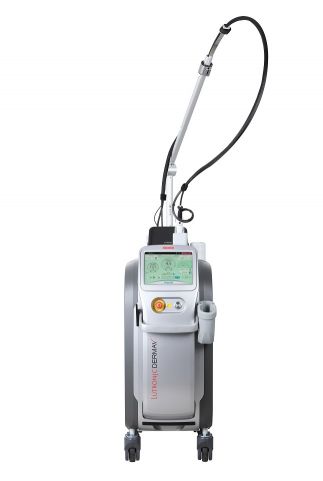
Lutronic recently received certification in Kazakhstan for its new product 'DermaV,' launched in March, successfully obtaining approvals in 10 regions including the United States, Europe, and Korea. It is an Nd:YAG laser surgical device equipped with long pulse (532 nm) and Nd:YAG (1064 nm) wavelengths, used in dermatology and plastic surgery clinics. The company expects this product, which was previously not part of Lutronic’s portfolio, to open new markets.
Iruda has pursued overseas expansion through local partners. Recently, it renewed its existing supply contract with the U.S. medical aesthetic specialist company Cutera. The contract, originally set to expire in 2024, has been extended until 2026 to maintain growth momentum.
In addition, Iruda granted Cutera additional sales rights for its flagship radiofrequency medical device 'Secret RF' in four European countries and is considering launching the composite medical device 'Secret Duo,' which received U.S. FDA approval last month.
Laseroptek is also accelerating preparations for full-scale entry into the U.S. market following FDA approvals for its picosecond lasers 'Piccolo Premium' and 'Helios785.'
Stable Revenue Growth Possible Through Consumables Sales
The aesthetic medical device industry is regarded as one that can sustain continuous growth due to its high proportion of overseas sales. Lutronic exports to over 80 countries worldwide, with overseas sales accounting for 83% of its consolidated revenue of 173.6 billion won last year. Due to the nature of medical devices, consumables such as microneedles generate continuous sales, contributing to sustained revenue growth rather than one-time device sales.
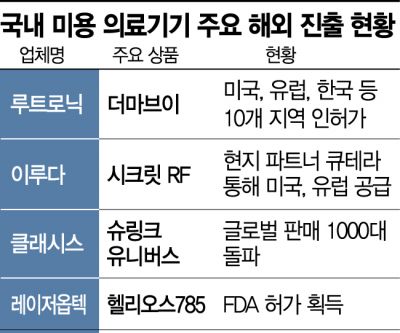
The global private equity firm Bain Capital, which acquired Hugel and achieved a 61.7% capital gain, also acquired the aesthetic medical device company Classys, reflecting this trend. Following Classys’ bestseller focused ultrasound treatment device 'Shrink,' the follow-up model 'Shrink Universe' has surpassed 1,000 units sold globally.
In addition to device sales, sales of various consumables are also increasing. Last year, consumables accounted for 45.1% (45.3 billion won) of Classys’ consolidated revenue of 100.6 billion won. Bain Capital reportedly considers this profit structure one of Classys’ attractive points.
However, a variable is the recent resurgence of COVID-19. Expectations for 'reopening' briefly increased as the Omicron variant’s spread seemed to subside, but concerns have arisen that demand for aesthetic procedures may decline again due to reduced outdoor activities and increased mask-wearing.
Nonetheless, since overseas market development is continuously underway, there is also a view that there is no major concern. An industry insider said, "At the beginning of the COVID-19 outbreak, such concerns materialized, but last year, when waves of infection and calm repeated, aesthetic medical device companies continued to grow. Although demand may temporarily decline due to a resurgence, it is not expected to significantly impact sustained growth."
© The Asia Business Daily(www.asiae.co.kr). All rights reserved.
![Clutching a Stolen Dior Bag, Saying "I Hate Being Poor but Real"... The Grotesque Con of a "Human Knockoff" [Slate]](https://cwcontent.asiae.co.kr/asiaresize/183/2026021902243444107_1771435474.jpg)


















