[Debt Relief Controversy②]
Banks Also Offer Up to 20 Years Repayment Deferral and Maturity Extension
Nominal Autonomy VS Excessive Concerns
"Detailed Criteria Must Be Established"

[Asia Economy Reporter Minwoo Lee] "Financial companies must provide answers regarding the missing parts of the government's financial support measures for vulnerable groups" (Kim Joo-hyun, Chairman of the Financial Services Commission, during the 'Press Conference on the Progress of Financial Sector Livelihood Stabilization Tasks' on the 14th)
When the extension of loan maturities and repayment deferrals for small business owners affected by COVID-19 ends at the end of September, commercial banks will have to directly prevent debt defaults. The Financial Services Commission estimates that currently, about 100 trillion KRW of debt belongs to vulnerable borrowers or those at risk of vulnerability. Of this, 30 trillion KRW will be managed through the establishment of the 'New Start Fund,' which will purchase non-performing loans from banks and then provide principal reductions, long-term/installment repayments, or interest reductions. The remaining 70 trillion KRW is the responsibility of the banks. The financial authorities plan to encourage commercial banks to support self-employed individuals and small business owners directly at the same level as government policies. Banks are also expected to offer benefits such as long-term/installment repayments of up to 20 years, equivalent to those provided by the fund.
According to the financial sector on the 20th, opinions are sharply divided between criticisms that this is merely 'autonomy in name only' and that the burden is being shifted to banks, and views that this is an unavoidable measure to take before a greater crisis hits. To quell controversies over government-controlled finance, there are calls for the government not to recklessly shift responsibility to financial companies but to establish precise standards and refine policies.
Government-Controlled Finance in Name Only vs. Premature Excessive Concerns
Concerns about entrusting banks with 'autonomy' under the 'Primary Financial Institution Responsibility Management System' stem from the fact that it is essentially a government 'directive.' The financial authorities have stated that for vulnerable loans excluded from the New Start Fund support, banks will be encouraged to take debt adjustment measures at a level equivalent to the fund based on the borrower's degree of default. Each bank is now in a position where it must extend maturities and defer repayments again for 90-95% of the targeted borrowers.
As a result, there are reactions that banks are effectively bearing the 'risk.' A representative from a commercial bank said, "Although detailed policy content is needed, if the bank itself judged that the borrower had sufficient repayment ability and classified the loan as non-performing, but it becomes a target for sale to the New Start Fund according to government standards, the bank could incur significant losses," adding, "This means losing the opportunity to recover principal and interest or to sell the non-performing loan in the market." Another commercial bank official expressed confusion, saying, "There is no specific information on which level of borrowers should have their maturities extended or receive repayment deferral support," and lamented, "It would have been better if these details were disclosed in advance or at the time of the policy announcement." Ultimately, dissatisfaction grew as the policy was announced without finalized 'details.'
Meanwhile, there are also views that the banking sector's anxiety is unfounded based on the same grounds. It is argued that complaints are being made prematurely without detailed information being disclosed. A financial sector official pointed out, "Although criticism of 'government-controlled finance' is common, it is premature to raise such issues regarding this policy," and added, "It is not too late to criticize after the policy details are finalized."
Urgent Support Needed for Vulnerable Groups... "Banks Have Sufficient Capacity"
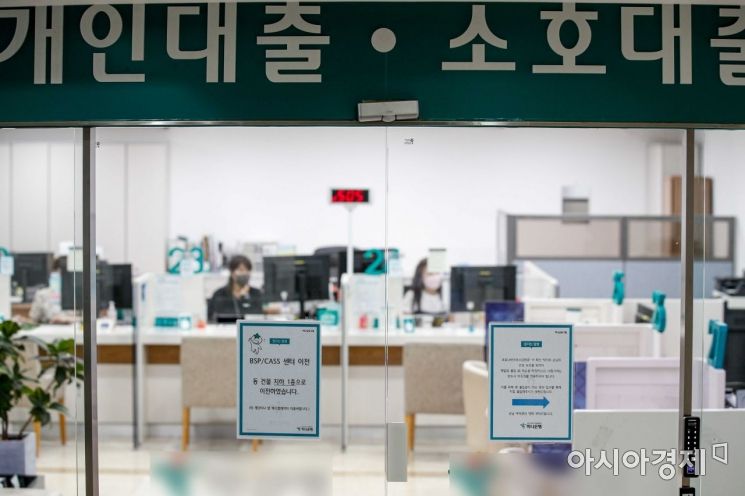 On the 7th, a scene at a bank counter in Seoul city, where major commercial banks are lowering loan interest rates while raising interest rates on fixed deposit and savings products./Photo by Kang Jin-hyung aymsdream@
With the government support plan including up to 90% principal reduction on loans, some criticize that it could cause 'moral hazard.' The financial authorities argue that this is an unavoidable measure to protect vulnerable groups amid rising interest rates and increasing domestic and international uncertainties.
There is also analysis that banks have the capacity to bear this, given their record-breaking recent profits. According to financial information analysis firm FnGuide, the combined consensus net profit forecast for the second quarter of this year for the four major financial holding companies?KB, Shinhan, Hana, and Woori?is 4.5367 trillion KRW. This surpasses the 4 trillion KRW mark again, following the first quarter's record high of 4.672 trillion KRW. It is expected that net profits will exceed 9 trillion KRW in the first half of the year. This is attributed to an increase in corporate loans offsetting a decrease in household loans, as well as improved net interest margins (NIM) due to rising base interest rates.
The loss absorption capacity, including loan loss provisions and allowances, has also increased. By the end of last year, commercial banks had accumulated approximately 37.6 trillion KRW in loan loss provisions and allowances, an increase of about 1.7 trillion KRW compared to the previous year. Since the authorities have requested additional reserves this year, loan loss provisions and allowances are expected to increase further.
Some banks have already taken proactive steps. Woori Bank is a representative example. It is considering introducing principal reduction benefits for multiple borrowers who have faithfully repaid their debts. For high-risk multiple borrowers who have diligently paid high-interest rates for one year, a portion of the principal will be reduced equivalent to the interest already paid. This is a preemptive measure to mitigate the shock of high interest rates for multiple borrowers excluded from government measures. IBK Industrial Bank is also reportedly planning to provide financial support to self-employed individuals and small business owners independently within this month, regardless of government policies.
However, since reliance on autonomy alone is insufficient, there are calls for appropriate incentives and, ultimately, detailed measures. Without established standards for primary financial institutions, classification of non-performing borrowers, and timing of installment repayments, the industry could face confusion, and moral hazard controversies could persist. Professor Seo Ji-yong of Sangmyung University's Department of Business Administration explained, "Since banks have earned significant interest income in the first half of the year, it is a time when they need to make efforts to enhance soundness as institutions with a public interest character," adding, "If active incentives and detailed measures are created, the policy effects will be properly realized."
© The Asia Business Daily(www.asiae.co.kr). All rights reserved.


















