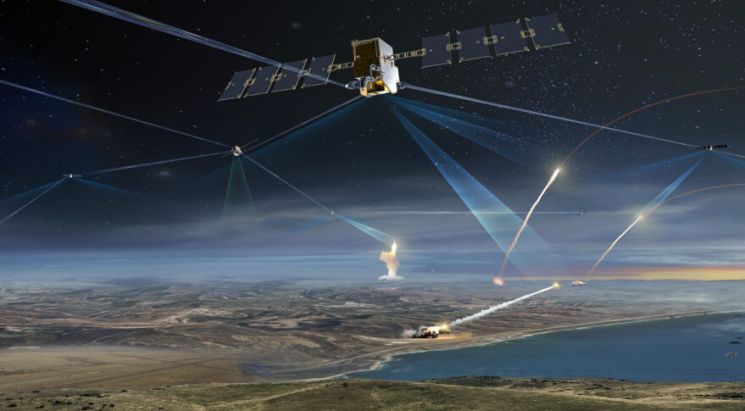
[Asia Economy Reporter Hyunwoo Lee] The U.S. Department of Defense has announced that it is developing a satellite system capable of tracking hypersonic missiles from China and Russia. In particular, following reports that Russia has directly used hypersonic missiles on the Ukrainian front, efforts to establish a defense system are accelerating.
On the 18th (local time), according to the U.S. Department of Defense, Derek Tournear, head of the U.S. Space Defense Agency (SDA), stated in a press briefing that "a $1.3 billion contract has been signed with defense contractors L3Harris Technologies and Northrop Grumman to launch 28 satellites." These satellites will be launched to build a system for tracking hypersonic missiles from China and Russia. The first launch is scheduled for April 2025.
Tournear emphasized the significance of this contract, saying, "The U.S. has not previously launched satellites to detect and track hypersonic missiles. We only had limited capabilities necessary for tracking them." Currently, the missile defense satellites used by the U.S. are primarily launched at about 35,000 km above the equator to detect short-range or intercontinental ballistic missiles.
In contrast, the satellites to be launched this time will be deployed in low Earth orbit within 1,000 km altitude and medium Earth orbit at 10,000 to 20,000 km altitude, enabling detection of hypersonic missile launches and tracking their trajectories to provide information necessary for interception. The Department of Defense plans to launch an additional 54 satellites beyond the 28 contracted this time.
The reason the U.S. government is hastening the establishment of a defense system against hypersonic missiles from China and Russia is interpreted as due to the rapid development of hypersonic weapons by both countries. Previously, China conducted a hypersonic missile test last year, and Russia directly used this weapon during the Ukraine war. Hypersonic missiles travel at speeds more than five times the speed of sound and, unlike ballistic missiles whose trajectories are relatively easy to track, their paths are difficult to predict, making interception challenging.
© The Asia Business Daily(www.asiae.co.kr). All rights reserved.
![Clutching a Stolen Dior Bag, Saying "I Hate Being Poor but Real"... The Grotesque Con of a "Human Knockoff" [Slate]](https://cwcontent.asiae.co.kr/asiaresize/183/2026021902243444107_1771435474.jpg)
















