Seoul Corporate Taxi Operation Rate Drops by Over 30%
Elderly Drivers Avoid Late Hours Due to Physical Challenges
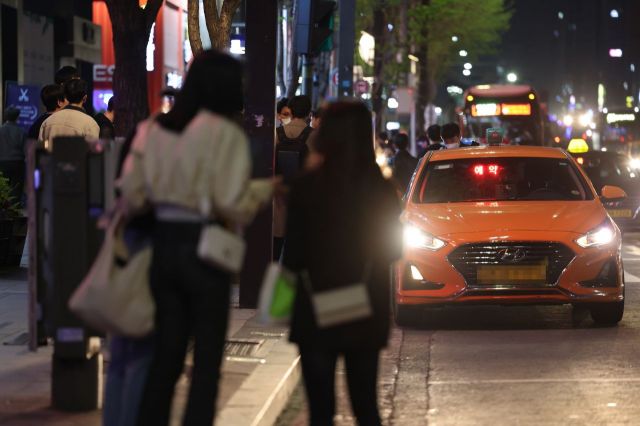
[Asia Economy Kim Gunchan, Intern Reporter] Kim, a university student living in Seoul, spent nearly an hour trying to catch a taxi to go home in the Itaewon area of Yongsan-gu after finishing plans with friends at 1 a.m. on the 16th. He couldn't get a taxi even through smartphone taxi-hailing applications (apps) like KakaoT. Kim said, "Since it was Friday night, I made plans with friends after work, but I was worried because I couldn't get a taxi and was just waiting for one to come," adding, "I even thought about riding a Dareung bike at dawn if nothing else worked."
Meanwhile, Mr. A, who tried to take a taxi to his destination during the sudden heavy rain that afternoon, failed to hail a taxi more than five times through smartphone apps. Eventually, he managed to catch a taxi on the street. Mr. A said, "Since it was daytime, I naturally thought I could call a taxi through KakaoT," and added, "It's the first time that calling a taxi from home didn't get one quickly."
Even though social distancing measures were fully lifted about two months ago, the 'taxi crisis' continues. Regardless of day or night, citizens on the roads without taxis are expressing that "catching a taxi is like picking stars from the sky."
The difficulty in catching taxis late at night is ultimately related to the reduced number of taxis. According to Seoul City, the average number of taxis operating during late-night hours (11 p.m. to 2 a.m.) in Seoul was 19,468 as of June. This contrasts with the average of 23,831 taxis operating in June 2019, before COVID-19.
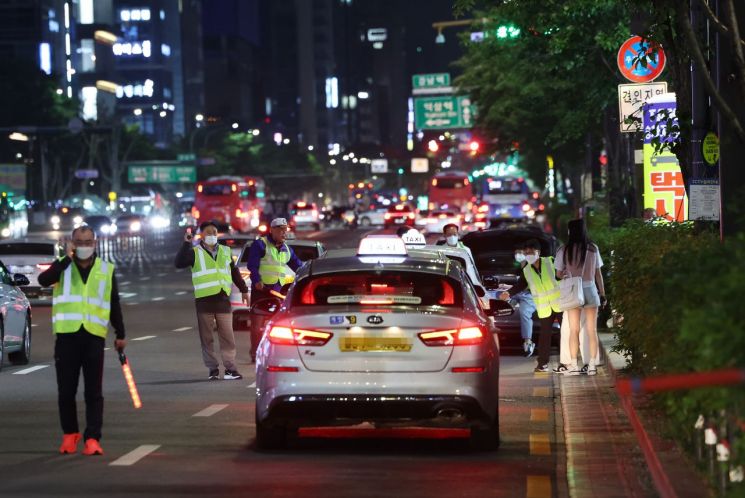 The Taxi Boarding Support Team is assisting citizens with boarding taxis late at night at a temporary taxi stand near Gangnam Station to alleviate the difficulty of getting a taxi during nighttime hours.
 [Photo by Yonhap News]
The decrease in the number of taxis is related to the decline in corporate taxi drivers. According to the National Taxi Transport Business Association Federation, the number of corporate taxi drivers nationwide dropped from 102,320 at the end of 2019 to 74,536 last May. The situation is similar in Seoul. According to Seoul City, the number of corporate taxi drivers decreased from 30,991 at the end of 2019 to 20,710 last May. Consequently, the operation rate of corporate taxis also declined, dropping from 50.4% in the first quarter of 2019 to 31.5% in the first quarter of this year. This means many corporate taxis are parked and not in operation.
The reason for the decrease in corporate taxi drivers is that during the COVID-19 period, income dropped, causing drivers to leave for delivery platforms or courier services. Taxi driver Choi, met in Seongdong-gu, explained, "Many corporate taxis have shifted to delivery," adding, "There is a significant shortage of drivers." Mr. B, who quit corporate taxi work early last year, said, "It was fine before COVID-19, but income decreased after COVID," and added, "I have no intention of returning to taxi work."
Another cause of the taxi crisis is the increasing age of individual taxi drivers. According to the Korea Transportation Safety Authority, the proportion of elderly drivers aged 65 or older among individual taxi drivers nationwide sharply increased from 39% (about 64,000) in 2019 to 48% (about 79,000) as of the end of June. Elderly taxi drivers are known to avoid working during late hours when passengers are crowded due to physical limitations.
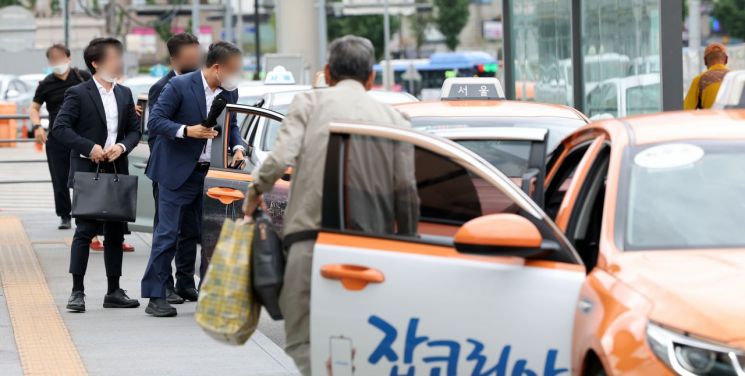 In the case of private taxis, the proportion of elderly drivers aged 65 and over who are reluctant to operate late-night taxis is increasing. The photo shows the taxi stand at Seoul Station.
 [Image source=Yonhap News]
To resolve the taxi boarding difficulty, voices from the field suggest easing the individual taxi rotation system in Seoul. Seoul City operates individual taxis under a three-shift system (Ga, Na, Da) to prevent driver fatigue and regulate supply and demand. Taxi driver Choi said, "I hope the tied-up three-shift system will be loosened," adding, "Of course, it would be difficult to remove it entirely, but since the problem is urgent, some adjustments should be made."
Given the situation, some taxi-hailing platforms are preparing dynamic pricing systems and incentive payments to attract taxi drivers during peak congestion hours and are recruiting taxi drivers.
Currently, large and premium taxis on platforms such as Tada, I.M. Taxi, and Kakao Mobility are implementing a dynamic pricing system that can raise fares up to four times. The dynamic pricing system allows taxis registered on the platform to charge different fares in real-time based on demand and supply at the time of the call. Taxi-hailing platform Uti (UT) announced it will pay up to 6,000 KRW per trip until next month. If a Uti-affiliated taxi driver works 25 days a month and completes seven calls during peak hours, they can receive 1.05 million KRW in incentives per month.
Recently, the government also expressed its intention to introduce a 'platform taxi dynamic pricing system' to resolve the late-night taxi boarding difficulty. On the 18th, the Ministry of Land, Infrastructure and Transport stated in a presidential briefing, "To alleviate the recently intensified late-night taxi boarding difficulties, we plan to introduce a platform taxi dynamic pricing system after consulting experts and industry opinions." Minister Won Hee-ryong said, "If dynamic pricing is introduced only during certain hours, supply may be cut off at the boundary," adding, "If drivers and platforms only take fares without resolving inconvenience, we will consider supplementary measures such as mandatory dispatch or mandatory operation."
© The Asia Business Daily(www.asiae.co.kr). All rights reserved.



















