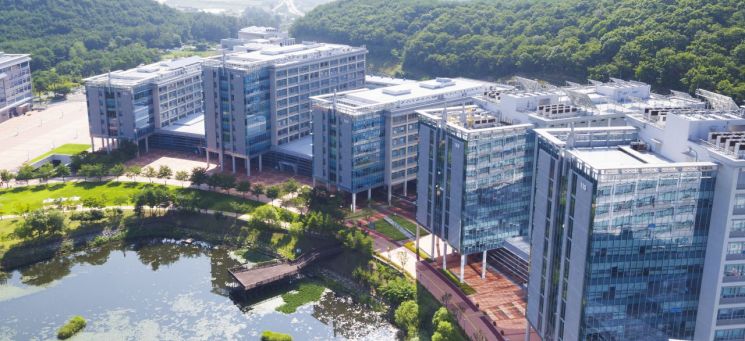
[Asia Economy Yeongnam Reporting Headquarters Reporter Hwang Du-yeol] How much has UNIST contributed to the development of Ulsan?
Data evaluating the effects of UNIST on Ulsan’s science and technology innovation, employment, and startup companies since its establishment has been released.
According to the data, UNIST has elevated Ulsan’s science and technology innovation capacity to 5th place nationwide, created more than 20,000 new jobs in Ulsan, and increased the number of companies related to UNIST’s research fields in the Ulsan area by 30%.
Additionally, it generates nearly 400 billion KRW in production and value-added effects annually in the Ulsan region, and the value of 66 startups established by 2020 is estimated at 540 billion KRW.
According to the “2021 Regional Science and Technology Innovation Capacity Evaluation” published by the Korea Institute of S&T Evaluation and Planning (KISTEP), Ulsan’s Regional Science and Technology Innovation Capacity Index (R-COSTII) composite score is 10.834 points, ranking 5th nationwide.
Ulsan, which was ranked 15th nationwide and near the bottom in 2010, has jumped to the upper ranks. In 2010, Ulsan scored 6.195 points, ranking 15th among 16 local governments.
In 2013, it rose to 9th place nationwide, reaching the mid-tier, and from 2017 onward, it fluctuated between 5th and 6th place, climbing to the upper ranks. The report cites the “proportion of science and engineering PhDs” as the key factor.
2013 was when UNIST began producing graduates with master’s and doctoral degrees in research personnel.
Ulsan’s strong indicators include “number of papers/citations per researcher (3rd place),” “number of papers/patents per 10,000 population (4th place),” and “proportion of science and engineering PhD graduates compared to the same age group population (5th place).”
From 2009 to 2020, UNIST filed and registered a total of 6,395 patents, raising Ulsan’s R-COSTII evaluation index.
Domestic patents include 3,398 applications and 1,872 registrations, totaling 5,270, while overseas patents include 907 applications and 218 registrations, totaling 1,125.
UNIST’s patent performance overwhelmingly surpasses other institutions in the Ulsan area. According to the Intellectual Property Statistics Service, in 2019, UNIST’s patent performance in Ulsan was 388 cases, more than the combined total of the 2nd, 3rd, and 4th ranked institutions.
Not only patents but also technology transfers and startup achievements are outstanding.
From 2009 to 2020, technology transfer achievements reached 130 cases, with a monetary value of 10.182 billion KRW.
During this period, 66 companies were founded, with an estimated value of 538 billion KRW. As of 2020, these startups employed 620 people and had total sales of 59.7 billion KRW.
The establishment of UNIST also contributed to job creation in Ulju-gun.
According to a paper published in 2021 by Professor Lee Jong-kwan of Ewha Womans University, the number of companies in industries closely related to UNIST’s research fields increased by 30% between UNIST’s founding and 2016.
In contrast, industries with low relevance to UNIST’s research fields showed no significant change in the number of companies. The establishment of UNIST led to the creation of new companies and jobs in the region.
In the 2018 paper “The Impact of University Campuses on Local Labor Markets (KDI Policy Research Series),” Professor Lee estimates that the establishment of UNIST created 21,835 new jobs.
The report analyzes that the employment creation effect was significant in manufacturing due to UNIST’s establishment, and service sector employment also increased due to rising local demand.
There is also an analysis of the economic ripple effect based on UNIST’s direct operating expenses of 310.6 billion KRW in 2020.
According to the results, UNIST generated 259.8 billion KRW in production inducement effects and 120.5 billion KRW in value-added inducement effects for Ulsan City. Employment inducement effects were analyzed at 1,919 people.
The results were obtained using the “Tool for Economic Impact Analysis (TIMPAL),” developed by Professor Isaiah’s team from UNIST’s School of Management Science.
TIMPAL is a tool based on input-output models and regional industry input-output tables published by the Bank of Korea, which derives economic ripple effects such as production, value-added, and employment caused by UNIST’s annual expenditures related to education and research on the national and regional economies.
According to TIMPAL, UNIST’s nationwide production inducement effect is 561.3 billion KRW, value-added inducement effect is 249.2 billion KRW, and employment inducement effect is 4,905 people.
UNIST’s expansion of regional talent admissions contributes to preventing consumption leakage outside the Ulsan area. It is estimated that entering university generates 40 million KRW in consumption per person annually, which can be maintained as consumption within the Ulsan region.
In 2021, UNIST selected 70 talents from the Ulsan region, and the consumption leakage prevented by selecting local talents is estimated at about 2.8 billion KRW.
Students recruited nationwide reside and engage in activities in Ulsan for periods ranging from as short as 2 years (bachelor’s 4 years, master’s 2 years, doctorate 4 years) to over 10 years. Their consumption and other activities contribute directly and indirectly to Ulsan’s economy.
The future income value of 908 UNIST graduates in 2020 is analyzed at 575 billion KRW, and the estimated future income value of a total of 5,646 UNIST graduates from 2012 to 2020 reaches 3.5418 trillion KRW.
UNIST President Lee Yong-hoon said, “We will continue to enhance the region’s science and technology innovation capacity and become an institution that economically benefits the region through employment creation and startups, to repay the support we have received from the Ulsan community.”
© The Asia Business Daily(www.asiae.co.kr). All rights reserved.
![Clutching a Stolen Dior Bag, Saying "I Hate Being Poor but Real"... The Grotesque Con of a "Human Knockoff" [Slate]](https://cwcontent.asiae.co.kr/asiaresize/183/2026021902243444107_1771435474.jpg)
















