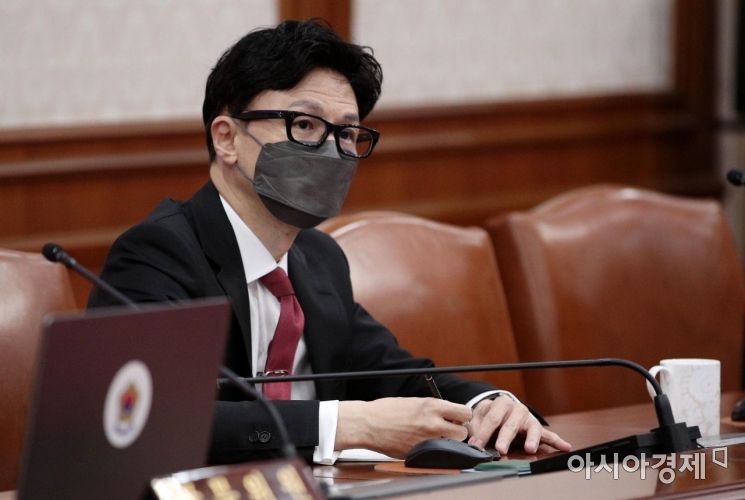
 Minister of Justice Han Dong-hoon is attentively listening to Prime Minister Han Duck-soo's opening remarks during the Cabinet meeting held via video conference between the Government Seoul Office in Jongno-gu, Seoul, and the Sejong Government Complex on the 14th. Photo by Kim Hyun-min kimhyun81@
[Asia Economy Reporter Hwang Sumi] The debate over the Ministry of Justice Minister Han Dong-hoon's proposed plan to lower the minimum age for "criminally responsible juveniles" is heating up. While some argue that criminal punishment should be enforced as juvenile crime becomes more serious, others point out that preventing recidivism should take priority by improving the environment, such as innovating the facilities and educational programs of protective disposition enforcement agencies. Meanwhile, the National Human Rights Commission of Korea (NHRCK) is reportedly opposed to the plan in practice.
According to Yonhap News on the 17th, the NHRCK decided at the Standing Committee meeting held on the 14th to refer the agenda item titled "Opinion on lowering the age of criminal responsibility and criminally responsible juveniles" to the plenary committee meeting scheduled for early next month.
Criminally responsible juveniles are youths aged 10 or older but under 14 who commit criminal acts. They are considered criminal minors and receive protective dispositions under the Juvenile Act instead of criminal punishment. Types of juvenile protective dispositions include transfer to juvenile detention centers, attending educational courses, and community service orders.
However, as dissatisfaction with the severity of juvenile crime has increased recently, voices calling for revision of the criminally responsible juvenile law have emerged. In particular, Minister Han Dong-hoon formed the "Task Force for Realigning the Age Criteria for Criminally Responsible Juveniles" last month and is pushing the plan to lower the age as a key agenda. Lowering the age means that youths aged 12 or 13 could be subject to criminal punishment. Minister Han reportedly asked the relevant departments to review the plan.
According to a report from the NHRCK's Child and Youth Human Rights Division, currently, seven bills each to amend the Criminal Act and Juvenile Act to lower the age of criminal responsibility below 14 have been submitted to the National Assembly. Unlike in the past, children's development has accelerated, and juvenile violent crime is increasing; the main rationale is that focusing only on correction to fix wrongful behavior instead of punishment has no crime prevention effect.
In fact, according to the National Police Agency, the number of juvenile violent crimes in 2021 was recorded at 8,474 cases. This figure showed a similar trend with 6,282 in 2017 and 6,014 in 2018, then increased to 7,081 in 2019. In 2020, it remained at 7,535, but increased by nearly 1,000 cases within a year.

Regarding this, the NHRCK's Child and Youth Human Rights Division holds the position that environmental improvement should be prioritized over harsh punishment. The NHRCK stated, "Child crimes should be handled through rehabilitation and restorative justice, so punitive measures are difficult to justify." They added, "The continuous increase in juvenile recidivism rates indicates that the correction and rehabilitation system is not functioning properly, so such systems need to be strengthened."
They also rebutted that even if children mature physically faster than before, it is hard to say their discernment has increased, and there is no scientific evidence to prove this. They cited the fact that the United Nations (UN) Committee on the Rights of the Child encourages raising the age of criminal responsibility to 14 or older as another reason for opposition.
Furthermore, they reported to the Standing Committee that the proposed legislative amendments submitted to the National Assembly do not align with international human rights standards aimed at social reintegration and recovery of juveniles, and expressed the opinion that institutional improvements such as expanding correctional facilities and probation officers are necessary to the Speaker of the National Assembly and the Minister of Justice.
Standing Committee members also agreed that the government's current move to lower the minimum age for criminally responsible juveniles is undesirable and that a new expression of opinion is needed. However, to add weight to the opinion, they decided to refer the agenda to the plenary committee, which includes non-standing members, rather than passing it in the Standing Committee. They also judged that since juvenile crime is becoming more violent, it is necessary to supplement related investigation data before expressing an opinion.
Meanwhile, experts have previously pointed out that education aimed at reducing the likelihood of recidivism is necessary rather than punishment regarding lowering the age of criminal responsibility. Psychiatrist Dr. Oh Eun-young appeared on MBC Radio's "Kim Jong-bae's Focus" on the 20th of last month and said, "The Juvenile Act places great importance on adults properly educating and guiding children, so the role of parents of criminally responsible juveniles seems very important."
Dr. Oh added, "All parents and adults should clearly and firmly teach children when they do something wrong. Being a criminally responsible juvenile does not mean the act is not a crime. It is a deferral because they are young, so adults' attitudes and parents' clear awareness that such behavior is unacceptable must be properly taught to children."
© The Asia Business Daily(www.asiae.co.kr). All rights reserved.
!["The Woman Who Threw Herself into the Water Clutching a Stolen Dior Bag"...A Grotesque Success Story That Shakes the Korean Psyche [Slate]](https://cwcontent.asiae.co.kr/asiaresize/183/2026021902243444107_1771435474.jpg)

















