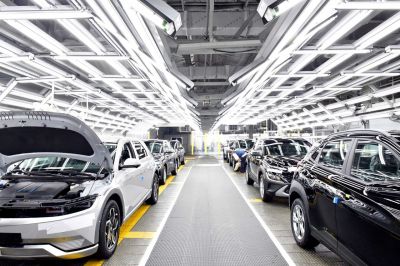
 Hyundai Motor Company and Kia Announce Large-Scale Investment in Domestic Electric Vehicle Sector.
 [Image Source=Yonhap News]
[Asia Economy Reporter Jang Hyowon] The proportion of eco-friendly vehicles in South Korea's automobile exports has surpassed 30% for the first time based on value. This is supported by the global trend of carbon neutrality, stricter emissions regulations, and increased demand for eco-friendly vehicles due to high oil prices. This is expected to further boost demand for lightweight materials for automobiles, especially in developed countries.
Hyundai Motor Company has declared itself a 'First Mover' in the electric vehicle era and aims to continuously expand its electric vehicle lineup, targeting sales of more than 1.8 million electric vehicles globally by 2030.
Recently, Hyundai announced plans to build a new factory in South Korea for the first time in 29 years. The plan is to make the domestic factory a core base for electric vehicle production, and the new plant is expected to be a global-level electric vehicle mass production facility. This decision is part of Hyundai Motor Group's plan announced in May to invest 63 trillion won domestically by 2025, of which 21 trillion won will be allocated to the domestic electric vehicle sector.
Hyundai plans to increase the domestic electric vehicle sales ratio from 6% last year to 45% by 2030. To achieve this, Hyundai and Genesis will expand their electric vehicle lineup from six models this year (three Hyundai models and three Genesis models) to more than 13 models by 2030 (six Hyundai models and seven Genesis models), including the Ioniq 6.
According to the Korea International Trade Association, automobile export value from January to May this year totaled $20.415 billion. Among this, eco-friendly vehicle (electric + hybrid) export value reached $6.198 billion, accounting for 30.4%. By country, exports to the United States exceeded $2.3 billion, the highest amount. Hyundai and Kia's electric vehicle market share in the U.S. ranks second only to Tesla.
With Korean-made eco-friendly vehicles receiving favorable reviews overseas, the export growth trend is expected to continue for the time being. As a result, stocks related to vehicle lightweighting, which is key to improving electric vehicle product competitiveness in terms of 'driving range' and 'driving performance,' are attracting attention.
Recently, electric vehicle manufacturers have been focusing on reducing vehicle weight. The lighter the vehicle, the higher the energy efficiency and the lower the emissions.
Electric vehicles inevitably weigh more than internal combustion engine vehicles due to the use of batteries and motors. According to the Korea Automotive Technology Institute, reducing the curb weight of a passenger car weighing 1,500 kg by about 10% improved fuel efficiency by 4-6% and acceleration performance by 8%. It also resulted in shorter braking distance, enhanced steering capability, extended chassis durability, and reduced emissions.
For electric vehicles, safety is as important as lightweighting. Hyundai Motor Group applies aluminum extrusion materials to protect the sides of the battery installation space, while Tesla uses different ratios of aluminum materials for each electric vehicle model to achieve lightweighting. The aluminum used by both companies is about 20-30% lighter than conventional steel.
Electric vehicles contain an average of 250 kg of aluminum, which is more than 70 kg heavier than internal combustion engine vehicles. Aluminum is known to be increasingly demanded as an alloy replacing steel for lightweighting electric vehicle batteries and improving fuel efficiency.
In South Korea, companies related to aluminum for vehicle lightweighting include Central Motec and Daecho AL.
Central Motec, established in 1994, is an automotive parts manufacturer producing lightweight aluminum control arms (components connecting the vehicle body and wheels). These aluminum control arms are supplied to Hyundai and Kia. Central Motec also has partnerships with global electric vehicle companies such as Tesla, Byton, Lucid, and Rivian.
Daecho AL is the only domestic company producing aluminum rolled sheets for vehicle lightweighting. Daecho AL's aluminum coils and sheets are used as industrial materials for secondary batteries and automotive parts. Daecho AL has developed and supplied aluminum materials for Hyundai's vehicle lightweighting and is known to supply heat protectors. Sales from electric vehicle battery cases and vehicle lightweighting account for 60% of Daecho AL's total revenue.
According to global consulting firm McKinsey, the proportion of lightweight materials, which was 29% in 2010, is expected to more than double to 67% by 2030. The share of mild steel in the automotive industry is expected to decrease by more than 50% within 10 years. Furthermore, the global market for lightweight materials for automobiles is projected to grow from $89 billion (approximately 118 trillion won) in 2019 to $157.8 billion (approximately 209 trillion won) by 2027, showing an average annual growth rate of 7.4%.
© The Asia Business Daily(www.asiae.co.kr). All rights reserved.
![Clutching a Stolen Dior Bag, Saying "I Hate Being Poor but Real"... The Grotesque Con of a "Human Knockoff" [Slate]](https://cwcontent.asiae.co.kr/asiaresize/183/2026021902243444107_1771435474.jpg)
















