Won-Dollar Exchange Rate Hits Highest Level in Over 13 Years and 2 Months
Won Value Declines Despite Big Step... Strong Dollar Intensifies
Import Prices Rise, Negatively Impacting Inflation
Calls for Korea-US Currency Swap Grow, But Difficult
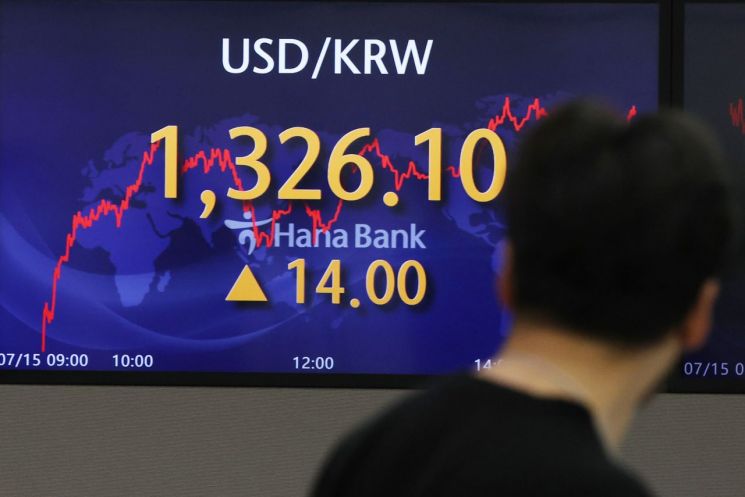 On the afternoon of the 15th, the won-dollar exchange rate was displayed on the electronic board in the dealing room of Hana Bank in Myeongdong. On that day, the won-dollar exchange rate closed at 1,326.1 won, up 14.0 won. [Image source=Yonhap News]
The won-dollar exchange rate has surged to its highest level in 13 years and 2 months, increasing concerns about the domestic economy. As the exchange rate rises, import prices increase, which is expected to further exacerbate the already unstable inflation. In the market, voices are calling for measures such as a Korea-US currency swap in light of US Treasury Secretary Janet Yellen's visit to Korea, but this is also expected to be difficult.
According to the financial and foreign exchange markets on the 16th, the value of the dollar has soared due to accelerated US monetary tightening, leading to a significant depreciation of major currencies including the Korean won. On the previous day in the Seoul foreign exchange market, the won-dollar exchange rate started trading at 1,318 won, rose to 1,326.7 won during the session, and closed at 1,326.1 won. This closing price is the highest level since April 29, 2009 (1,340.7 won), marking the highest in 13 years and 2 months.
The surge in the won-dollar exchange rate is due to the sharp decline in the value of the won against the dollar. As the US Consumer Price Index (CPI) inflation rate reached an all-time high in 41 years, the Federal Reserve (Fed) is expected to implement a giant step (a 0.75 percentage point increase in the benchmark interest rate), strengthening the preference for the dollar. Concerns about a recession due to the Ukraine crisis are also contributing to the dollar's dominance.
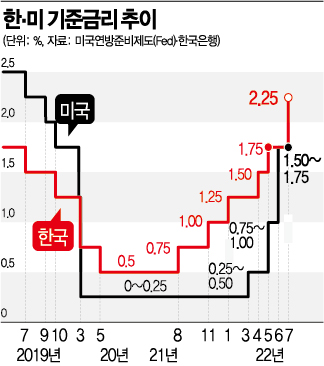
The Bank of Korea's Monetary Policy Committee raised the benchmark interest rate by a big step (0.50 percentage points) for the first time on the 13th, as domestic consumer inflation reached the 6% range and concerns about capital outflows due to the interest rate differential between Korea and the US increased, but this seems insufficient. With rising international oil prices and various raw material costs combined with the exchange rate increase, inflation is expected to worsen, making the economy more difficult for ordinary citizens.
The foreign exchange authorities are releasing foreign exchange reserves to reduce volatility and defend the won's value, but this is also difficult to sustain for long. As of the end of June, South Korea's foreign exchange reserves stood at 438.28 billion dollars, down 9.43 billion dollars from the end of the previous month. This is the lowest level in 1 year and 7 months since November 2020. The decline was due to the strong dollar reducing the valuation of foreign currency assets composed of other currencies, as well as the extensive use of foreign exchange reserves to defend the won's value.
The Bank of Korea stated, "Considering our economic situation, the current foreign exchange reserves are at a level sufficient to respond to external shocks," but experts pointed out that it is hard to be reassured as the current account surplus is shrinking significantly. They explained that if the global economy falls into recession and semiconductor exports are hit, problems with foreign exchange reserves could arise. Especially for South Korea, where the proportion of foreign stock investment is high and security risks are increasing, sufficient foreign exchange reserves are important.
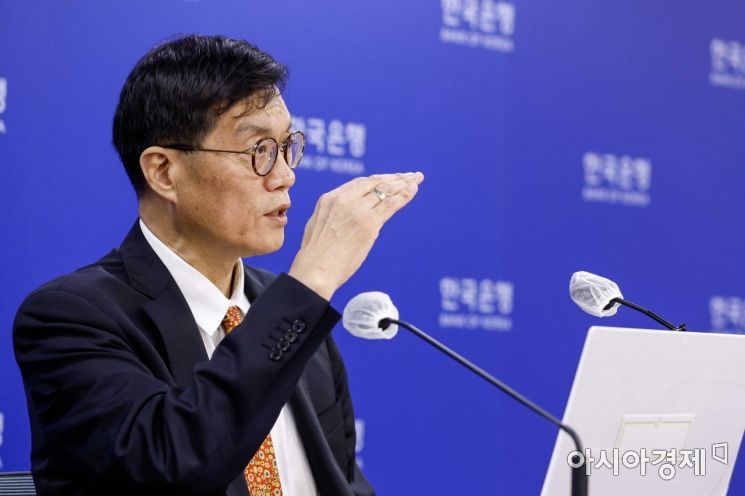 Bank of Korea Governor Lee Chang-yong is answering questions from the press at the Monetary Policy Direction press conference held at the Bank of Korea in Jung-gu, Seoul on the 13th. Photo by Kang Jin-hyung aymsdream@
Accordingly, voices in the political and market sectors are growing for the resumption of the Korea-US currency swap. Kim Tae-nyeon, chairman of the Democratic Party's Special Committee on Economic Crisis Response, said at a recent meeting with the four major commercial banks, "We need to properly inform that we have also invested in the US so that a standing currency swap agreement can be concluded," and added, "I ask Deputy Prime Minister Choo Kyung-ho and Governor Lee Chang-yong to meet with US congressional officials and work to create a favorable atmosphere."
Governor Lee Chang-yong of the Bank of Korea also said at a press conference held immediately after the Monetary Policy Committee meeting on the 13th, "When President Joe Biden visited Korea last time, the two leaders said they would consider various measures to stabilize the foreign exchange market, so I expect discussions about that will naturally take place during Deputy Prime Minister Choo Kyung-ho's meeting with Treasury Secretary Yellen."
However, many expect that concluding a Korea-US currency swap agreement will not be easy. In particular, the possibility of establishing a standing currency swap with the five countries the US has agreements with? the UK, Japan, the European Union, Switzerland, and Canada?is close to zero. Governor Lee also expressed caution about the possibility of resuming the Korea-US currency swap due to the current exchange rate instability, saying, "The Korea-US currency swap in 2008 was aimed at stabilizing emerging and major countries, including Korea, when the global financial market was shaken."
© The Asia Business Daily(www.asiae.co.kr). All rights reserved.
![Clutching a Stolen Dior Bag, Saying "I Hate Being Poor but Real"... The Grotesque Con of a "Human Knockoff" [Slate]](https://cwcontent.asiae.co.kr/asiaresize/183/2026021902243444107_1771435474.jpg)













