After Albanyji Prime Minister's Inauguration, COVID-19 Quarantine Support Fund Abolished but Recent Surge in Cases
Korean Situation Similar to Australia...Cases Increasing but Self-Quarantine Support Fund Reduced
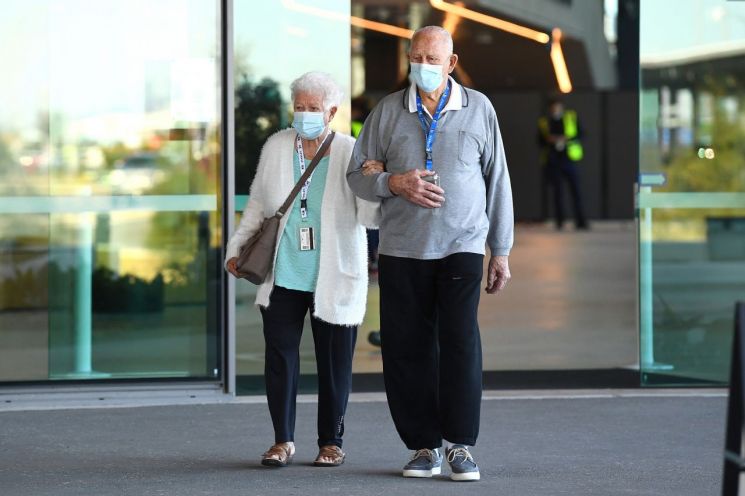
[Asia Economy Intern Reporter Kim Se-eun] Voices are growing louder in Australia, where self-quarantine support measures have been discontinued, urging the government to resume the payment of support funds.
According to local media and major foreign news outlets on the 15th (local time), the Australian government abolished the self-quarantine support fund system on the 30th of last month.
The Australian government introduced the self-quarantine support fund system during the previous administration to support non-regular workers who could face economic instability, providing AUD 750 (approximately KRW 670,000) per week. As of the end of last year, about 2.4 million people had received the support funds.
However, the current government led by Prime Minister Albanese abolished the system citing fiscal deterioration. According to the UK Guardian, Tim Watts, Assistant Minister for Foreign Affairs, stated, "The support was already planned to end under the previous government," and argued that the government must resolve the AUD 1 billion (KRW 900 billion) debt left by the former administration.
Prime Minister Albanese also emphasized during his visit to Fiji, a Pacific island nation, to attend the Pacific Islands Forum (PIF), saying to reporters, "Along with the policy, a debt worth trillions of dollars was also passed on. The new government cannot be responsible for this debt."
However, recently in Australia, the number of confirmed cases has surged as the highly transmissible Omicron subvariants BA.4 and BA.5 spread.
Australian health authorities also announced that millions of additional cases could occur within weeks. Both opposition parties and labor groups, small business owners, hospitality sectors, and corporate organizations have strongly demanded the reinstatement of support funds, criticizing the government for abolishing the self-quarantine support policy.
Meanwhile, South Korea has similarly discontinued support for COVID-19 home treatment costs and reduced quarantine support.
On the 24th, the Central Disaster and Safety Countermeasures Headquarters announced that the "quarantine situation is stable," and from the 11th of this month, COVID-19 patients in quarantine must bear the costs of treatment and medication for home care themselves.
Until now, COVID-19 confirmed patients only paid about KRW 5,000 for testing. However, with the system reform, individuals must now cover treatment and medication costs for home care, outpatient, and non-face-to-face consultations. Only relatively expensive oral antiviral drugs, injections, and hospitalization costs continue to be supported by the government as before.
The self-quarantine living support fund, which was previously paid to all confirmed patients, is expected to be reduced to about half. Previously, support was provided regardless of income, but from the 11th, support funds will only be given to households with median income at or below 100%. For a four-person household, the monthly income must be KRW 5,121,000 or less, and for a single-person household, KRW 2,234,000 or less, based on 120% of the calculated insurance premium, to be eligible for the living support fund this year.
The problem is that after a period of calm, the COVID-19 outbreak has shifted to a resurgence phase with 40,000 new daily confirmed cases. Moreover, on the 14th, an infection case of BA.2.75 (Centaurus), known to be 3.24 times more transmissible than existing variants, was discovered, heightening tensions surrounding the resurgence.
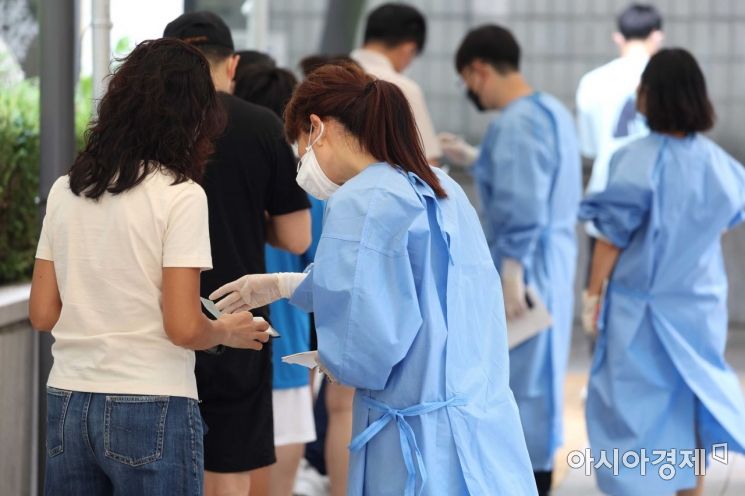 On the 15th, as the spread of COVID-19 continued, the screening clinic at Seocho-gu Public Health Center in Seoul was crowded with citizens seeking testing. Photo by Mun Ho-nam munonam@
Meanwhile, some express concerns that the reduction of support funds may lead to COVID-19 suspected patients avoiding testing.
Professor Eom Jung-sik of Gachon University Gil Medical Center said, "A significant number of infected individuals may not be able to maintain their livelihood without support funds," and urged, "Since this is a matter directly related to public health and life, it requires careful consideration."
© The Asia Business Daily(www.asiae.co.kr). All rights reserved.
![Clutching a Stolen Dior Bag, Saying "I Hate Being Poor but Real"... The Grotesque Con of a "Human Knockoff" [Slate]](https://cwcontent.asiae.co.kr/asiaresize/183/2026021902243444107_1771435474.jpg)

















