Creation of Water and Rest Spaces Including 212m 'Historical Waterway' from Joseon Foundation to Present, 77 Water Streams 'Tunnel Fountains'
On-site Exhibition of Yukjo Street Remains and Cultural Assets Unearthed During Construction at 'Saheonbumun Site'...Enhancing Historicity
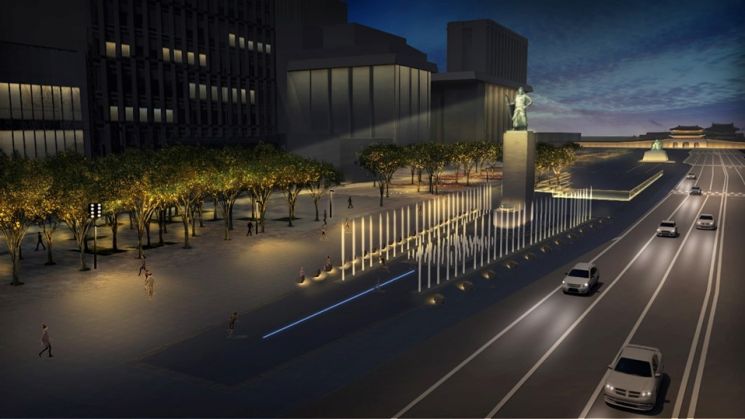
[Asia Economy Reporter Lim Cheol-young] ‘Gwanghwamun Square,’ the historical and cultural center space of the Republic of Korea, is being reborn as a park-like square rich in forests and shade, and will return to the citizens on the 6th of next month. ‘Gwanghwamun Square’ will be more than twice as large as before, with one-quarter of the square’s area filled with green space.
The ‘Hangeul Fountain,’ which creates consonants and vowels with streams of water, and the ‘Myeongnyang Fountain’ in front of Admiral Yi Sun-sin’s statue, will be developed as spaces that recall King Sejong’s people-centered spirit and Admiral Yi Sun-sin’s leadership, while also providing a cool water play area during the hot summer. Some of the relics and buried cultural assets, including the ‘Sahyeonbu Gate site’ excavated during construction, will be exhibited on-site in their original excavated state, allowing visitors to vividly experience the traces of Yukjo Street.
On the 17th, Seoul City announced that the construction of ‘Gwanghwamun Square’ will be completed within this month and will reopen on the 6th of next month. It has been 1 year and 9 months since the groundbreaking. The current progress rate is 91%. Following the supplementary and development plan for Gwanghwamun Square announced by Mayor Oh Se-hoon in June last year, Seoul City has been promoting the redevelopment of Gwanghwamun Square with a focus on ?strengthening historicity ?enhancing historical and cultural storytelling ?activating connections around the square.
Gwanghwamun Square has been designed as a park-like square where forest and water harmonize and provide rest, with various water features, seating areas, and stands created throughout the square as resting spaces. In front of Sejongno Park, a 212-meter-long ‘Historical Water Path’ has been created to add freshness. It is a historical and cultural storytelling space engraved with the history from the founding of Joseon in 1392 to the present year by year. In front of Sejong Center for the Performing Arts, a 40-meter-long ‘Tunnel Fountain’ made up of 77 streams of water and the ‘Hangeul Fountain,’ which embodies the principles of the creation of Hangeul, have been installed, expected to become a water play area for children visiting the square.
Since its initial creation in 2009, the historicity of Gwanghwamun Square, which Seoul City has emphasized the most, will be further strengthened through this reopening. The ‘Sahyeonbu Gate site’ (in front of Sejongno Park), excavated during the construction of Gwanghwamun Square, will be developed into an on-site exhibition hall (20m×20m) where some relics such as wells and drainage channels can be viewed vividly in their original excavated state.
All relics such as the Samgunbu site (in front of the Government Complex), Byeongjo site (in front of Sejongno Park), and Hyeongjo site (in front of Sejong Center for the Performing Arts) will be preserved in situ, and fences and drainage channels will be recreated above the relics so that visitors can encounter the traces of Yukjo Street, which had only been imagined until now. Additionally, major historical and cultural resources of Gwanghwamun Square, loved by citizens such as the King Sejong statue and Admiral Yi Sun-sin statue, will be upgraded into more attractive places by enhancing storytelling and various attractions.
Behind the King Sejong statue, a ‘Media Glass’ made of glass structures will be installed at the entrance of ‘Sejong Story.’ During the day, it will provide openness to make the entrance more visible, and at night, it will display various media art through the ‘Media Glass,’ offering visual attractions. Content featuring the achievements of King Sejong and Admiral Yi Sun-sin, Hallyu content such as Taekwondo, and artworks by emerging artists will be displayed, with new content broadcast regularly.
In front of Admiral Yi Sun-sin’s statue, the ‘Myeongnyang Fountain’ will be created, where visitors can feel Admiral Yi Sun-sin’s leadership and humanity. Victory monuments inscribed with Admiral Yi Sun-sin’s major battle achievements and sayings will be installed on both sides of the ground fountain, and lighting will be added at night to provide a magnificent night view.
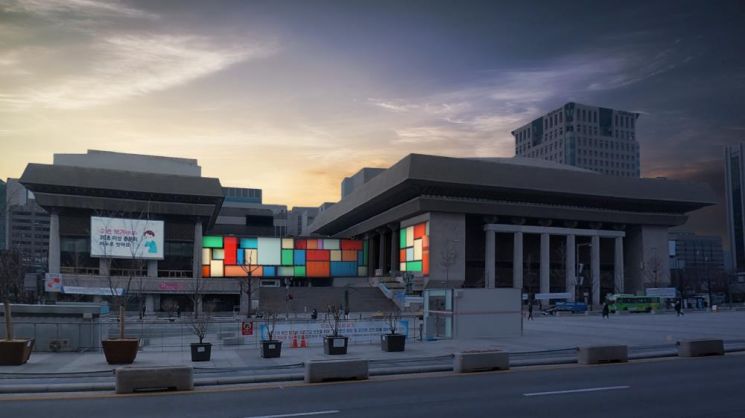
Furthermore, Seoul City will present diverse cultural and nightscape content in connection with the surroundings of Gwanghwamun Square. A 53-meter-long ‘Video Window (Media Wall)’ will be installed on the concrete sloped wall that was in ‘Haechi Madang’ in front of Sejong Center for the Performing Arts. Media facades will also be installed on the remodeling construction barriers of Sejong Center for the Performing Arts and the KT Building, which face each other across ‘Haechi Madang,’ offering a splendid night view.
With the opening of Gwanghwamun Square, media art works themed ‘Raonhaje’ (a pure Korean word meaning ‘joyful tomorrow’) and the coolness of summer nights will be exhibited on the walls of the Chamber Hall and Grand Theater of Sejong Center for the Performing Arts. On the KT Building construction barriers, immersive media art and media facade content introducing Korea’s nature and culture will be displayed.
Meanwhile, Seoul City will also establish ‘operational standards’ for the convenient and comfortable use of the square by citizens. The areas permitted for square use for cultural events are set to two places: ?‘Yukjo Madang’ on the north side of the square (lawn area, 2,492㎡) and ?‘Nori Madang’ in front of the King Sejong statue (2,783㎡). These are similar in size and location to the previous square use permission areas to minimize inconvenience to citizens.
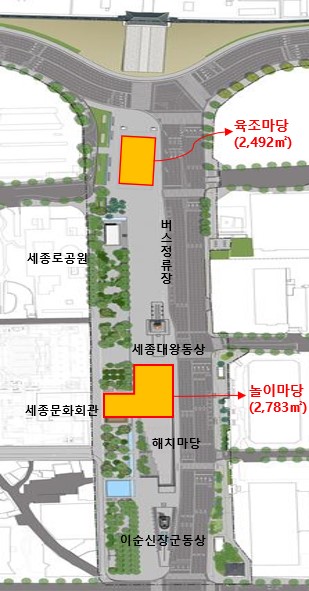
Use of the square through application permission will be possible from the 22nd of next month, and applications can be submitted from the 8th of next month on the Gwanghwamun Square website.
Yeo Jang-kwon, head of Seoul City’s Balanced Development Headquarters, said, “Since the founding of Joseon, ‘Gwanghwamun Square,’ the center of the nation and symbol of the capital Seoul, has remained by our side as a place of history connecting past and present, a cultural space linking people and art, and a forum for exchanging diverse opinions.” He added, “With the addition of nature, greenery, and comfortable resting places, and the harmony of history and culture, we hope many citizens will fill Gwanghwamun Square, which will reopen, with meaningful footsteps.”
© The Asia Business Daily(www.asiae.co.kr). All rights reserved.



















