- KB Geumyung Research Institute Achieves First Place, Surpassing Commercial Real Estate Apartments
- Value of Commercial Facilities Expected to Rise Further Following Social Distancing Lift
In 2022, investment trends in the real estate market are undergoing a significant shift. For years, housing prices have skyrocketed, with residential properties and officetels (residential-use) leading the real estate market. However, recently, interest in commercial real estate has also been rising.
Commercial real estate is not classified as housing, so it carries a much lighter tax burden. Additionally, loan qualification requirements are less stringent. While mortgage loans for housing face considerable restrictions on the number of loans per household and guarantee limits, non-residential loans for commercial facilities are relatively more flexible.
Similar results were found in the “2022 Korean Wealth Report” released earlier this year by Hana Bank’s Hana Financial Management Research Institute. Examining the real estate asset composition of individuals with assets exceeding 1 billion KRW last year, residential housing for living purposes accounted for 39%, and commercial real estate accounted for 38%, making up the majority. Considering that commercial real estate accounted for 34% in 2020, this represents an increase of about 4% in one year.
Meanwhile, many real estate experts expect the value of commercial facilities to rise further this year as social distancing measures are lifted and commercial districts become more active.
Amid the growing interest of asset owners in commercial real estate, the ‘Cheongju Central City’ complex commercial facility, located in a prime area of Cheongju, is now available for sale.
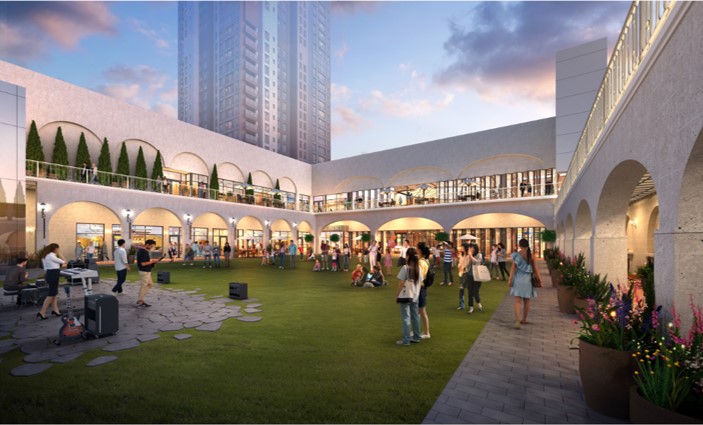
‘Cheongju Central City’ is a mammoth-scale complex commercial facility being built in the Gagyeong-dong area of Cheongju City. It will be established in two locations: ‘Central Square’ within the terminal complex and ‘Hills Avenue Central’ in the residential-commercial complex.
The terminal complex will be constructed with 7 basement floors and 49 above-ground floors, covering a total floor area of 166,149㎡. Part of the first floor of the terminal complex will be used as an express bus terminal, and from the first to the fifth floor, Hyundai City Outlet is planned to open. Megabox will be located on the 6th and 7th floors, along with Central Square (total floor area 8,786㎡). Escalators and elevators will be installed at key locations, allowing easy movement throughout the entire complex.
The ‘Hills Avenue Central’ complex commercial facility in the residential-commercial complex will be built from the first to the third floor above ground, with a total floor area of 10,830㎡. It can accommodate the stable demand from the residential units within the complex. Moreover, a connecting passageway to Hyundai City Outlet will be provided, enabling visitors to move between complexes without going outside.
Contractors of ‘Cheongju Central City’ can also reduce the financial burden caused by rising loan interest rates. Interest-free benefits on interim payments are offered, so there is little need to worry about financial costs until move-in. Furthermore, after moving in, there is a possibility of entering the ‘recovery phase,’ one of the four stages of the economic cycle.
The Cheongju Central City complex commercial facility offers a 10% down payment and 40% interest-free interim payment benefits. The interest-free interim payment reduces the initial burden on investors and prevents additional financial costs until completion, allowing investors to purchase commercial spaces at a lower cost even during periods of high interest rates and inflation.
‘Cheongju Central City’ is currently operating a sales promotion center.
© The Asia Business Daily(www.asiae.co.kr). All rights reserved.
![Clutching a Stolen Dior Bag, Saying "I Hate Being Poor but Real"... The Grotesque Con of a "Human Knockoff" [Slate]](https://cwcontent.asiae.co.kr/asiaresize/183/2026021902243444107_1771435474.jpg)
















