China's Q2 GDP Barely Positive at 0.4%... Second Worst on Record
State-Owned Enterprises Increase Fixed Asset Investment, Private Firms Slightly Up, Foreign Firms Negative
[Asia Economy Beijing=Special Correspondent Jo Young-shin] The costly bill for China's 'Zero (0) COVID (lockdown) policy' has arrived.
China's National Bureau of Statistics announced on the 15th that China's gross domestic product (GDP) growth rate for the second quarter of this year was preliminarily estimated at 0.4% year-on-year. This is the lowest level in more than two years since the minus (-) 6.8% in the first quarter of 2020 and the second worst result in history. The Chinese leadership's economic growth target for this year is 'around 5.5%.' The prevailing assessment is that achieving this year's economic growth target is virtually out of reach.
◆ Economic Growth Target Out of Reach = The Chinese economy seemed to rebound after hitting a peak of 18.3% in the first quarter of last year, then recording 7.9% in the second quarter, 4.9% in the third quarter, 4.0% in the fourth quarter, and 4.8% in the first quarter of this year.
What held back the Chinese economy was the resurgence of COVID-19 and the resulting lockdowns as part of the containment policy. To curb the COVID-19 resurgence that began at the end of March, Chinese authorities implemented unprecedented lockdowns in major cities such as Shanghai, causing the Chinese economy to start collapsing. The fact that the economy did not return to negative growth since the first quarter of 2020 is a relief, but the economy has significantly worsened.
Accordingly, China's GDP in the first half of the year grew by only 2.5% year-on-year. This is a huge 3.5 percentage points below the government target of 5.5%.
◆ Chinese Consumers Closed Their Wallets = The National Bureau of Statistics explained that China's per capita consumption expenditure in the first half of this year was 11,756 yuan. This is a 2.5% nominal increase compared to a year earlier. The real increase rate, excluding price factors, was 0.8%.
On the other hand, per capita disposable income in the first half of the year increased by 4.7% year-on-year to 18,463 yuan. The real increase rate, excluding price factors, was 3.0%. Income increased, but spending decreased. The reason why domestic demand inevitably stagnated was confirmed in household income and consumer expenditure items.
In particular, spending related to leisure such as education, culture, and entertainment recorded -7.4%, and clothing purchases also showed -2%. People refrained from unnecessary spending beyond basic living expenses.
Consumption expenditure in cities with higher income levels decreased by -0.9%, while rural areas with lower income levels recorded 4.0%. This phenomenon can only be interpreted as a result of the lockdowns.
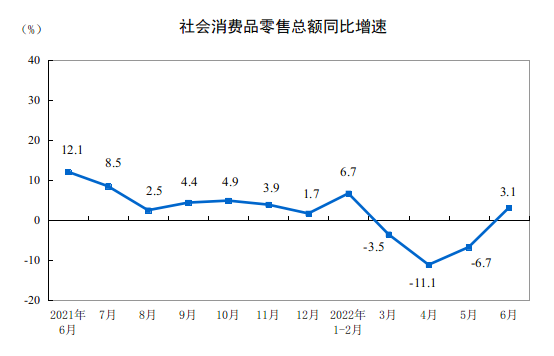
◆ Consumption Barely Turned Positive = The biggest victim of the containment policy was domestic demand (consumption). China's retail sales in June increased by 3.1% year-on-year. After three months of negative growth, it turned positive again.
Retail sales, a gauge of domestic demand, turned negative at -3.5% (year-on-year) in March, then -11.1% in April, and -6.7% in May. Although the decline narrowed as the COVID-19 spread was brought under control, it will take considerable time for consumer sentiment, once extinguished, to revive.
The hardest-hit areas were the economic capital Shanghai and the industrial and manufacturing regions near the Yangtze River Delta, including Jiangsu Province, Zhejiang Province, and Anhui Province. In Shanghai, social consumer goods sales decreased by -18.9% month-on-month in March, followed by -48.3% in April and -36.5% in May. The cumulative social consumer goods sales in May were -18.7% year-on-year. Although the Shanghai lockdown was lifted from June, it is impossible to make up for the negative figures in just one month.
The decline in consumption is also reflected in trade statistics. China's exports in the first half (January to June) increased by 13.2% year-on-year to 11.14 trillion yuan, but imports rose by only 4.8% (866 billion yuan).
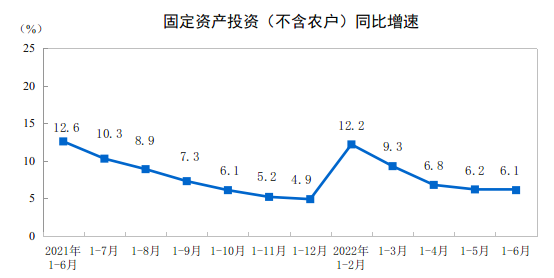
◆ Slow Pace of Fixed Asset Investment = In June, China's fixed asset investment increased by only 0.95% month-on-month.
Accordingly, fixed asset investment in the first half of the year increased by only 6.1% year-on-year. Although Chinese authorities instructed local governments to invest in infrastructure and other projects, investment did not increase due to lockdown measures.
By region, the central region increased by 10.7% year-on-year, the western region by 8.0%, and the eastern region by 4.5%. Investment in the northeastern region decreased by 0.9%. By industry, the primary industry increased by 4.0%, the secondary industry by 10.9%, and the tertiary industry by 4.0%.
By enterprise type, state-owned enterprises increased investment by 9.2%, while private enterprises increased by only 3.5%. Additionally, fixed asset investment by foreign-invested enterprises showed a negative growth of 2.9%.
Recognizing the seriousness of the situation, Chinese authorities are rushing to implement seven major projects, including expanding road networks, to stimulate the economy. They are also reportedly preparing additional fiscal policies, such as raising the issuance limits for special bonds allocated to local governments.
Within China, there is an open acknowledgment that if the economic growth rate enters the 4% range this year, it would be considered a success, reflecting preparations for the economic shock.
© The Asia Business Daily(www.asiae.co.kr). All rights reserved.


















