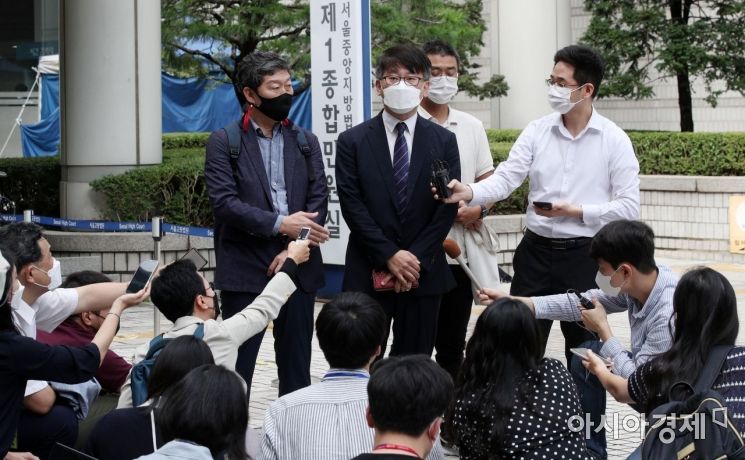
 Attorney Jeon Beom-jin (center) and Kim Young-hwan, Director of External Cooperation at the Institute for Research in Collaborationist Activities (left), among others, are answering reporters' questions after the verdict hearing of the lawsuit filed by the bereaved families of forced labor victims against Nippon Steel at the Seoul Central District Court in Seocho-gu on the 8th. The court ruled in favor of the defendant, stating, "The plaintiff's claim is dismissed." Photo by Kim Hyun-min kimhyun81@
[Asia Economy Reporter Hwang Yoon-joo] The public-private consultative council discussing compensation issues for victims of forced labor under Japanese colonial rule held its second meeting on the 14th, exchanging opinions on various contentious issues.
The Ministry of Foreign Affairs held the second meeting of the public-private consultative council in the afternoon, chaired by First Vice Foreign Minister Cho Hyun-dong, with participation from the victims' litigation representatives, support organizations, experts from academia, legal and economic sectors, and former diplomats.
While the first meeting was more of an introductory session where participants expressed their individual opinions, the second meeting involved more concrete discussions based on the issues previously identified.
According to the Ministry of Foreign Affairs, during the two-hour and twenty-minute meeting, discussions were held on three major topics: legal questions that may arise from a civil lawsuit perspective, the issue of Japan's apology, and the 'diplomatic protection' issue raised by the victims' litigation representatives.
The Supreme Court of Korea issued final rulings in October and November 2018 ordering Shin Nihon Seitetsu (New Japan Steel) and Mitsubishi Heavy Industries to compensate the victims of forced labor, but these defendant companies have not fulfilled their compensation obligations.
Accordingly, legal procedures for forced asset seizure (monetization) have progressed, and there are expectations that this could materialize as early as this fall. The public-private consultative council is discussing the three lawsuits for which the Supreme Court has issued final rulings.
At the meeting, it was reported that there was deliberation on the normative aspect that the responsibility of the Japanese defendant companies must be realized according to the Supreme Court rulings, and how to address the practical constraints such as Japan's uncooperative stance.
The victims who attended the first meeting had requested the government to make diplomatic efforts to facilitate direct negotiations with the Japanese perpetrator companies and called for the activation of diplomatic protection.
There were also a variety of opinions regarding the subject, method, and timing of Japan's apology. While the direct parties, Shin Nihon Seitetsu and Mitsubishi Heavy Industries, could initially be the subjects of the apology, an apology from the Japanese government might also be necessary.
To prevent monetization, it is practically necessary to create funds to be paid to the plaintiffs instead of the Japanese defendant companies' compensation, and this issue is expected to be a significant point of contention. However, even if a third party adopts the so-called 'subrogation' method by creating a fund and compensating on behalf of the defendants, the victims maintain that the participation of the defendant companies is a 'red line.'
On the other hand, some opinions were raised suggesting that since the Korean government, which previously received funds under the Claims Agreement, also bears moral responsibility, it might be worth considering a bold repayment by the Korean government in exchange for receiving an apology from Japan.
Whether all victims who received the Supreme Court's final rulings will agree to subrogation is also an issue. It is reported that the victims and others have expressed the opinion that the consent of the creditor plaintiffs is legally essential in the context of debt repayment by a third party.
Some victims have already declared non-participation. Support organizations and litigation representatives for grandmothers Yang Geum-deok and Kim Seong-ju, victims of forced mobilization as Mitsubishi Heavy Industries' comfort women, announced on the day that they have decided not to participate in the public-private consultative council.
© The Asia Business Daily(www.asiae.co.kr). All rights reserved.

















