"Burden of Interest Rate Hikes Should Not Be Passed to Socially Vulnerable... Will Actively Utilize Financial Resources"
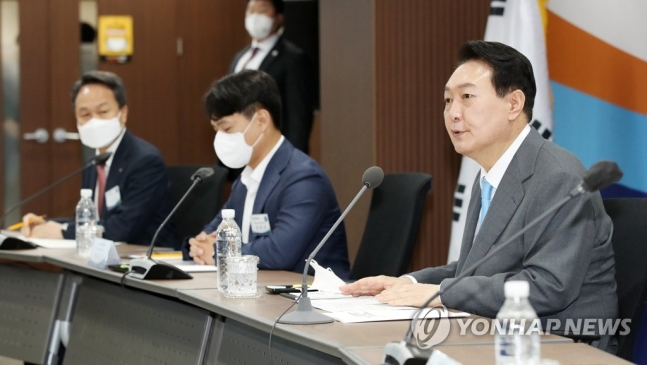 President Yoon Suk-yeol presided over the 2nd Emergency Economic and Livelihood Meeting on the morning of the 14th at the Integrated Support Center for Low-Income Finance in Jung-gu, Seoul. / Photo by the Presidential Office Press Photographers Group
[Asia Economy Reporter Baek Kyunghwan] On the 14th, President Yoon Seok-yeol stated, "If the economy of the common people collapses, the foundation of the national economy collapses," and announced that financial resources will be actively utilized to reduce the financial burden on ordinary citizens. This came in response to concerns that the burden on ordinary people would increase following the Bank of Korea's historic first big step (a 0.50 percentage point increase in the base interest rate) the previous day. He promised measures such as purchasing debts of small business owners to reduce repayment burdens and converting loans to low-interest loans.
On the same day, President Yoon visited the Central Integrated Support Center for Ordinary People’s Finance located at the Press Center on Taepyeong-ro, Jung-gu, Seoul. He directly listened to repayment difficulties from citizens present at the site and instructed Deputy Prime Minister and Minister of Economy and Finance Choo Kyung-ho and Financial Services Commission Chairman Kim Ju-hyun to promptly implement measures to alleviate debt burdens.
President Yoon’s visit was the first field action of the Emergency Economic and Livelihood Meeting, arranged to hear opinions from private experts and field workers and to discuss livelihood stabilization measures in response to rising interest rates.
At the Emergency Economic and Livelihood Meeting, President Yoon diagnosed, "In a situation where base interest rate hikes to curb inflation are taking place worldwide, the debt burden on vulnerable groups is increasing. Self-employed and small business owners, who inevitably had to increase loans due to COVID-19, ordinary citizens who took out all-in loans to purchase homes, and young people who borrowed to invest in stocks are all struggling with principal and interest repayments."
However, President Yoon emphasized, "That burden must not be passed on to socially vulnerable groups," and stated, "Although the interest rate hike is an inevitable measure to curb inflation, if the government does not proactively support, the social cost will ultimately increase."
To this end, President Yoon mentioned, "For small business owners struggling with repayments, the Asset Management Corporation will purchase loan claims and reduce burdens through maturity extensions and interest reductions." He also proposed measures for high-interest borrowers, saying, "We will lower burdens by converting loans to low-interest loans through guarantees from the Korea Credit Guarantee Fund," and presented ▲ interest reductions before delinquency occurs ▲ principal repayment deferrals ▲ burden relief through youth safe conversion loans ▲ interest rate reductions and long-term fixed-rate loan conversions for mortgage borrowers. Considering that the recent interest rate hike will increase the burden not only on salaried workers but also on self-employed people who have been holding on with debt, President Yoon urged, "Related agencies should pay special attention to ensure that the burden of high inflation and high interest rates is not passed on to ordinary people and vulnerable groups."
Following President Yoon’s directive to promote debt burden relief measures, the Financial Services Commission acted swiftly. On the same day, the FSC announced the ‘Financial Sector Livelihood Stabilization Promotion Plan,’ which includes establishing a new start fund worth 30 trillion won to purchase non-performing loans and implementing a low-interest refinancing program worth 8.5 trillion won to ease financial burdens on self-employed and small business owners. The plan also includes expanding the safe conversion loan by an additional 5 trillion won to reduce housing financial burdens, supplying 25 trillion won, and offering preferential benefits such as additional interest rate reductions for low-income youth. Additionally, support measures were included to reduce interest burdens on jeonse (long-term deposit) loans by expanding the low-interest jeonse loan guarantee limit from the existing 200 million won to 400 million won.
© The Asia Business Daily(www.asiae.co.kr). All rights reserved.
![Clutching a Stolen Dior Bag, Saying "I Hate Being Poor but Real"... The Grotesque Con of a "Human Knockoff" [Slate]](https://cwcontent.asiae.co.kr/asiaresize/183/2026021902243444107_1771435474.jpg)
















