Delivery Robots Expected to Lower Delivery Fees
Still Violating Four Current Laws
Commercialization Likely to Take Time Even with Regulatory Easing
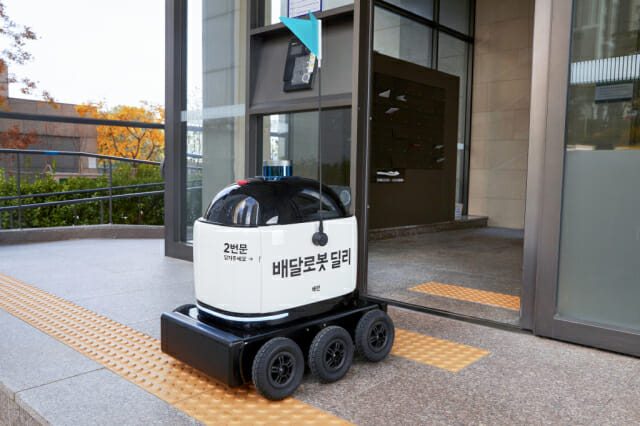
[Asia Economy Intern Reporter Lee Seohee] In July last year, Baedal Minjok launched an outdoor delivery-driving robot service. When a delivery person arrives at the apartment entrance and hands over the food to the robot, the robot takes the elevator and delivers the food right to the resident’s front door. This allows delivery workers to save time, and residents can receive their food without concerns about viruses or crime.
The delivery robot industry has rapidly grown over the past three years due to the increase in delivery orders caused by COVID-19 and the spread of contactless culture. However, there are still many challenges to overcome before delivery-driving robots can be fully commercialized, due to layered regulations and technical limitations.
◆ Expected Effects: Solving Delivery Worker Shortage and Lowering Delivery Fees
The anticipated benefits of commercializing delivery-driving robots are solving the ‘delivery worker shortage’ and ‘reducing delivery fees.’ Earlier this year, delivery agencies such as Saenggakdaero and Barogo faced difficulties in securing riders and raised delivery fees paid to delivery workers up to 10,000 KRW. It was explained that it was difficult to recruit enough delivery drivers compared to the surge in orders, which led to increased labor costs.
Accordingly, delivery platforms providing services through delivery agencies also raised their delivery fees. For Baedal Minjok’s ‘regular orders’ provided through delivery agencies, some stores set a minimum order amount of 10,000 KRW with delivery tips around 8,000 KRW. For ‘Baemin1,’ which provides services through its partner Baemin Riders, the maximum delivery fee was raised from 5,000 KRW to 6,000 KRW starting March this year, an increase of 1,000 KRW.
According to Statistics Korea, the transaction amount for food services increased more than twofold from 1.0557 trillion KRW in the second half of 2019 (before COVID-19) to 2.4505 trillion KRW in the second half of 2021 (after COVID-19). However, during the same period, the number of delivery workers only increased from 349,000 to 428,000, a 20% increase.
If delivery-driving robots are commercialized, delivery workers are expected to save about 5 to 6 minutes per order. If the delivery time per person decreases, companies can reduce labor costs accordingly, which could lead to lower delivery fees. This means delivery companies save on labor costs, and consumers save on delivery fees.
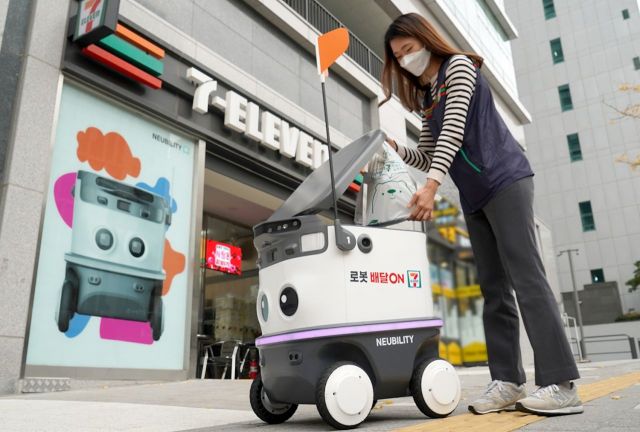
◆ Delivery Robots That Cannot Deliver... ‘Many Obstacles’ Until System Reform
However, there are many challenges to overcome before delivery-driving robots can be commercialized. The first step is to revise the layered regulations.
The laws currently blocking delivery-driving robots include the Road Traffic Act, the Enforcement Decree of the Act on Urban Parks and Green Areas (Park Green Area Act), the Act on the Development of Living Logistics Service Industry (Living Logistics Act), and the Personal Information Protection Act. Under current laws, delivery-driving robots are classified as ‘vehicles’ and are prohibited from traveling on sidewalks and crosswalks. Also, under the Park Green Area Act, which prohibits powered devices over 30kg from entering parks, delivery robots cannot operate in parks. In reality, there is almost no space outdoors where delivery-driving robots can move.
The Living Logistics Act limits transportation means to freight trucks and two-wheeled vehicles, thus not allowing robot delivery services. The Personal Information Protection Act is also problematic. Delivery-driving robots recognize obstacles while moving through cameras attached to their bodies, but the act prohibits transmitting or broadcasting recorded videos. Without revising these regulations, there is practically no way for delivery-driving robots to be used in daily life.
◆ Even with Regulatory Relaxation... ‘Lack of Technological Capability’ Is Also a Barrier
Even if regulations are relaxed, challenges remain. Currently, delivery-driving robots are only used on well-maintained flat surfaces or inside buildings. To move smoothly on complex roads and sidewalks, a high level of technological capability is required. For this reason, experts say it will take considerable time before delivery-driving robots are introduced into daily life.
Professor Shin Gyusik of Hanyang University’s Department of Robotics said, “Generally, artificial intelligence (AI) requires a much higher level of technology to move and navigate than to simply make judgments. If robots are immediately deployed in the environments where humans live now, their ability to control speed and elevation is insufficient, making practical use difficult. To commercialize delivery-driving robots, it is necessary to improve the robots’ mobility technology and create environments that facilitate robot movement,” he advised.
Meanwhile, on the 10th of last month, the government held a Regulatory Reform Committee meeting at the Government Seoul Office and finalized regulatory improvement plans in fields such as energy and new materials, unmanned mobility, information and communication technology (ICT) convergence, and biohealthcare. According to a press release from the Office for Government Policy Coordination, the government plans to amend the current Living Logistics Act to include robots and drones as transportation means and proceed with regulatory relaxation to commercialize delivery-driving robots.
© The Asia Business Daily(www.asiae.co.kr). All rights reserved.