Looking into What the National Pension Service Bought...
[Asia Economy Reporter Minji Lee] Amid the domestic stock market's zigzag movement due to recession concerns and tightening fears, the National Pension Service (NPS) has been accumulating shares in auto parts and defense stocks, where expectations for earnings improvement have increased.
According to the Financial Supervisory Service on the 12th, among the stocks in which the NPS disclosed holding more than 5% of shares from the 27th of last month to the 8th of this month, there were a total of 35 companies where the NPS increased its stake. Over the past two weeks, volatility in the domestic stock market has significantly expanded. On the 28th of last month, the index hovered around the 2400 level but plunged to the 2290 level on the 6th of this month, showing volatility of over 5%.
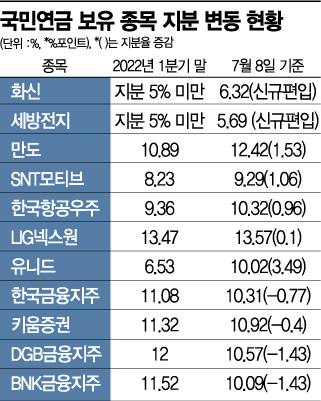
During the period of extreme volatility, the only new stock added by the NPS was Hwashin. On the 30th of last month, the NPS purchased about 2.16 million shares of Hwashin, securing a 6.21% stake. Hwashin is a major parts supplier for Hyundai Motor, producing key components for automotive steering systems. Besides Hwashin, the NPS also increased stakes in other auto parts companies such as Mando (10.89%→12.42%) and Hankook Connector (10.43%→11.14%). During this period, the NPS did not reduce or exclude other auto parts holdings and maintained stakes in Hyundai Wia (9.78%), Hyundai Mobis (9.5%), Myungshin Industrial (6.31%), and Hanon Systems (5%).
Auto parts stocks showed a different price trend compared to major domestic automakers Kia and Hyundai during the first half of the year. Although Hyundai Motor (-15%) and Kia (-5%) experienced declines since the beginning of the year, they outperformed the KOSPI's year-to-date return (-21%) by a wide margin, helping to cushion the drop in returns. This was largely due to increased production focused on high-margin models and inventory reduction in distribution channels, which sustained record-high earnings and boosted investor sentiment. In contrast, parts stocks such as Hanon Systems (-25%), Hankook Connector (-29%), and Hyundai Wia (-31%) sharply declined during the same period. This was due to cost pressures and reduced parts supply caused by production delays at automakers, which weighed on earnings.
The recent increased interest of the NPS in parts stocks is attributed to the gradual improvement in automakers' operating rates, leading production volumes to align more closely with sales. In particular, last week, China's Ministry of Commerce announced measures to revitalize automobile distribution, which is expected to benefit parts stocks with significant shipments to China. Researcher Kim Gui-yeon of Daishin Securities said, “If automakers' strong earnings continue, there is a high possibility of a bottom rebound in parts companies' earnings. Among parts companies, investing in those that have quickly recovered volumes based on portfolios with Chinese local OEMs and North American electric vehicle customers is promising.”
Additionally, the NPS increased investment in defense-related stocks such as Korea Aerospace Industries (9.36%→10.32%) and LIG Nex1 (13.47%→13.57%). The ongoing war between Ukraine and Russia has led to major countries strengthening their defense capabilities, raising expectations for increased overseas orders of various guided weapons including complete aircraft, Hyungung, Cheongung, and Shingung missiles, which positively influenced investment sentiment.
Conversely, among the stocks where the NPS adjusted its weight downward, securities and financial holding companies stood out. Major stocks included Korea Financial Group (-0.77%), Kiwoom Securities (-0.4%), BNK Financial Group (-1.43 percentage points), and DGB Financial Group (-1.43 percentage points). Amid rising interest rates and recession impacts causing instability in the financial market, concerns that securities firms' profit margins could shrink significantly compared to last year appear to have been reflected in investor sentiment. Researcher Choi Jung-wook of Hana Securities explained, “Financial stocks face renewed regulatory risks as supervisory authorities and political circles criticize excessive profit-seeking by banks. The simultaneous end of COVID-19 financial support and interest rate hikes in September are also increasing concerns about deteriorating asset quality.”
© The Asia Business Daily(www.asiae.co.kr). All rights reserved.

















