Tensions in Asia-Pacific Relations to Worsen if Japan Revises Constitution, US-Japan to Increase Pressure on China
Kishida to Modify 'Abenomics', Promote New Capitalism Policy Based on Growth and Distribution
[Asia Economy Beijing=Special Correspondent Jo Young-shin] Chinese state media expressed concern that Japan's ruling Liberal Democratic Party (LDP) will actively push for constitutional revision following its landslide victory in the House of Councillors (upper house) election.
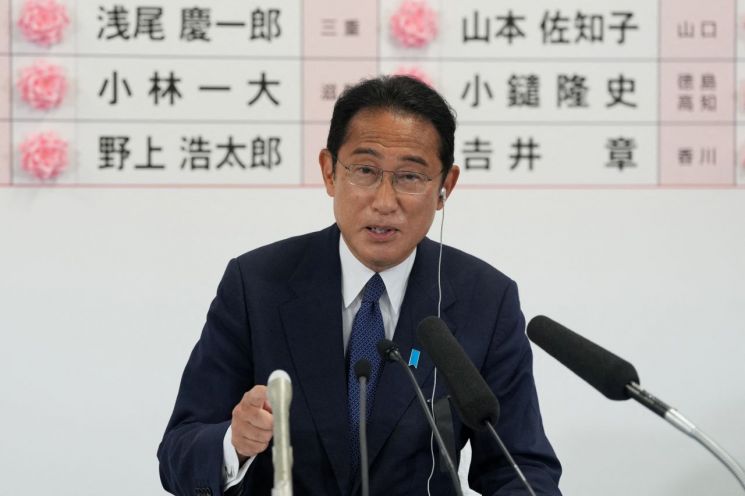
Huanqiu Shibao reported on the 11th that in the election held on the 10th, shortly after the assassination of former Japanese Prime Minister Shinzo Abe, the LDP and its coalition partner Komeito secured more than two-thirds of the seats, enough to enable constitutional revision.
The outlet stated that in this election for a total of 125 seats, the Japanese ruling party won 76 seats, and combined with their existing 70 seats, they now hold a total of 146 seats. Adding the seats of two other parties supporting constitutional revision (Japan Innovation Party and Democratic Party for the People), the total pro-revision seats increase to 177. The threshold for enabling constitutional revision is 166 seats or more.
The media noted that Japan's constitution, known as the Peace Constitution, has never been amended since its enactment in 1946.
Lu Yaodong, a researcher at the Institute of Japanese Studies at the Chinese Academy of Social Sciences, predicted, "The victorious Japanese political forces will hasten the process of revising the Peace Constitution under the banner of 'inheriting Abe's political legacy.'"
Da Zegang, director of the Northeast Asia Research Institute at the Heilongjiang Academy of Social Sciences, analyzed the election results, saying, "Abe's assassination resulted in the consolidation of conservative forces."
Huanqiu Shibao, citing experts, warned that if Japan succeeds in constitutional revision, it will break free from the constraints of the Peace Constitution and follow the path of becoming a military power, including potentially joining the North Atlantic Treaty Organization (NATO).
It also pointed out that Japan's shift toward conservatism will further strain relations with neighboring countries, warning that this would have very harmful consequences not only for the Asia-Pacific region but for the entire world.
The media also forecast that U.S.-Japan relations will strengthen further. Researcher Lu said, "Following Abe's assassination, Japanese Prime Minister Fumio Kishida will seek to strengthen the U.S.-Japan alliance more than Abe did, and both countries will take a more aggressive stance toward China."
In fact, U.S. President Joe Biden ordered government agencies to fly flags at half-staff to honor former Prime Minister Abe, and U.S. Secretary of State Antony Blinken made an unplanned visit to Japan on the 11th to showcase U.S.-Japan relations.
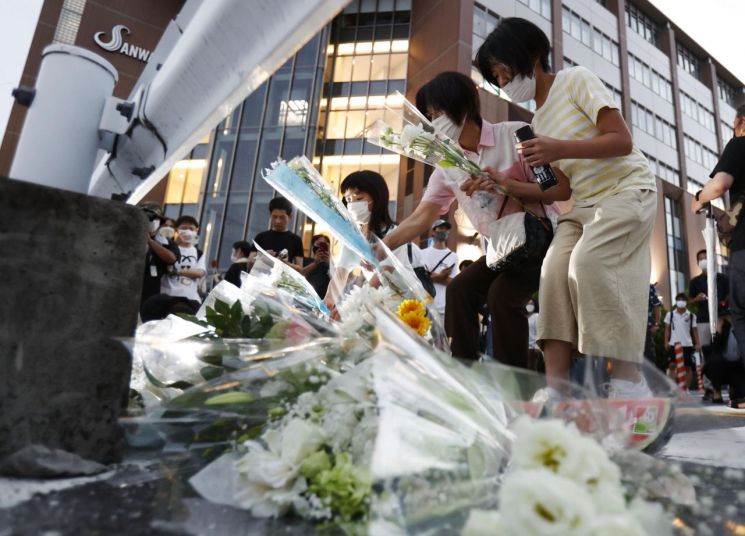
On the same day, Huanqiu Shibao published a separate article suggesting that there may be changes to Japan's existing economic policy known as "Abenomics."
The outlet cited a report from Nihon Keizai Shimbun, stating that Prime Minister Kishida plans to modify Abenomics and pursue his own economic policy with a strong emphasis on "new capitalism."
Huanqiu Shibao explained that behind the achievements of Abenomics, characterized by quantitative easing, lie side effects such as worsening fiscal deficits, widening income inequality, and low economic growth, and that after Abe's death, Kishida is likely to implement his own economic policies.
Lu Hao, deputy director of the Institute of Japanese Studies at the Chinese Academy of Social Sciences, said, "Kishida's new capitalism economic policy is based on balancing growth and distribution," and predicted that there may be changes in Japan's economic policy. He added, "Although there are movements within Japan to reduce economic dependence on China, given the unfavorable global economic conditions, Japan cannot ignore the huge Chinese market."
Chen Yan, director of the Japan Enterprise China Research Institute, assessed, "After Abe's death, Kishida will face less pressure from conservative forces within the party," and "Kishida is likely to further expand trade with China."
© The Asia Business Daily(www.asiae.co.kr). All rights reserved.
![Clutching a Stolen Dior Bag, Saying "I Hate Being Poor but Real"... The Grotesque Con of a "Human Knockoff" [Slate]](https://cwcontent.asiae.co.kr/asiaresize/183/2026021902243444107_1771435474.jpg)

















