Exports $15.8 Billion · Imports $21.3 Billion
Energy Imports Including Crude Oil and Coal Up 77%
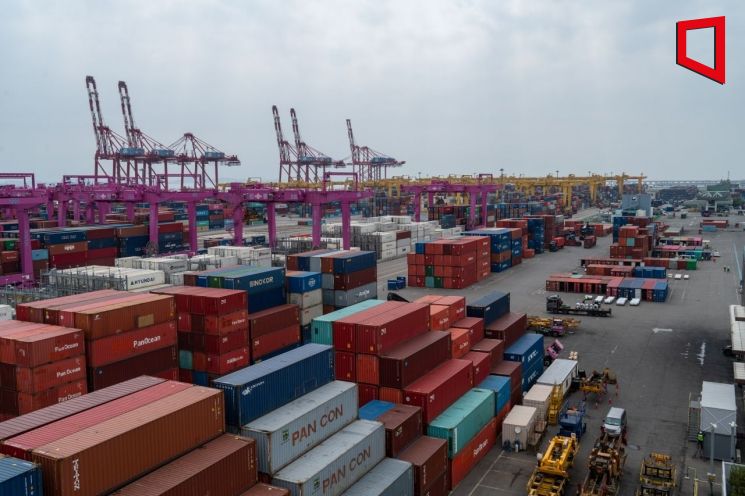
[Asia Economy Sejong=Reporter Dongwoo Lee] Due to a surge in energy raw material prices leading to a sharp increase in import value, the trade balance recorded a deficit of over $5.5 billion in early July. This raises the possibility of a trade deficit for four consecutive months from April to this month. A four-month consecutive trade deficit is the first since 2008 (June to September), and there are concerns that if this situation continues, this year could record the largest trade deficit in history.
According to the export-import status announced by the Korea Customs Service on the 1st, the trade balance from July 1 to 10 recorded a deficit of $5.528 billion. During this period, imports amounted to $21.311 billion, an increase of 14.1% compared to the same period last year, while exports increased by only 4.7% to $15.783 billion. The number of working days during this period was 7, one day less than the same period last year (8 days). Considering this, the average daily export value increased by 19.7% compared to a year ago.
Concerns over a four-month consecutive trade deficit have grown since April, when a deficit of $2.46 billion was recorded. The cumulative trade deficit for this year totaled $15.884 billion as of the previous day. The trade deficit in the first half of this year ($10.3 billion) surpassed the $10 billion trade deficit recorded in August 2008 during the financial crisis two months earlier, and the outlook is that the deficit will widen in the second half of this year.

The continuous increase in the trade deficit is due to soaring global energy prices, which have significantly increased import values. During this period, imports of the three major energy sources?crude oil, gas, and coal?amounted to $6.496 billion, an increase of $2.834 billion (77.3%) compared to the same period last year (approximately $3.662 billion).
Exports of major items increased compared to a year ago, including semiconductors (10.4%), petroleum products (96.7%), and passenger cars (6.1%). Conversely, exports of precision instruments (-20.4%), home appliances (-27.2%), and automobile parts (-14.6%) decreased. By country, exports increased to the United States (6.2%), Vietnam (15.5%), and Singapore (49.7%), while exports to major export destinations such as China (-8.9%), the European Union (-18.6%), and Japan (-9.1%) declined.
From June last year to this month, the import growth rate has exceeded the export growth rate for 14 consecutive months. Major import items that increased include crude oil (95.4%), semiconductors (31.6%), coal (125.8%), and gas (11.0%), while petroleum products (-1.4%), machinery (-3.2%), semiconductor manufacturing equipment (-33.4%), and passenger cars (-44.1%) decreased. By country, imports increased from China (13.2%), the United States (4.9%), and Saudi Arabia (192.3%), while imports from the EU (-36.0%) and Russia (-20.8%) decreased.
© The Asia Business Daily(www.asiae.co.kr). All rights reserved.
![Clutching a Stolen Dior Bag, Saying "I Hate Being Poor but Real"... The Grotesque Con of a "Human Knockoff" [Slate]](https://cwcontent.asiae.co.kr/asiaresize/183/2026021902243444107_1771435474.jpg)

















