Seizing Party Leadership to Seek Opportunity for Starting Personal Politics
Acceleration of 'Abe's Long-cherished' Constitutional Amendment Expected
Driving 'New Capitalism'
Differentiation from Abenomics through Growth and Distribution
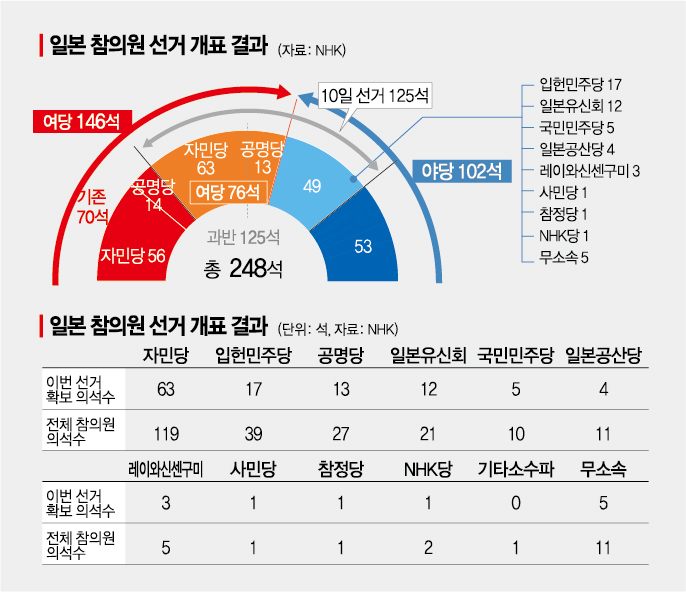
[Asia Economy Reporters Kim Hyunjung, Jung Hyunjin] Japanese Prime Minister Fumio Kishida and the Liberal Democratic Party (LDP) received overwhelming support in the House of Councillors election on the 10th, ushering in a ‘golden three years’ without large-scale elections for the next three years. Having laid the foundation for long-term rule, they are expected to focus on finalizing the constitutional amendment, a long-cherished project of former Prime Minister Shinzo Abe, while breaking away from Abenomics and presenting independent economic policies. There is also speculation that Kishida will attempt to break free from ‘Abe’s shadow’ by consolidating party leadership and establishing a foothold for full-fledged personal politics.
According to Kyodo News on the 11th, the voter turnout for this House of Councillors election was 51.68%. Although this is a very low figure compared to historical turnout rates, it is a slight improvement compared to the 48.08% turnout in the House of Councillors election three years ago, when political apathy peaked. Early voting, conducted over 17 days from June 23 to July 9, saw a record high participation of 19.61 million people, drawing relatively significant interest from Japanese voters who had been indifferent to politics.
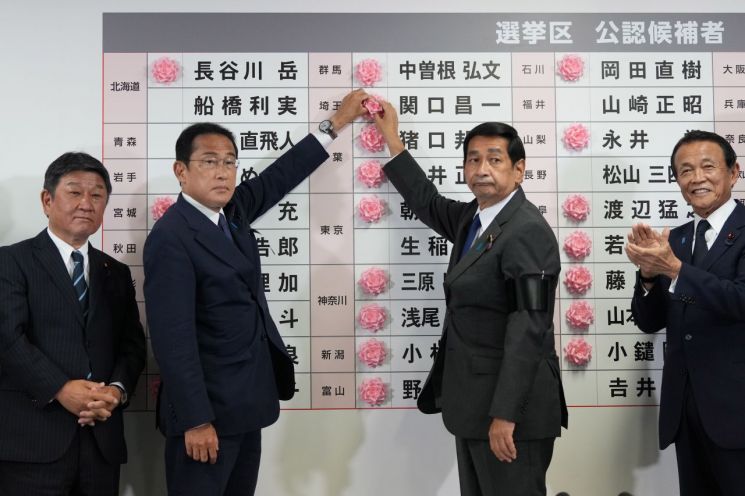
◆Top Priority is ‘Constitutional Amendment’= The solid support for the LDP and Prime Minister Kishida reflects not only mourning for former Prime Minister Abe, who was shot and killed two days before the election, but also a consolidated demand for stronger security. Riding this public sentiment, Kishida is expected to accelerate the constitutional amendment, Abe’s long-standing project.
On the night of the election day, Kishida appeared on multiple broadcast programs to reaffirm his commitment to constitutional revision. The LDP, led by Kishida as party president, adopted a party stance in March 2018 to explicitly state the legal basis for the existence of the Self-Defense Forces in Article 9 of the Constitution, and this was also a campaign pledge during the election.
Additionally, there is an expectation that efforts to raise defense spending, currently about 1% of Japan’s GDP (5.4 trillion yen), to 2% within five years will gain momentum. With heightened security concerns due to Russia’s invasion of Ukraine, China’s military expansion, and North Korea’s improved nuclear and missile capabilities, coupled with the assassination of the former party president, national interest and demand for security have surged. However, given Japan’s precarious fiscal situation and the high costs involved, Kishida may proceed cautiously with this plan.
◆Cabinet Reshuffle and LDP Personnel... Attempt to Consolidate Party Leadership?= After stepping down as prime minister in 2020, former Prime Minister Abe continued to exert influence on diplomacy and fiscal policy based on his position as leader of the largest faction within the LDP. As a result, the Kishida Cabinet, formed in October last year, had long been overshadowed by Abe’s influence. Especially since Kishida, who led the moderate faction ‘Kochikai,’ became prime minister with the support of the hardline ‘Seiwakai (Abe faction),’ he was in a position where he had to actively consider their voices.
With Abe’s sudden death leaving no clear successor, Kishida is expected to move quickly to consolidate party leadership and begin his own ‘personal politics.’ It is reported that he is considering starting a cabinet reshuffle and LDP executive personnel changes as early as the end of August.
For a while, it seems likely that he will choose to work alongside right-wing figures. On the 11th, Sankei Shimbun exclusively reported that Kishida is considering retaining Deputy President Taro Aso and LDP Secretary-General Toshimitsu Motegi, whose first terms expire this fall. Deputy President Aso is known as a ‘gaffe machine’ and is counted among Japan’s prominent right-wing figures.
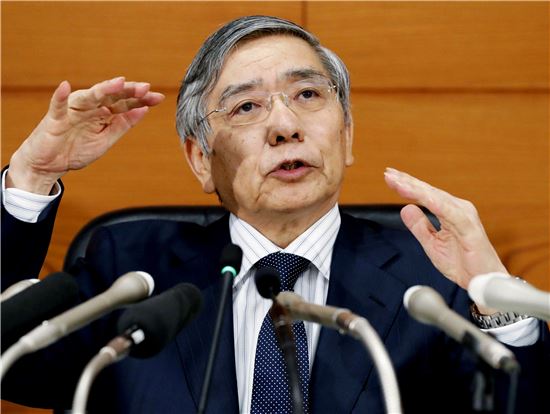 Haruhiko Kuroda, Governor of the Bank of Japan. (Photo by AP Yonhap News)
◆Breaking with Abenomics to Strengthen ‘New Capitalism’= Strengthening the economic policy of ‘New Capitalism,’ which emphasizes an independent path, is also a key task for Prime Minister Kishida. The ‘New Capitalism’ he proposed is an economic policy designed to solve social problems while achieving economic growth.
According to the implementation plan released last May, this policy focuses on four core areas: ▲investment in people ▲science and technology ▲startups ▲decarbonization and digitalization. To this end, the Japanese government is preparing measures such as creating a new ministerial position responsible for supporting startups.
However, since this policy encompasses both growth and distribution, there are criticisms that it differs significantly from ‘Abenomics.’ Last month, Nihon Keizai Shimbun reported that former Prime Minister Abe, while alive, told close aides, “There are too many messages about distribution. The market criticizes it as socialism.”
With the term of Haruhiko Kuroda, Governor of the Bank of Japan (BOJ) and a symbol of Abenomics, ending in April next year, attention is also focused on his successor. The selection of a successor who will devise an exit strategy for the easing policy, a core of Abenomics, is expected to intensify after this fall.
Given Japan’s high inflation and weak yen are becoming key issues in economic policy, and opposition parties are attacking with proposals such as tax cuts and cash payments to citizens, the appointment of the new BOJ governor could become a clear turning point in breaking away from Abenomics. The BOJ is scheduled to hold monetary policy meetings on the 20th and 21st of this month to decide interest rates.
© The Asia Business Daily(www.asiae.co.kr). All rights reserved.
!["The Woman Who Threw Herself into the Water Clutching a Stolen Dior Bag"...A Grotesque Success Story That Shakes the Korean Psyche [Slate]](https://cwcontent.asiae.co.kr/asiaresize/183/2026021902243444107_1771435474.jpg)

















