First Meeting of Industry-Specific ESG Working Groups Held on the 11th
High Expectations as Practical Channels for Information Exchange Within the Same Industry
Attended by Food, Pharmaceutical & Bio, and Cosmetics Industry Representatives
[Asia Economy Reporter Donghoon Jeong] The Korea Chamber of Commerce and Industry (KCCI) held the "1st Industry-specific ESG (Environmental, Social, Governance) Working Group Meeting" on the 11th to discuss the impact of ESG issues on different industrial sectors and corresponding response strategies.
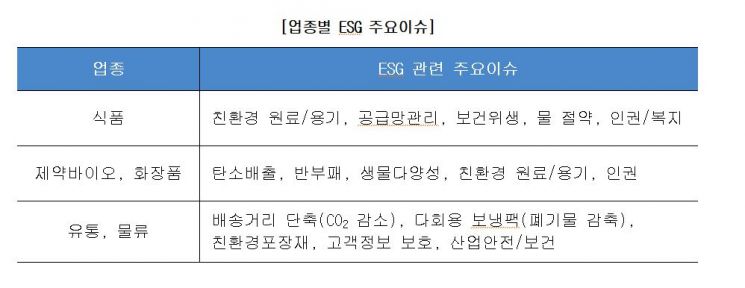
At the meeting held at the KCCI Hall in Jung-gu, Seoul, with key practitioners and association officials from major companies related to food, pharmaceuticals, bio, and distribution, the industry-specific working groups were organized into five categories: ▲ Food, Pharmaceuticals & Bio, Cosmetics, Distribution & Logistics ▲ Energy, Petrochemicals, Heavy Industry ▲ IT (Semiconductors, Electrical & Electronics, Information & Communication) ▲ Automobiles, Steel ▲ Finance. The plan is to sequentially hold meetings starting with working meetings for industries related to pharmaceuticals & bio, food, and cosmetics, which are classified as "high-risk sectors" under the European Union (EU) Supply Chain Due Diligence Act.
A KCCI official explained, "Last April, KCCI formed an ESG agenda group centered on Korea's top 20 conglomerates, actively operating it as a consultative body for communication within the economic community and policy task discovery. Recently, major banks have also joined." He added, "At last month's meeting, the opinion that industry-specific practical channels are needed to respond to global ESG issues was actively reflected, leading to the formation of industry-specific working groups."
On the day, invited speaker Seungho Park, Senior Researcher at the ESG Management Center of the Korean Standards Association, explained global ESG trends: "ESG initially started as a voluntary initiative in the private sector but now operates as a global regulation, and in terms of ESG disclosure, detailed disclosure of industry-specific key issues is being required."
Regarding response strategies for the food, pharmaceuticals & bio, cosmetics, and distribution & logistics sectors, he emphasized, "It is necessary to respond to common ESG requirements," and added, "Due to the nature of these industries, consumer issues and supply chain issues are important, so inspection and establishment of response strategies for these are needed."
A representative from a pharmaceutical company based in Seoul who attended the meeting said, "ESG evaluation criteria differ by institution, making ESG preparation difficult, and I was curious about how other companies are preparing." He evaluated, "Through the KCCI working group, there will be opportunities for practitioners in the same industry to share know-how on ESG evaluation and sustainability report preparation, which will be practically helpful."
Woo Tae-hee, Executive Vice Chairman of KCCI, said, "With the recent full-scale promotion of global ESG regulations such as the EU Taxonomy, Supply Chain Due Diligence Guidelines, and ISSB disclosure standards, domestic companies are facing difficulties in responding." He added, "I hope the newly formed industry-specific working groups will play an important role as a consultative body for joint industry responses to global ESG issues."
© The Asia Business Daily(www.asiae.co.kr). All rights reserved.
![Clutching a Stolen Dior Bag, Saying "I Hate Being Poor but Real"... The Grotesque Con of a "Human Knockoff" [Slate]](https://cwcontent.asiae.co.kr/asiaresize/183/2026021902243444107_1771435474.jpg)
















