COVID-19 Resurgence... Self-Employed Fear Business Restrictions
Struggling with High Inflation and Minimum Wage Hike... Koja Association "Considering Collective Action"
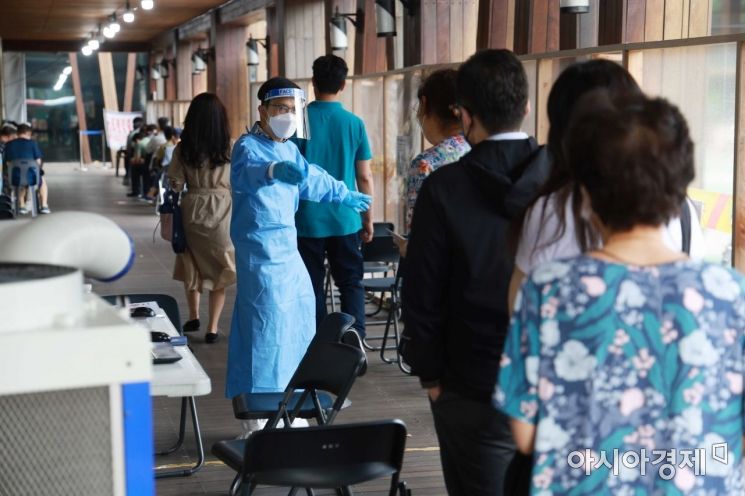 On the 11th, as the COVID-19 resurgence phase began, the screening clinic set up at Songpa-gu Public Health Center in Seoul was crowded with citizens seeking testing. Photo by Mun Ho-nam munonam@
Kang, a self-employed man in his 30s running a bar in Yongsan-gu, Seoul, is facing a line of customers who came to drink beer with the summer, but his expression is full of worry. The rising costs of raw materials due to high inflation and the increasing wages for part-time workers along with the minimum wage hike are becoming a burden. With the resurgence of COVID-19, he is anxious that even the customers who have been coming might stop. Kang said, “I run the store with the joy of receiving the increasing number of customers, but if COVID-19 re-spreads as before, I am worried it will pour cold water on this atmosphere.”
On the 8th, the government, including quarantine authorities, officially declared the resurgence of COVID-19 and decided to announce countermeasures on the 13th. On the 5th, the number of confirmed COVID-19 cases surged nearly threefold compared to the previous day to 18,136, and on the 9th, it reached 20,286, marking over 20,000 cases for the first time in 45 days. However, quarantine authorities are expected not to impose as strong measures as before, such as business hour restrictions.
Nevertheless, self-employed people are concerned about the COVID-19 resurgence. Quarantine measures due to the spread of COVID-19 directly affected business operations. According to the data portal of Korea Credit Data, the average sales of small business owners nationwide increased by 2.9% in the week of April 18?24, after social distancing was lifted. In the following week, April 25?May 1, sales increased by 5.1% compared to the previous week. Jeon (46), who runs a restaurant in Yongsan-gu, said, “The fact that it takes a long time to control COVID-19 once it spreads is a source of fear for self-employed people,” adding, “Self-employed people are already expressing trauma related to COVID-19.”
Self-employed people are already struggling with high inflation. Last month, the consumer price inflation rate was 6.0%, the highest in 24 years. Food material prices are even more severe. Due to an early spring drought causing poor crop yields, summer vegetable prices are also soaring. The owner of a meat restaurant in Dongdaemun-gu, Seoul, said, “With high inflation coinciding with summer, I paid 98,000 won for a box of lettuce,” adding, “It is also a burden to give it free to customers.”
With many outgoing expenses, labor costs are also precious to self-employed people. Although customers have increased since the lifting of social distancing, they cannot hire more people due to labor cost burdens. The minimum wage for next year was set at 9,620 won, a 5% increase from this year, causing difficulties for self-employed people. Kwon (30), who runs a gukbap restaurant in Goyang-si, Gyeonggi Province, said, “The minimum wage has risen a lot in recent years, so we are using one person instead of two,” adding, “But we cannot raise food prices, so all the burden falls on the self-employed.”
Self-employed people are preparing to raise their voices again. Min Sangheon, co-representative of the Korea Federation of COVID-19 Victims in Self-Employment, said, “The various difficulties currently faced by self-employed people need to be conveyed to the political sphere and society,” adding, “Specific action plans and messages will be decided through a meeting next week.”
© The Asia Business Daily(www.asiae.co.kr). All rights reserved.
![Clutching a Stolen Dior Bag, Saying "I Hate Being Poor but Real"... The Grotesque Con of a "Human Knockoff" [Slate]](https://cwcontent.asiae.co.kr/asiaresize/183/2026021902243444107_1771435474.jpg)
















