KEF, OECD Advisory Group BIAC's
Publication of Second Half Survey Results from 31 Member Countries
[Asia Economy Reporter Moon Chaeseok] According to a survey of economic organizations from 31 member countries of the Organisation for Economic Co-operation and Development (OECD), more than half forecast that the gross domestic product (GDP) will decrease by up to about 1% in the second half of the year due to the Russia-Ukraine war. As the war prolongs and global supply chain disruptions worsen, OECD member countries are viewing the economic outlook for the latter half of this year negatively.
On the 11th, the Federation of Korean Industries (FKI) released the results of an economic policy survey conducted last month by BIAC, the Business and Industry Advisory Committee to the OECD, targeting economic organizations from 31 OECD member countries. BIAC was established in 1962 by economic organizations from OECD member countries and serves as an advisory body on OECD economic policies. Since 1996, the FKI has been the representative member organization for Korea.
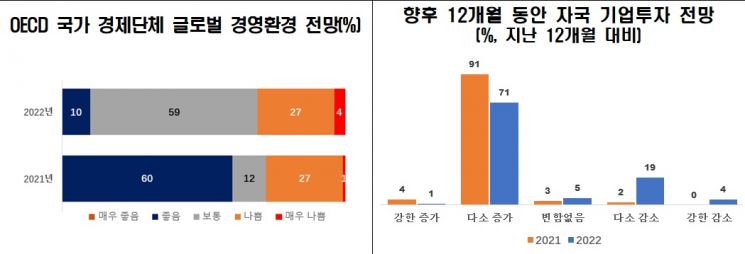
The proportion of institutions that viewed the business environment in the second half of the year positively (very good/good) was only 10% of the total, a sharp drop from 60% last year. The 'neutral' category rose from 12% to 59%, and the negative (bad/very bad) category increased from 28% to 31%.
The most concerning issue, cited by 74%, was 'energy prices and supply.' The 'global supply chain' issue followed at 17%. A notable decline was seen in investment outlooks. The proportion expecting an increase in domestic corporate investment fell by 23 percentage points from 95% last year to 72% this year. The share expecting a decrease in investment rose from 2% to 23% during the same period.
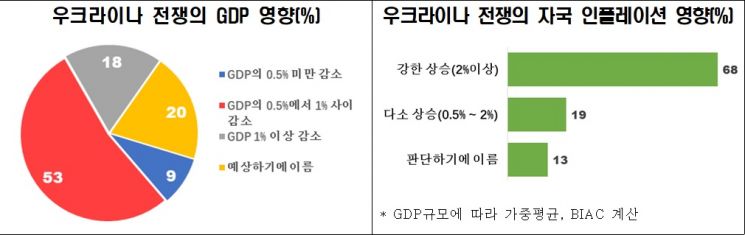
Economic organizations from OECD member countries responding to the survey expressed concerns that the Russia-Ukraine invasion, which erupted during the recovery phase from the COVID-19 pandemic, could exacerbate crises caused by supply chain disruptions. Regarding the impact of the Russia-Ukraine war on their country's GDP, 53% of respondents answered that it would decrease by 0.5 to 1%. Additionally, 18% of institutions said it would decrease by more than 1%.
Concerns about inflation were also significant. 68% of the responding economic organizations forecast that the Ukraine war would cause inflation to rise above 2%.
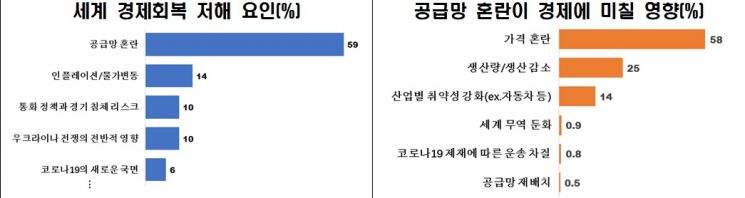
59% of the responding institutions identified 'supply chain collapse' as a risk factor that could hinder global economic recovery in the future. Supply chain issues were expected to lead to price volatility (58%), reduced industrial output (25%), and increased vulnerability across industries (14%). This suggests a weakening of industrial competitiveness.
Most companies answered that the intensity of their country's economic reforms was weak compared to the slow pace of economic growth. When asked about the intensity of policy reforms in their country over the past 12 months, 68% of respondents said it was at a 'slow level.' The causes of delayed economic recovery innovation were cited as 'lack of political will and leadership for innovation' (67%, multiple responses) and 'lack of political unity such as loose coalitions and partisan conflicts' (64%), among others. BIAC emphasized, "Strong will and leadership under growth-friendly reform policies are necessary for economic recovery."
Kim Bongman, Director of the International Headquarters at FKI, said, "This year, expectations for economic growth have significantly declined due to global supply chain disruptions and the Russia-Ukraine war. We ask that you remember that private economic organizations worldwide are appealing for growth-centered structural reforms for a rapid economic recovery."
© The Asia Business Daily(www.asiae.co.kr). All rights reserved.
![Clutching a Stolen Dior Bag, Saying "I Hate Being Poor but Real"... The Grotesque Con of a "Human Knockoff" [Slate]](https://cwcontent.asiae.co.kr/asiaresize/183/2026021902243444107_1771435474.jpg)













