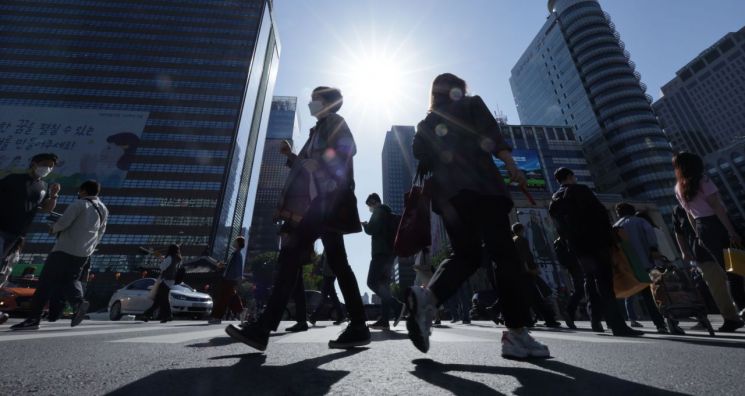
 On the morning of May 9th, citizens heading to work are crossing the pedestrian crosswalk at Gwanghwamun Intersection in Seoul. [Image source=Yonhap News]
[Asia Economy Reporter Sumi Hwang] Recently, as social distancing measures have been eased and remote work has decreased, the number of office workers returning to their workplaces has increased, leading to a rise in cases of workplace bullying. Foreign media have described this as a chronic workplace culture issue in Korea. In particular, significant perception gaps regarding workplace power abuse appear depending on age and rank, prompting views that awareness and sensitivity among office workers need to be raised.
Civil society group Workplace Power Abuse 119 and the Public Coexistence Solidarity Fund commissioned the public opinion research firm Embrain Public to conduct a survey, releasing the results of the 'Workplace Power Abuse Sensitivity Index' on the 10th.
The Workplace Power Abuse Sensitivity Index quantifies the degree of agreement on 30 items representing situations that can be experienced from joining to leaving a company, using a 5-point scale. A higher score indicates greater sensitivity to elements of power abuse. Workplace Power Abuse 119 formed a research team in 2019 and has published these survey results every June since then.
This survey was conducted online from the 10th to the 16th of last month, targeting 1,000 office workers nationwide aged 19 and older, based on the employment population ratio from the economically active population survey. The sampling error is ±3.1 percentage points at a 95% confidence level.
According to the survey, this year's Workplace Power Abuse Sensitivity Index averaged 73.8 points, a slight increase compared to the past two years during the COVID-19 pandemic. The scores were 69.2 in 2020 and 71 in 2021.
Foreign media also reported on workplace bullying cases in Korea. On the 4th (local time), CNN in the United States reported, "As Korean office workers resume commuting, power abuse is also returning," describing it as "a chronic workplace culture in Korea." They transcribed '갑질' as 'gapjil,' explaining it as "a person in power dominating subordinates," and pointed out that "this has been a long-standing issue especially prevalent in families dominating Korean corporations and politics."
The item with the highest sensitivity score was verbal abuse (86.1 points), followed by insults (85.6 points), orders for personal errands (82.5 points), ostracism (80.6 points), and drinking culture (80.6 points). Notably, the sensitivity index for drinking culture increased the most, rising 16.3 points from 64.3 in 2020 over two years. This is analyzed as a result of increased sensitivity to unwanted company dinners due to the reduction of such gatherings during social distancing in the COVID-19 period.
 Cases of workplace bullying have been on the rise recently. The photo is not related to the specific content of this article. [Image source=Pixabay]
On the other hand, sensitivity was low in items such as consideration for employees with childcare responsibilities (53.7 points) and dismissal of low performers (57.6 points). Sensitivity to holding departing employees accountable (58.8 points), overtime work (59.6 points), and exaggerated job postings (61.0 points) was also low. Particularly, the sensitivity index for consideration of employees with childcare responsibilities showed a continuous decline from 60.3 points in 2020 to 56.6 points in 2021.
Sensitivity scores also varied by gender and age. By age group, those in their 20s scored the highest (76.2 points). Significant gaps between people in their 20s and 50s were observed in areas such as the Pence rule (avoiding behaviors that could lead to sexual harassment allegations, 18.2 points), after-work SNS activity (11.9 points), and talent shows (11.1 points).
Additionally, women (77.1 points) showed a sensitivity score 5.8 points higher than men (71.3 points). The largest gender differences were seen in the Pence rule (12.7 points), informal speech (9.9 points), female employee work (9.9 points), and forced drinking (9.7 points). Differences by rank were also noted. The average score difference between regular employees (74.3 points) and senior managers (70.9 points) was 3.4 points. Particularly, senior managers showed significantly lower sensitivity in areas such as vacation restrictions (15.5 points), overtime work assigned (14.7 points), and work on holidays or traditional holidays (12.8 points).
Experts say that workplace bullying prevention education and other measures are needed to raise sensitivity among office workers, especially regarding bullying types and cases that fall below the overall average.
Meanwhile, as workplace bullying cases have shown an increasing trend recently, the importance of addressing this issue is expected to grow. According to Workplace Power Abuse 119, 29.6% of respondents reported experiencing workplace bullying in the past year. This is lower than the 44.5% reported in September 2019, right after the enactment of the Workplace Bullying Prohibition Act, but 6.1 percentage points higher than the 23.5% reported in March this year. The easing of social distancing and the end of remote work are analyzed to have contributed to the increase in power abuse.
© The Asia Business Daily(www.asiae.co.kr). All rights reserved.


















