[Asia Economy Reporter Hyunseok Yoo] The waiting period for delivery of some major models from Hyundai Motor and Kia is decreasing. This is interpreted as an improvement in the supply of parts used in vehicles, such as semiconductors.
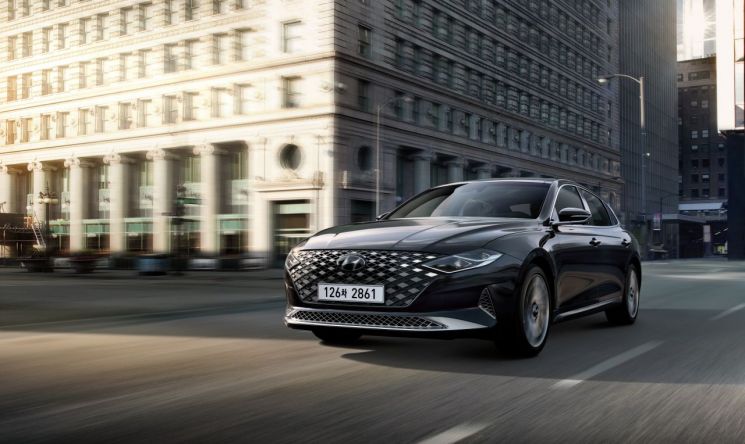
According to the completed car industry on the 9th, Hyundai's Grandeur (2.5 gasoline) shortened from 6 months to 5 months in May, and the 3.3 gasoline model shortened from 3 months to 2 months. Also, the Casper's waiting period decreased from 3 months to 1 month.
Along with this, Kia's K8 (2.5 gasoline) shortened from 10 months to 9 months, and the LPI model from 13 months to 10 months. For the Sorento, the gasoline model was reduced from 14 months to 13 months, and the HEV from 18 months to 17 months. Additionally, the Carnival gasoline model, which used to take over 10 months, decreased from 10 months to 5 months.
The easing of the new car delivery crisis appears to be influenced by increased production volume. According to DB Financial Investment, Hyundai's global wholesale sales last month reached 340,000 units, a 5% increase compared to the previous month. Kia's sales were 260,000 units, a 10% increase compared to the previous month. Kim Pyeongmo, a researcher at DB Investment Securities, explained, "Global wholesale sales of Hyundai and Kia are rapidly recovering from the low point in January and February," adding, "Factory sales rebounded in May, and wholesale sales in major regions are also recovering."
In particular, along with increased production volume and favorable exchange rate conditions, second-quarter performance is also expected. Hana Financial Investment forecasted that Hyundai's sales and operating profit in the second quarter will increase by 12% and 26% year-on-year, reaching 34 trillion KRW and 2.39 trillion KRW, respectively. Kia's sales and operating profit are expected to increase by 13% and 20% year-on-year to 20.8 trillion KRW and 1.78 trillion KRW, respectively.
Song Seonjae, a researcher at Hana Financial Investment, said, "Hyundai and Kia's second-quarter performance is expected to exceed previous estimates," adding, "Although market demand will be sluggish in most countries, Hyundai and Kia's global sales excluding China will be at the same level as the previous year due to increased market share." He further explained, "This is because of the expanded price effect from incentives at the lowest level in 10 years and the additional rise in the KRW-USD exchange rate in the second quarter."
© The Asia Business Daily(www.asiae.co.kr). All rights reserved.

















