WTI Price Surpassed $120 Last Month, Decline Continues
Stable Employment Indicators and Increased Economic Activity Expected to Sustain Demand
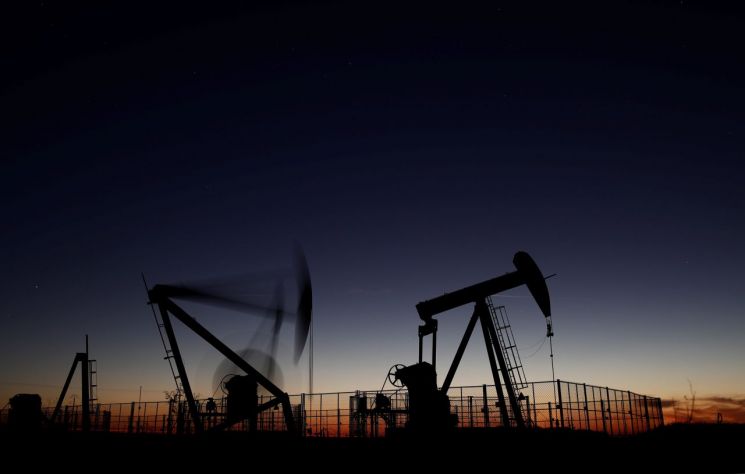
[Asia Economy Reporter Minji Lee] Although the fear of an economic recession is engulfing global financial markets and causing international oil prices (WTI) to decline, analysis suggests that oil prices at the current level will be supported in the second half of the year.
On the 9th, West Texas Intermediate (WTI) crude oil was priced at $104.79 per barrel. After soaring above $122 in early last month, WTI prices fell to as low as $98.53 this month, showing a downward trend.
The recent sharp drop in oil prices is attributed to the oil market shifting to a supply surplus, coupled with investment sentiment being affected by forecasts of weakened energy demand due to a global economic recession. Although crude oil had shifted to an oversupply state from the second quarter, speculative buying continued due to production disruptions and geopolitical tensions, sustaining the upward trend in oil prices. However, currently, major countries including the United States, the United Kingdom, and the Eurozone have announced high-intensity tightening measures, and concerns over an economic recession are weakening consumer purchasing power and dampening consumer sentiment, raising worries that oil demand will decrease.
Nevertheless, despite concerns about demand, oil prices are not expected to show a sharp decline. Shinhan Financial Investment forecasts that oil prices in the second half of the year will fluctuate in the low $100s per barrel in the third quarter and average in the $90s in the fourth quarter.
Primarily, the U.S. employment market is showing solid performance. Despite fears of entering a recession, the average weekly new unemployment claims in the second quarter were only 200,000. This is significantly different from past recessions when claims exceeded 500,000 on average.
Researcher Im Hwan-yeol of Shinhan Financial Investment explained, “The labor market is still demand-driven, and wage inflation pressures continue. Oil demand correlates with employment conditions, and considering the trend of expanding face-to-face service employment due to reopening, a sharp decline in demand within the year will be limited.”
Even if the consumption environment worsens, deferred demand centered on services is expected to support the bottom of the consumption economy. Considering the proportion of services in household consumption, robust service demand is expected to be maintained through at least the third quarter due to deferred demand. Although gasoline consumption has slowed since June, it is not expected to decline trend-wise due to the influx of summer driving demand.
Researcher Im added, “Excluding strategic petroleum reserves, crude oil inventories are at their lowest levels compared to the past five years. As economic activity gradually increases with economic normalization, the influx of driving demand in the U.S. during the summer will support the downward rigidity of crude oil prices.”
© The Asia Business Daily(www.asiae.co.kr). All rights reserved.
![Clutching a Stolen Dior Bag, Saying "I Hate Being Poor but Real"... The Grotesque Con of a "Human Knockoff" [Slate]](https://cwcontent.asiae.co.kr/asiaresize/183/2026021902243444107_1771435474.jpg)
















