[Asia Economy Sejong=Reporter Kim Hyewon] As the domestic consumer price inflation rate soared to the 6% range for the first time since the foreign exchange crisis, the government has announced another 800 billion won scale livelihood measure. It will apply zero tariffs on imported beef, chicken, coffee beans, and other items with high perceived living costs, and strengthen living expense support for vulnerable groups by increasing the support rates for energy vouchers, diapers, baby formula, and sanitary pads.
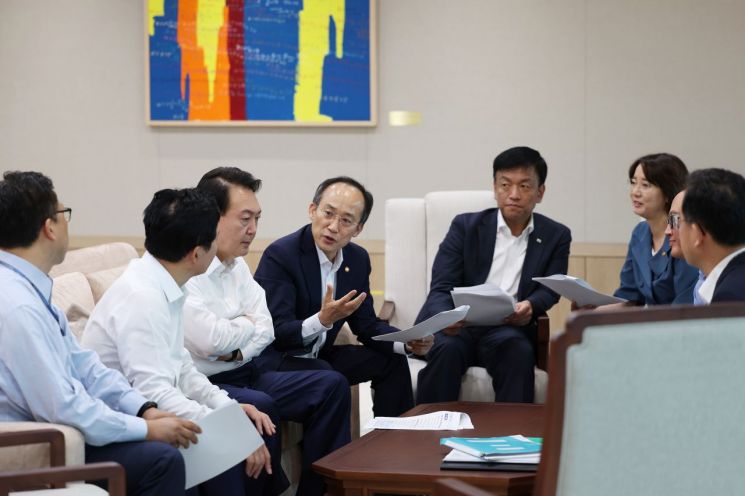
This 'Livelihood Stabilization Plan to Alleviate the Burden of High Inflation' was decided at the first Emergency Economic Livelihood Meeting presided over by President Yoon Seok-yeol on the 8th. It came about 20 days after the new government announced its economic policy direction and immediate price stabilization measures on the 16th and 19th of last month, respectively.
The government stated, "Severe price conditions continue mainly due to strong supply-side pressures, so we have prepared a total support plan worth 800 billion won to support vulnerable groups and reduce the living cost burden on ordinary citizens." The government’s diagnosis is that high oil prices persist and demand-side inflationary pressures will increase with the summer peak season.
The government will invest about 480 billion won in financial support for vulnerable groups and about 330 billion won in additional tariff quota support for food items such as beef and baby formula. The funds will be secured through changes in fund operation plans and budget utilization and reallocation.
This livelihood stabilization measure is characterized by expanding the scope and targets while aligning with previously announced policy tasks such as strengthening support for vulnerable groups, reducing the burden of food expenses for ordinary citizens, and alleviating living cost burdens.
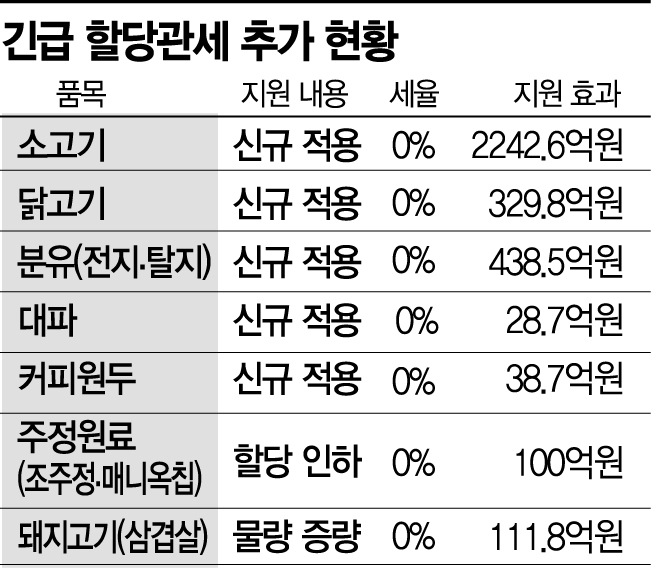
The plan aims to reduce cost burdens by applying tariff quotas to major livestock products with noticeable price increases, such as imported pork and beef, and to increase market supply by supporting slaughtering and feed costs for farms. Importing U.S. and Australian beef duty-free is expected to lower retail prices by up to 5-8%. The import price of chicken, currently subject to 20-30% tariffs, is also expected to be significantly reduced.
Early release of agricultural products with unstable prices ahead of Chuseok, such as potatoes, garlic, onions, radishes, and napa cabbage, will be implemented, along with additional imports in August and September. Some seafood items with continuously rising prices, such as mackerel, cutlassfish, squid, and pollock, will be shifted to a regular release system.
Additionally, 50 billion won will be added to the scale of discount coupons for agricultural, livestock, and fishery products using contingency funds. Individuals can receive up to a 20% discount with a limit of 10,000 won per person. The energy voucher amount for 1.6 million low-income individuals (1.18 million households) will be raised from 172,000 won to 185,000 won starting in October, with an investment of 15.3 billion won.
The government rice sale price for recipients of housing and education benefits and near-poverty groups will be lowered by 3,000 won to 7,900 won per kilogram until the end of the year. The monthly support rates for diapers and baby formula for basic livelihood recipients, near-poverty groups, and single-parent families will be increased by 6,000 won and 4,000 won to 70,000 won and 90,000 won, respectively. The sanitary pad support for vulnerable female adolescents will be raised by 1,000 won to 13,000 won per month.
The annual support amount for the Culture Nuri Card, which near-poverty and lower groups can use for cultural and artistic activities, will be increased by 10,000 won to 110,000 won, and the monthly sports class voucher amount for low-income children, youth, and persons with disabilities will be raised by 10,000 won to 95,000 won.
The criteria for selecting single-parent recipients will be relaxed, and from October, single-parent families with incomes between 52% and 58% of the median income will receive 100,000 won per month in childcare support. Overlapping support for childcare and emergency welfare livelihood support will be allowed from August. Care support hours for households raising children with severe disabilities will be expanded from 840 hours to 960 hours annually, and heating and cooling costs and rice support rates for senior centers will be increased.
The independence allowance for youth aged 18 and over who have left child protection facilities will be raised from 300,000 won to 350,000 won per month, and the crisis youth living support fund will increase from a maximum of 550,000 won to 650,000 won per month. The support rate for self-support work projects will be raised from 1.17 million won to 1.21 million won per month (market entry type standard).
The interest rate on living stabilization funds for low-income workers will be lowered from 1.5% to 1.0%, and the supply scale will increase from 199.1 billion won to 224.1 billion won. The supply scale of the Worker Sunshine Loan for low-credit and low-income individuals will also increase by 200 billion won.
Loan conditions for living expenses for unemployed persons undergoing long-term vocational training will be eased, and the incentive for participants in national strategic industry training will be temporarily raised by 84,000 won to 200,000 won per month.
Other measures to alleviate the living cost burden for ordinary citizens will also be pursued. The 30% reduction in sales surcharges on liquefied petroleum gas (LPG), mainly used by taxi drivers and small business owners (about 12 won per liter), will be extended until the end of the year. The amount of tax-free diesel fuel price-linked subsidies to ease fishermen’s fuel costs will also increase by 24.2 billion won.
The Didimdol Loan will temporarily allow borrowers to choose repayment methods such as equal principal and interest installments, equal principal installments, or graduated installments, whichever is more advantageous. The freeze on public rental housing rents will also be extended. The quality of public Wi-Fi will be improved, and the launch of mid-tier 5th generation mobile communication (5G) plans for five households will be expedited.
President Yoon hastened the Emergency Economic Livelihood Meeting, originally expected next week, due to the complex crisis situation of the Korean economy trapped in high inflation, high interest rates, and low growth. It was also an occasion to instruct the establishment of linked policies with the new government’s five-year fiscal management direction and fiscal reform tasks discussed at the first National Fiscal Strategy Meeting since his inauguration the day before. Since economic recovery through expansionary fiscal policy like the Moon Jae-in administration is no longer effective, the plan is to secure budgets through a shift to sound fiscal policy and take care of the livelihood economy.
There is a widespread sense of crisis within the presidential office that it will be difficult to govern if soaring prices are not controlled. The recent simultaneous decline in approval ratings for President Yoon and the People Power Party is also interpreted as a premonition. A presidential office official said, "Unlike party-government consultations and the Emergency Economic Ministers’ Meeting, this meeting will handle more detailed information and realistic alternatives, and related ministries will promptly take follow-up actions."
© The Asia Business Daily(www.asiae.co.kr). All rights reserved.


















