Monthly Expenses Increase Up to 130,000 KRW
Parking Fees Rise in Gangnam Office District
Food Costs Increase in Yeouido
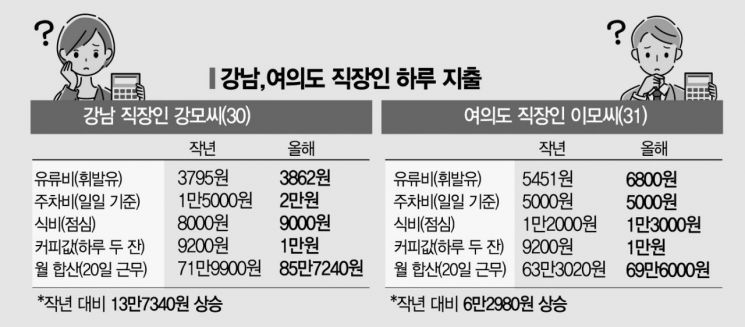
Kang (30), who works at a small-to-medium enterprise located in Gangnam-gu, Seoul, recently changed his lifestyle completely as he felt the impact of rising prices. Instead of commuting by car, he started using the subway and bus. Lunch prices increased by about 1,000 won per menu item, so he switched to a more affordable 5,400 won Korean buffet, but even that price rose by 300 won, prompting him to start bringing packed meals. Coffee, an indispensable part of office workers' lives, is also prepared at home now, as the price per cup already increased by 400 won in January. Kang sighed, "Restaurants raised all their (food) prices, so I looked for cheaper places, but even those got crowded with nearby office workers, so I’m settling with packed meals. For coffee, I bring it from home in the morning, and if about one-fifth is left, I dilute it with cold water to drink."
Due to high inflation, office worker-dense areas like Gangnam and Yeouido have been hit hard. Office workers say there is nothing that hasn’t gone up, from commuting costs to parking fees and meal expenses. In Gangnam, parking fee increases were significant, while in Yeouido, meal costs added to the burden. According to the investigation, monthly expenses during working hours rose by at least 60,000 won and up to 130,000 won compared to last year.
Lee (31), who works at a mid-sized company in Yeouido, said the rise in car-related costs and coffee prices hit him hard. The cost of commuting 36 km round-trip by car increased by 1,349 won per day. Due to company circumstances, he cannot park for free and has to use public parking lots, which is an additional burden. Because of frequent overtime, he used to drink 4 to 5 cups of coffee a day, but due to the price increase, he reduced it to 2 cups daily. He also shifted his consumption pattern to mainly low-priced coffee rather than franchise coffee.
The situation is similar for office workers outside Gangnam and Yeouido. Kim (29), who commutes from Gangseo-gu to Gimpo-si, Gyeonggi-do, has no choice but to bear the burden of rising fuel costs as using public transportation is difficult. He said, "When I filled up 25 liters once a week, the fuel cost was in the low to mid-30,000 won range, but now it exceeds 50,000 won." Kim added, "I have no choice but to save on meal expenses, so I even have dinner at the company cafeteria."
According to the Statistics Korea announcement on the 5th, the consumer price index for June was 108.22 (2020=100 basis), up 6% compared to the same month last year. This is the highest increase since November 1998 (6.8%) during the foreign exchange crisis. The living cost index, which reflects perceived inflation, also rose 7.4% compared to the same month last year.
The high inflation trend felt by office workers is expected to continue for the time being. This is because price increases for products that allow for quick lunch solutions have been announced. Sandwich specialty store Subway announced that starting from the 12th, it will raise prices of its main 15 cm sandwich products by an average of 5.8%. Lotte Ria already started raising product prices from the 16th of last month, and McDonald’s and Burger King each raised prices once between January and February.
© The Asia Business Daily(www.asiae.co.kr). All rights reserved.
![User Who Sold Erroneously Deposited Bitcoins to Repay Debt and Fund Entertainment... What Did the Supreme Court Decide in 2021? [Legal Issue Check]](https://cwcontent.asiae.co.kr/asiaresize/183/2026020910431234020_1770601391.png)















