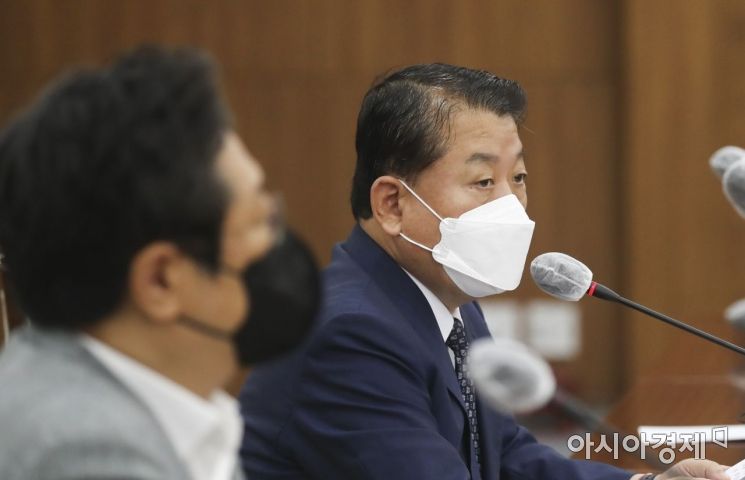
 Kim Byung-joo, head of the West Sea Public Official Death Incident Task Force of the Democratic Party of Korea, is speaking at the 4th meeting of the West Sea Public Official Death Incident Task Force held at the Ministry of National Defense in Yongsan-gu, Seoul, on the 7th. Photo by the National Assembly Press Photographers Group
[Asia Economy Yang Nak-gyu, Military Specialist Reporter] It has been confirmed that some of the initial classified information collected by the military authorities in relation to the killing of a civil servant in the West Sea in September 2020 was deleted from the military intelligence distribution network. However, the original information is still being preserved.
The information collected by the South Korean and U.S. intelligence authorities is shared through the Military Intelligence Management System (MIMS) with the National Intelligence Service, the ROK-U.S. Combined Forces Command, and the Intelligence Headquarters. The management entity and procedures for MIMS information are stipulated in military directives. Depending on the nature of the information, the heads of intelligence at the Ministry of National Defense and the Joint Chiefs of Staff can both manage it.
However, the military’s position is that deleting the original information is impossible. The information remains on the main servers of the intelligence agencies or the Ministry of National Defense, and even the heads of intelligence agencies find it difficult to issue deletion orders. Former Director Park also emphasized the unfairness of the prosecution’s accusation in a statement after the National Intelligence Service was reported, saying, “The intelligence acquired by the military authorities is shared by the National Intelligence Service, not produced by it,” and questioned, “Does deleting intelligence received by the National Intelligence Service mean that the original source intelligence is deleted?”
On the 7th, Kim Jun-rak, the Public Affairs Officer of the Joint Chiefs of Staff, regarding the killing of the late Lee Dae-jun, affiliated with the Ministry of Oceans and Fisheries, stated about the suspicion that some classified information uploaded to MIMS was deleted, “The original information was not deleted, but necessary measures were taken to prevent sensitive information uploaded to the Military Intelligence Management System from being disseminated to units unrelated to direct duties.”
Although the original was not deleted, necessary measures such as deleting classified information were taken to prevent its dissemination to subordinate units unrelated to the work. The original refers to the special intelligence (SI) on North Korea secured by U.S. intelligence agencies, which played a decisive role in judging Lee Dae-jun’s defection to the North during the West Sea civil servant shooting incident.
At that time, the term “defection to the North” was likely collected through U.S. military reconnaissance aircraft such as the RC-135 Rivet Joint or RC-12X Guardrail. The South Korean military also possesses the signal intelligence collection device ‘Baekdu,’ but it mainly operates in the forward land areas. The video intelligence was also captured by the U.S. military. The video recording of floating objects is known to have been identified by the U.S. military reconnaissance satellite ‘Key Hole’ using infrared detectors to identify objects 10 cm above the North Korean ground.
Kim said, “The Military Intelligence Management System separately manages a system for distributing information that requires a high level of security for operational and military purposes among various operational systems,” and explained, “The necessary information goes to the units or agencies that need it and is utilized, but measures were taken to prevent such sensitive information from being disseminated to units unrelated to direct duties.”
In particular, when asked if the Joint Chiefs of Staff meant that it was a procedural measure rather than unauthorized deletion, he said, “It should be seen as a measure taken as necessary,” and reiterated, “The original has not been deleted.”
On the same day, the Ministry of National Defense reportedly explained to the Democratic Party’s Task Force (TF) on the West Sea civil servant killing case, which visited the ministry building, that deletion of MIMS information “occasionally happens.”
After the meeting with the Ministry of National Defense, the Democratic Party TF told reporters, “MIMS, which sends information to the National Intelligence Service, is also a system operated by the Ministry of National Defense, and the National Intelligence Service cannot delete MIMS information.”
They particularly defined the fact that the deletion of MIMS classified information was reported externally as a “security incident” and insisted that the cause of the leak should be investigated.
Assemblyman Kim Byung-joo said, “The MIMS system is a highly confidential SI (Special Intelligence) level 2 system,” and added, “The activities within the MIMS system, such as document deletion or adjustment of distribution lines, being exposed externally itself can be regarded as a widespread security incident,” and said, “The Ministry of National Defense also called it a widespread security incident and said it would conduct an internal investigation on the related matters.”
© The Asia Business Daily(www.asiae.co.kr). All rights reserved.
![Clutching a Stolen Dior Bag, Saying "I Hate Being Poor but Real"... The Grotesque Con of a "Human Knockoff" [Slate]](https://cwcontent.asiae.co.kr/asiaresize/183/2026021902243444107_1771435474.jpg)
















